
NETGEAR GS116EP-100NAS vs Allied Telesis AT-x530L-18GHXm-10: Specification Comparison
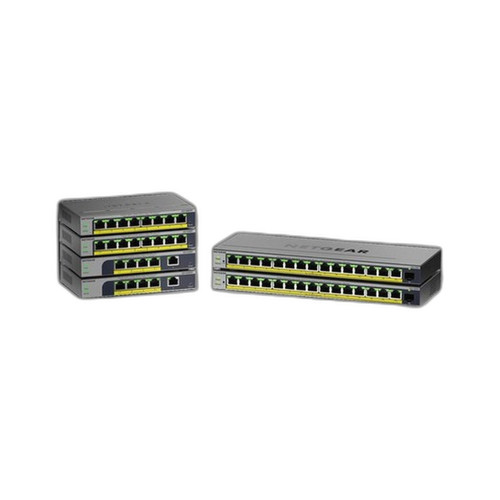
Both the NETGEAR GS116EP-100NAS and the Allied Telesis AT-x530L-18GHXm-10 are 16-port PoE-capable network switches aimed at powering and connecting IP security cameras, wireless access points, and IoT devices. The NETGEAR is an unmanaged, wall-mount Gigabit PoE+ switch targeting small-site simplicity, while the Allied Telesis is a managed, rack-mount multi-gigabit PoE++ switch targeting mid-to-large deployments demanding higher per-port power, greater switching throughput, and centralized management. Both occupy the 16-port PoE switch class, making them cross-shoppable where deployment scale and budget are the primary differentiators.
In This Guide
- Which switch delivers the PoE power budget and per-port wattage your devices actually need?
- How do switching throughput, uplink speed, and management capabilities compare?
- Which physical form factor, mounting, and operating environment best fits your installation?
- Which should you choose: the GS116EP-100NAS or the AT-x530L-18GHXm-10?
- Side-by-Side Specs
- FAQ
Which switch delivers the PoE power budget and per-port wattage your devices actually need?
The NETGEAR GS116EP-100NAS provides PoE+ (802.3at) on all 16 ports at up to 30W per port. A total PoE power budget is not specified in the available evidence, so buyers cannot confirm aggregate watt headroom from spec alone.
The Allied Telesis AT-x530L-18GHXm-10 specifies a 720W total PoE power budget across all 16 ports, with per-port flexibility: all 16 ports support up to 30W (PoE+), 12 ports support up to 60W (PoE++ / 802.3bt Type 3), and 8 ports support up to 90W (PoE++ / 802.3bt Type 4). This makes it suitable for high-draw devices such as PTZ cameras with onboard heaters, 802.11ax tri-band APs, or thin clients.
For deployments running standard IP cameras or single-radio APs drawing 10–25W, the NETGEAR's 30W ceiling is typically sufficient. Any device requiring more than 30W — or any site where the sum of simultaneous loads must be known precisely — requires the Allied Telesis, which is the only product here with a documented aggregate budget (720W) and 60W/90W per-port capability.
How do switching throughput, uplink speed, and management capabilities compare?
The NETGEAR GS116EP-100NAS is unmanaged and provides Gigabit (1Gbps) copper on all 16 ports. Switching fabric figures listed in the spec range from 10Gbps to 32Gbps across multiple entries, which appear to reflect different measurement conventions; no single authoritative fabric figure is isolated in the evidence. There are no dedicated uplink ports and no management interface — traffic forwarding is automatic with zero configuration.
The Allied Telesis AT-x530L-18GHXm-10 delivers a 200Gbps switching fabric with a 148.8Mpps forwarding rate. All 16 data ports are multi-gigabit (100M/1/2.5/5G via RJ-45), two dedicated 1/10G SFP+ ports provide fiber or DAC uplinks to aggregation switches or NVRs, and two stacking ports allow daisy-chain clustering for unified management across multiple units. Latency is documented at 2.56µs at 10Gbps and 5.23µs at 5Gbps.
The NETGEAR is a plug-and-play device with no VLAN, QoS, RSTP, or remote management. The Allied Telesis supports all of these capabilities as an enterprise managed switch — critical for separating camera VLANs, prioritizing video traffic, and integrating into a monitored network operations environment. The NETGEAR's management capability spec is simply absent by design; the Allied Telesis's management feature set is not fully enumerated in the provided spec data but is consistent with the x530L managed product line.
Which physical form factor, mounting, and operating environment best fits your installation?
The NETGEAR GS116EP-100NAS is a wall-mount unit with an operating temperature range of 32°F to 104°F (0°C to 40°C). Physical dimensions are not specified in the provided evidence. Its metal connector types are listed but no chassis dimension or weight data is available from the spec.
The Allied Telesis AT-x530L-18GHXm-10 is a 1U rack-mount unit measuring 441 × 256 × 44 mm (17.36 × 10.07 × 1.73 in), weighing 4.3 kg unpackaged. Maximum power consumption is 970W and maximum heat dissipation is 3,317 BTU/h, with an audible noise level of 42 dBA — relevant for IDF closet noise budgets. Operating temperature range is not specified in the provided evidence for this unit.
The NETGEAR is suited to wiring closets, back-of-rack wall mounts, or small-site utility rooms where a standard IEC rack is unavailable. The Allied Telesis requires a 1U rack slot and a power circuit capable of supporting up to 970W under full PoE load. Installers must verify rack space, power circuit amperage, and cooling capacity before deploying the Allied Telesis in an enclosed cabinet, given its 3,317 BTU/h heat output.
Which should you choose: the GS116EP-100NAS or the AT-x530L-18GHXm-10?
Our take: The GS116EP-100NAS is the stronger choice when the deployment is a small site with standard PoE devices (≤30W each), no rack infrastructure, and a requirement for instant plug-and-play operation with zero management overhead. The AT-x530L-18GHXm-10 is the stronger choice for any site needing more than 30W per port, a documented aggregate PoE budget, or managed network features. Concretely: the Allied Telesis provides a specified 720W PoE budget versus no documented figure for the NETGEAR; it supports 90W per port on 8 ports versus the NETGEAR's 30W ceiling on all ports; and its switching fabric is a documented 200Gbps versus an unverified figure for the NETGEAR. The Allied Telesis also adds dual 10G SFP+ uplinks and stacking ports absent entirely from the NETGEAR. Choose the NETGEAR for small unmanaged camera drops; choose the Allied Telesis for enterprise VMS racks, high-watt PTZ or heated camera installations, or multi-switch managed deployments.
Side-by-Side Comparison
Spec-for-spec, from manufacturer data.
| Specification | NETGEAR GS116EP-100NAS | Allied Telesis AT-x530L-18GHXm-10 |
|---|---|---|
| Product Type | Unmanaged PoE+ Switch | Managed PoE++ Switch |
| Total Data Ports | 16 | 16 multi-gigabit + 2 SFP+ |
| Port Speed (Copper) | 1Gbps (Gigabit) | 100M / 1 / 2.5 / 5Gbps (multi-gig) |
| Uplink Ports | — | 2× 1/10G SFP+ |
| Stacking Ports | — | 2 |
| PoE Standard | PoE+ (802.3at) | PoE / PoE+ / PoE++ (802.3bt) |
| Max PoE Per Port | 30W | 90W (8 ports) / 60W (12 ports) / 30W (all 16) |
| Total PoE Budget | Not specified | 720W |
| Switching Fabric | Not specified (conflicting entries) | 200Gbps |
| Forwarding Rate | Not specified | 148.8Mpps |
| Management | Unmanaged | Managed (feature set not fully enumerated in spec) |
| Mount Type | Wall | 1U Rack |
| Dimensions (W×D×H) | Not specified | 441 × 256 × 44 mm (17.36 × 10.07 × 1.73 in) |
| Max Power Consumption | Not specified | 970W |
| Heat Dissipation | Not specified | 3,317 BTU/h |
| Operating Temperature | 32°F – 104°F (0°C – 40°C) | Not specified |
Frequently Asked Questions
Which should you choose: the GS116EP-100NAS or the AT-x530L-18GHXm-10?
The GS116EP-100NAS is the stronger choice when the deployment is a small site with standard PoE devices (≤30W each), no rack infrastructure, and a requirement for instant plug-and-play operation with zero management overhead. The AT-x530L-18GHXm-10 is the stronger choice for any site needing more than 30W per port, a documented aggregate PoE budget, or managed network features. Concretely: the Allied Telesis provides a specified 720W PoE budget versus no documented figure for the NETGEAR; it supports 90W per port on 8 ports versus the NETGEAR's 30W ceiling on all ports; and its switching fabric is a documented 200Gbps versus an unverified figure for the NETGEAR. The Allied Telesis also adds dual 10G SFP+ uplinks and stacking ports absent entirely from the NETGEAR. Choose the NETGEAR for small unmanaged camera drops; choose the Allied Telesis for enterprise VMS racks, high-watt PTZ or heated camera installations, or multi-switch managed deployments.
Is the GS116EP-100NAS or AT-x530L-18GHXm-10 better for larger deployments with many high-wattage cameras?
The AT-x530L-18GHXm-10 is purpose-built for larger and higher-demand deployments. It provides a documented 720W total PoE budget, supports up to 90W per port on 8 ports and 60W on 12 ports, and includes dual 10G SFP+ uplinks and stacking for multi-switch management. The GS116EP-100NAS caps at 30W per port with no documented aggregate power budget and no uplinks or management capability, making it unsuitable for high-wattage PTZ cameras or multi-switch environments.
Can I use either switch without any network configuration knowledge?
The NETGEAR GS116EP-100NAS is fully unmanaged — it requires zero configuration and forwards traffic automatically out of the box, making it accessible to any installer. The AT-x530L-18GHXm-10 is a managed switch; while it may operate with default settings for basic connectivity, its value features (VLANs, QoS, RSTP, stacking) require configuration by a qualified network engineer. The provided spec data does not enumerate its full management interface details.
Does the AT-x530L-18GHXm-10 require a rack, and how much power does it draw?
Yes — the AT-x530L-18GHXm-10 is a 1U rack-mount unit (441 × 256 × 44 mm) and requires a standard 19-inch equipment rack. Under full load it consumes up to 970W and dissipates up to 3,317 BTU/h, so installers must verify that the rack power circuit and cabinet cooling can support these figures. The NETGEAR GS116EP-100NAS is a wall-mount unit; its maximum power consumption is not specified in the available evidence.
More Network Switch Comparisons
- Vivotek GEL-205A-260 vs TP-Link SL1218MP
- Vivotek GEL-205A-260 vs Allied Telesis AT-x530L-18GHXm-10
- Vivotek GEL-205A-260 vs Ubiquiti USW-LITE-16-POE
- Vivotek GEL-205A-260 vs Ubiquiti USW-16-POE
- TP-Link SL1218MP vs Allied Telesis AT-x530L-18GHXm-10
- TP-Link SL1218MP vs Ubiquiti USW-LITE-16-POE
Network Switch Buying Guides
Get a Second Opinion on Your Camera Choice
Share your site layout, coverage goals, and budget. Our team will validate the camera selection, flag anything we would change, and recommend products that match the use case.