
Kantech KT-SG-MT-KP2 vs HID 920NWNNEKE00BM: Specification Comparison
Both the Kantech KT-SG-MT-KP2 and the HID 920NWNNEKE00BM R40 Multiclass are wall-mounted, dual-frequency (HF/LF) access control readers designed to handle mixed credential environments—making them legitimate cross-shop candidates for installers evaluating a single reader that bridges legacy 125 kHz proximity cards and modern 13.56 MHz smart cards. The comparison centers on credential breadth, communication protocol flexibility, keypad availability, security posture, and form factor, all of which drive panel compatibility and deployment cost in enterprise and mid-market access control projects.
In This Guide
- Which reader supports a broader credential set and output protocol for mixed-technology deployments?
- How do the two readers compare on encryption and on-reader security architecture?
- Which reader better fits constrained installation spaces, and does it include a keypad for PIN-based multi-factor authentication?
- Which should you choose: the KT-SG-MT-KP2 or the 920NWNNEKE00BM?
- Side-by-Side Specs
- FAQ
Which reader supports a broader credential set and output protocol for mixed-technology deployments?
The KT-SG-MT-KP2 explicitly lists MIFARE Plus EV1, ISO/IEC 14443A/B, HID Proximity, and ioProx, covering both 13.56 MHz and 125 kHz frequencies simultaneously. Its output protocols include OSDP, Wiegand, and RS-485, giving installers three wiring options and native support for the modern OSDP v2 secure channel.
The HID 920NWNNEKE00BM covers iCLASS SE, HF SEOS/MIGR, and LF protocols (including a factory-loaded HF MIGR profile EVCF0113_ICE0282), with output limited to Wiegand 26-bit at 100 µs pulse width / 1000 µs spacing per its listed specs. OSDP is not listed as a supported output for this model in the provided specifications.
For sites running ioProx or MIFARE credentials alongside HID Prox, the KT-SG-MT-KP2's credential list is more explicit. For sites standardized on iCLASS SE with a phased LF migration path, the 920NWNNEKE00BM's factory-loaded migration profile reduces field configuration steps. Neither reader's spec lists claim support for the other's proprietary formats.
How do the two readers compare on encryption and on-reader security architecture?
The KT-SG-MT-KP2 specifies AES-256 encryption and communicates over OSDP and RS-485, which enables the encrypted OSDP secure channel between reader and controller—a significant hardening factor against eavesdropping and replay attacks on the reader line.
The HID 920NWNNEKE00BM specifies 'iCLASS SE encrypted card data' as its encryption descriptor. The provided specifications do not list an AES bit-depth figure, do not mention OSDP support, and describe output as Wiegand only—a protocol that transmits card data in the clear on the wire between reader and panel unless additional line encryption is applied externally.
From the provided specs, the KT-SG-MT-KP2 presents a more complete on-wire security story: AES-256 plus OSDP together protect both the card transaction and the reader-to-controller link. The 920NWNNEKE00BM's security is described only at the card-data layer; Wiegand-only output leaves the reader line itself unencrypted per the listed specs.
Which reader better fits constrained installation spaces, and does it include a keypad for PIN-based multi-factor authentication?
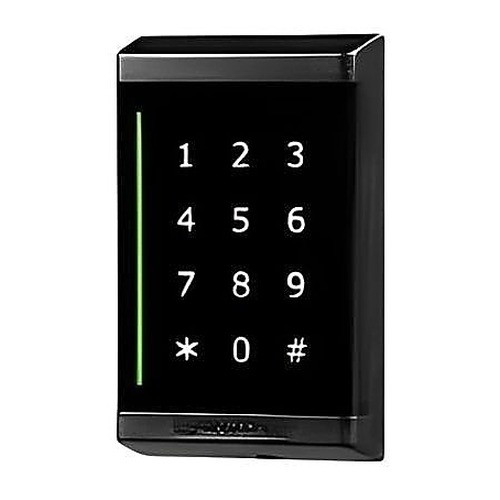
The KT-SG-MT-KP2 is a single-gang form factor (115.8 mm × 44.6 mm × 24.7 mm per the dimension fields, weight 0.45 lb) with an integrated numeric keypad, mounting on a standard North American or European single-gang electrical box. The keypad enables card-plus-PIN multi-factor authentication without a separate device.
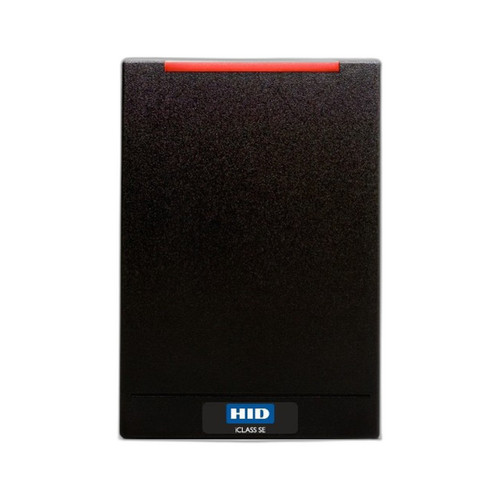
The HID 920NWNNEKE00BM is listed as a wall-mount reader. Its spec sheet entry for 'Keypad' reads 'No Yes (2 x 6 layout) No Yes (3 x 4 layout)'—this appears to reflect multiple SKU variants within the R40 product family rather than a definitive yes/no for this specific part number (920NWNNEKE00BM). Physical dimensions and weight are not provided in the supplied specifications for this model.
For installations where box depth or gang-size is constrained and PIN capability is required in a single unit, the KT-SG-MT-KP2's single-gang profile and confirmed integrated keypad are directly specified. The keypad status of the 920NWNNEKE00BM at this exact SKU cannot be confirmed from the provided data.
Which should you choose: the KT-SG-MT-KP2 or the 920NWNNEKE00BM?
Our take: The KT-SG-MT-KP2 is the stronger choice when OSDP-secured reader lines, multi-factor PIN authentication in a compact footprint, and broad credential flexibility are required. Three concrete spec deltas support this: first, the KT-SG-MT-KP2 specifies AES-256 encryption plus OSDP output, while the 920NWNNEKE00BM lists Wiegand-only output with no OSDP mentioned, leaving the reader-to-panel wire unencrypted per available specs. Second, the KT-SG-MT-KP2 explicitly includes an integrated keypad in a single-gang form factor; the 920NWNNEKE00BM's keypad status at SKU 920NWNNEKE00BM is ambiguous in the provided specifications. Third, the KT-SG-MT-KP2 carries a lifetime warranty versus the 920NWNNEKE00BM's two-year warranty. The 920NWNNEKE00BM's factory-loaded iCLASS SE migration profile (EVCF0113_ICE0282) is a meaningful advantage for sites standardized on HID iCLASS SE infrastructure undertaking a phased LF-to-HF migration. Platform lock-in is a key qualifier: the KT-SG-MT-KP2 targets Kantech/Tyco ecosystems; the 920NWNNEKE00BM is optimized for HID-centric deployments.
Side-by-Side Comparison
Spec-for-spec, from manufacturer data.
| Specification | Kantech KT-SG-MT-KP2 | HID 920NWNNEKE00BM |
|---|---|---|
| Product Type | Multi-Technology Reader with Keypad | Smart Card Reader (Multiclass Wall) |
| Reader Technology | Multi-Technology; Smart Card; Proximity; Keypad | iCLASS SE Smart Card Reader (Multiclass HF/LF) |
| Credential Types | DESFire, MIFARE Plus EV1, ISO 14443A/B, HID Prox, ioProx, NFC/13.56 MHz, 125 kHz | iCLASS SE, HF SEOS/MIGR, LF protocols, Wiegand, PIG |
| HF Frequency | 13.56 MHz | 13.56 MHz (HF) |
| LF Frequency | 125 kHz | LF (specific frequency not listed in provided specs) |
| Output Protocol | OSDP, Wiegand, RS-485 | Wiegand 26-bit (100 µs pulse, 1000 µs spacing) |
| OSDP Support | Yes | Not listed in provided specs |
| Encryption | AES-256 | iCLASS SE encrypted card data (bit-depth not specified) |
| Integrated Keypad | Yes (numeric) | Ambiguous at this SKU per provided specs |
| Mount Type | Single-gang wall (North America / Europe) | Wall mount |
| Form Factor | Single gang | Wall reader (dimensions not provided in specs) |
| Dimensions (mm) | 115.8 × 44.6 × 24.7 | Not provided in specs |
| Weight | 0.45 lb | Not provided in specs |
| Input Voltage | 5 VDC | Not provided in specs |
| Warranty | Lifetime | 2-year |
| Country of Origin | US | Not provided in specs |
Frequently Asked Questions
Which should you choose: the KT-SG-MT-KP2 or the 920NWNNEKE00BM?
The KT-SG-MT-KP2 is the stronger choice when OSDP-secured reader lines, multi-factor PIN authentication in a compact footprint, and broad credential flexibility are required. Three concrete spec deltas support this: first, the KT-SG-MT-KP2 specifies AES-256 encryption plus OSDP output, while the 920NWNNEKE00BM lists Wiegand-only output with no OSDP mentioned, leaving the reader-to-panel wire unencrypted per available specs. Second, the KT-SG-MT-KP2 explicitly includes an integrated keypad in a single-gang form factor; the 920NWNNEKE00BM's keypad status at SKU 920NWNNEKE00BM is ambiguous in the provided specifications. Third, the KT-SG-MT-KP2 carries a lifetime warranty versus the 920NWNNEKE00BM's two-year warranty. The 920NWNNEKE00BM's factory-loaded iCLASS SE migration profile (EVCF0113_ICE0282) is a meaningful advantage for sites standardized on HID iCLASS SE infrastructure undertaking a phased LF-to-HF migration. Platform lock-in is a key qualifier: the KT-SG-MT-KP2 targets Kantech/Tyco ecosystems; the 920NWNNEKE00BM is optimized for HID-centric deployments.
Can the KT-SG-MT-KP2 or the 920NWNNEKE00BM read both old HID Prox cards and new MIFARE smart cards at the same door?
Both readers are described as dual-frequency (HF 13.56 MHz + LF 125 kHz) and are positioned for mixed-credential environments. The KT-SG-MT-KP2 explicitly lists HID Proximity and MIFARE Plus EV1 in its credential spec. The 920NWNNEKE00BM lists iCLASS SE, HF SEOS/MIGR, and LF protocols; its support for standard HID Prox (non-iCLASS) at this SKU is not explicitly confirmed in the provided specifications. Verify the exact LF formats supported with HID's product team before specifying for a HID Prox migration.
Does either reader support OSDP for a more secure reader-to-panel connection?
Yes, the KT-SG-MT-KP2 lists OSDP as a supported communication protocol alongside Wiegand and RS-485. The HID 920NWNNEKE00BM's provided specifications list only Wiegand (100 µs pulse width, 1000 µs spacing) as its output protocol; OSDP is not mentioned for this model in the supplied data. If OSDP-secured reader lines are a project requirement, the KT-SG-MT-KP2 satisfies that requirement from the listed specs; the 920NWNNEKE00BM does not, per available data.
Which reader has the longer warranty, and does that affect total cost of ownership for a large deployment?
The KT-SG-MT-KP2 carries a lifetime warranty per its listed specification. The HID 920NWNNEKE00BM carries a two-year warranty per its listed specification. For large deployments with long amortization horizons, the lifetime warranty on the KT-SG-MT-KP2 eliminates post-warranty repair or replacement cost risk that the two-year term on the 920NWNNEKE00BM does not cover. No pricing data was provided for either unit, so a full TCO comparison cannot be made from the available specifications alone.
More Access Control Reader Comparisons
- HID 920PHRNEK00203 vs Kantech KT-SG-MT-KP2
- HID 920PHRNEK00203 vs Kantech KT-SG-MT2
- HID 920PHRNEK00203 vs DMP USB
- HID 920PHRNEK00203 vs HID HID-920-PTNN
- HID 920PHRNEK00203 vs HID 920NWNNEKE00BM
- HID HID-920-PTNN vs Kantech KT-SG-MT-KP2
Access Control Reader Buying Guides
Get a Second Opinion on Your Camera Choice
Share your site layout, coverage goals, and budget. Our team will validate the camera selection, flag anything we would change, and recommend products that match the use case.