
Best Proximity Card Readers for Business
Proximity and RFID card readers for commercial access — 125 kHz vs 13.56 MHz, read range, and Wiegand vs OSDP wiring.

Jerry Tildsen
Access Control & Intercoms Specialist · Working integrator
Bottom line
Choosing the right proximity or RFID card reader comes down to three practical decisions: credential frequency (legacy 125 kHz vs. modern 13.56 MHz or multi-technology), wiring protocol (Wiegand for installed infrastructure vs. OSDP for encrypted, supervised communication), and environmental rating (indoor lobbies vs. parking garages vs. outdoor perimeters). The products listed here span those trade-offs from cost-effective single-technology readers to multi-tech units that bridge legacy and modern credential ecosystems — match the reader class and IP rating to your site conditions before anything else.
What This Setup Needs
Access control readers look deceptively similar on a spec sheet, but the wrong choice locks you into a credential format, a wiring protocol, or an enclosure that fails in the field. Here are the factors that actually drive the decision on a commercial installation:
- Credential frequency and technology class: 125 kHz proximity (HID Prox, EM4100) is the installed base at most legacy sites — cheap cards, long field life, but no encryption. 13.56 MHz smart cards (MIFARE, iCLASS, DESFire) add sector-level encryption and support multi-application credentials. Multi-technology readers support both, giving you a migration path without a forklift upgrade. If your site is issuing new credentials anyway, go 13.56 MHz or multi-tech; if you're maintaining an existing 125 kHz population for years, confirm the reader supports your specific card family.
- Wiring protocol — Wiegand vs. OSDP: Wiegand is the 40-year-old de facto standard; virtually every panel accepts it, but it sends credential data in the clear with no supervision — a wire tap can clone reads. OSDP v2 (Open Supervised Device Protocol) is RS-485 bidirectional, encrypted, and supervised — the panel knows if the reader is disconnected or tampered. For new construction or panel replacements, OSDP is the defensible choice; for retrofit into legacy panels that only speak Wiegand, confirm compatibility before specifying OSDP readers.
- IP and environmental rating: IP55 handles splash and dust in covered vestibules or indoor loading docks. IP65 seals against low-pressure water jets — adequate for covered exterior entries. IP67 is full temporary immersion resistance, correct for exposed outdoor columns, parking structures, and coastal or industrial environments. Never downgrade IP to save money on a reader that will see standing water, pressure washing, or driving rain.
- Operating temperature range: Standard commercial electronics typically spec to 0°C / 32°F. Northern climates, unheated parking decks, and cold-storage facilities need readers rated to -20°C (-4°F) or colder. If a spec sheet shows -40°F on the low end, that is a meaningful differentiator for extreme-cold deployments — do not assume all outdoor-rated readers share it.
- Form factor and mounting: Single-gang wall-plate readers suit interior doors and turnstiles. Pedestal or enclosure-mount units are used at vehicle lanes or where surface conduit is exposed. Verify the back-box depth against your wall construction — thin drywall partitions and poured-concrete walls need different junction box solutions, and some readers ship with integral housings that dictate the rough-in.
- Power source: Most readers are passive (powered by the panel's reader port, typically 12 VDC). Some enclosure-type units, particularly those integrating multiple functions, accept PoE+ or AC/DC input — valuable when a panel reader port cannot supply enough current or when the reader is mounted far from the panel and you want to run a single Cat6 home-run.
- Read range: Standard proximity readers read 2–4 inches (5–10 cm). Long-range readers extend to 12–36 inches for hands-free access at vehicle barriers or ADA-compliant lobby applications where a user cannot reach a standard-height reader. Confirm the stated read range is with the credential type you are issuing — range varies significantly between card families on the same reader hardware.
Our Picks
Selected from our catalog by spec-fit. All channel-direct and factory-new — not ranked by price.
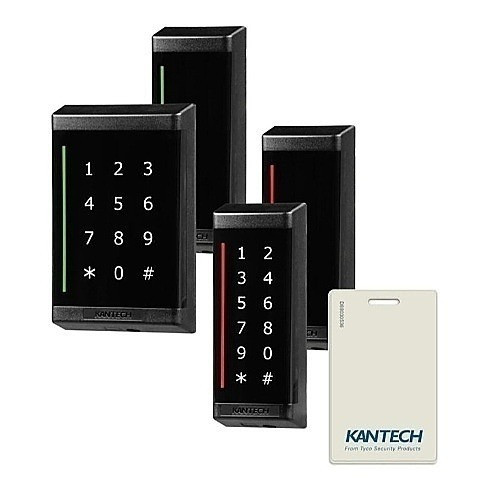
Kantech P345-SPACER
Multi-Tech
The Kantech P345-SPACER is a multi-technology reader well-suited for sites in active credential migration — it can handle multiple card technologies simultaneously, and its IP65 rating makes it a sound choice for covered exterior entries or indoor-outdoor transition points where occasional water exposure is expected.
View product →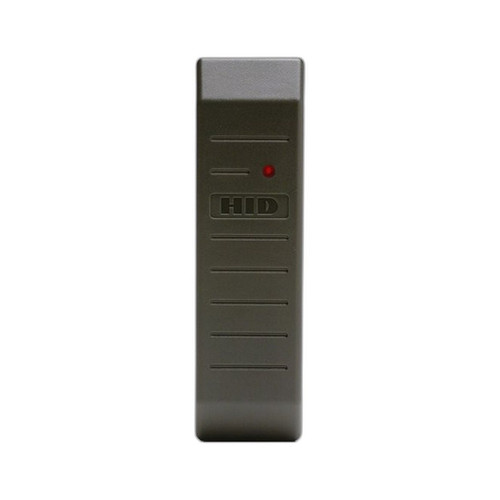
HID 5365EGP00
Proximity/RFID
The HID 5365EGP00 is a wired proximity/RFID reader in a mount form factor rated IP55, making it a strong fit for interior or semi-protected entry points on an existing Wiegand or OSDP panel infrastructure where a compact, reliable HID-ecosystem reader is the path of least resistance.
View product →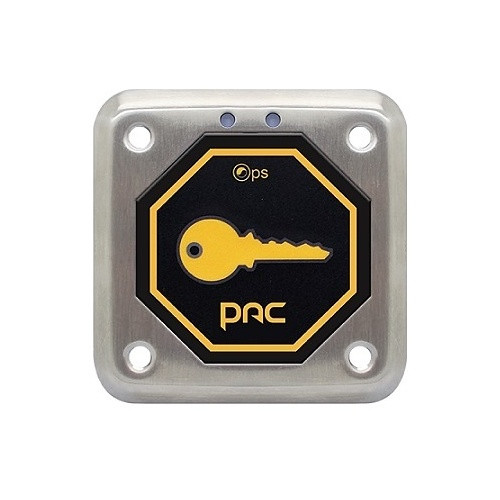
Comelit 909020116
Proximity/RFID
The Comelit 909020116 is a proximity/RFID reader built into an enclosure with PoE+ input and a robust IP67 rating, well-suited for installations where you want to run a single Cat6 home-run to an exposed outdoor location and power the reader over the network cable without a separate low-voltage feed from the panel.
View product →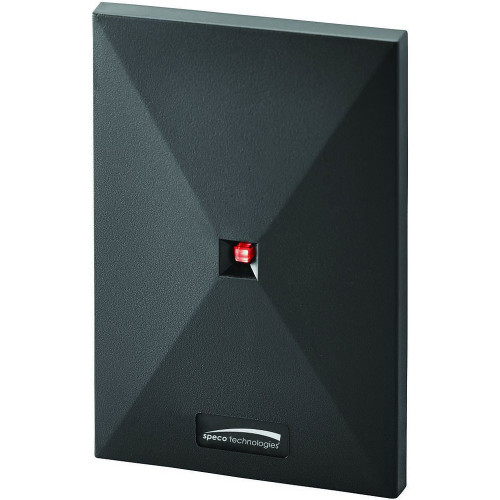
Speco Technologies AP500HA
Proximity/RFID
The Speco Technologies AP500HA is a Wiegand/ABA Track II proximity reader rated IP67 and specified to operate from -40°F to 149°F, making it a strong fit for exposed outdoor perimeter doors, unheated parking structures, or cold-climate installations where temperature extremes and direct weather exposure would disqualify standard commercial readers.
View product →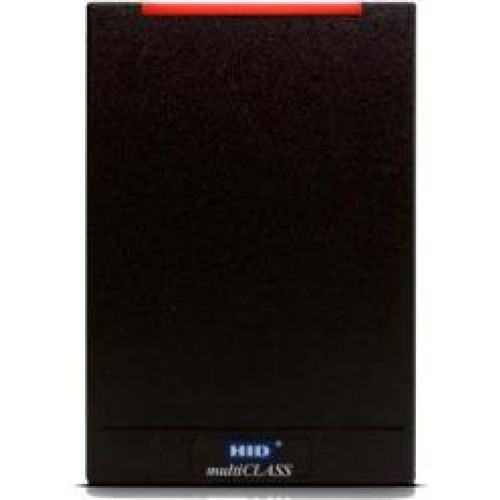
HID 920PHRNEK00203
Multi-Tech
The HID 920PHRNEK00203 is a multi-technology reader in a housing form factor rated IP65, well-suited for facilities running mixed credential populations — legacy 125 kHz cards alongside modern 13.56 MHz smart credentials — where you need a single reader footprint to serve both without requiring a complete card re-issue.
View product →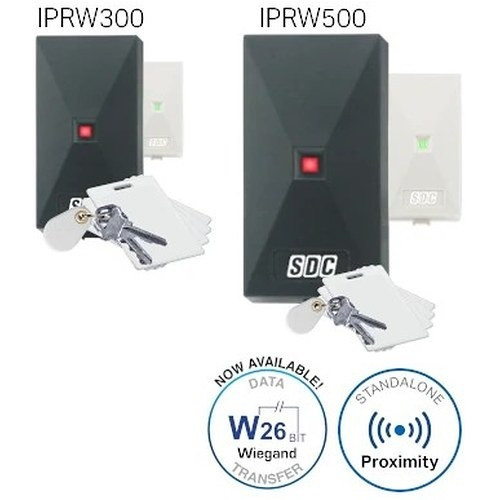
SDC IPRW300
Proximity/RFID
The SDC IPRW300 is a wired proximity/RFID reader rated IP67, making it a solid choice for wet or demanding environments — vehicle entrances, exterior columns, or industrial facilities — where wired connectivity back to a panel is established and you need a reader enclosure that can withstand immersion-level moisture exposure.
View product →Frequently Asked Questions
What is the difference between 125 kHz and 13.56 MHz card readers?
125 kHz readers use older proximity technology (HID Prox, EM4100) that broadcasts a fixed card number with no encryption — the credential cannot be validated beyond 'is this number on the access list.' 13.56 MHz smart card readers (iCLASS, MIFARE, DESFire) support on-card encryption, mutual authentication between card and reader, and multi-application credentials like combining access and cashless vending on one card. For new deployments, 13.56 MHz is the more secure choice; for sites with a large legacy 125 kHz card population, multi-technology readers let you run both formats during a phased transition.
Can I use an OSDP reader on my existing Wiegand panel?
Not directly — OSDP requires an RS-485 connection and a panel or controller that speaks the OSDP protocol. Most legacy panels only have Wiegand reader ports. Some panels offer an OSDP module add-on; others require a protocol converter in the field. If you are specifying OSDP readers for a security or supervision benefit, confirm your panel firmware and hardware support OSDP v2 before ordering readers, or budget for a panel upgrade alongside the reader replacement.
What IP rating do I need for an outdoor access control reader?
For a covered exterior entry with no direct rain exposure, IP55 is generally adequate. For exposed outdoor locations — building perimeters, parking structures, gate posts — IP65 is the practical minimum, as it is rated for low-pressure water jets from any direction. In environments with pressure washing, flooding risk, or standing water (vehicle wash lanes, industrial sites), IP67 or higher provides temporary submersion protection and is the defensible specification. Always check whether the IP rating applies to the full assembly including the housing and cable entry, not just the reader module.
What read range should I specify for a standard door versus a vehicle lane?
For pedestrian doors, a standard proximity read range of 2–4 inches (5–10 cm) is typical and appropriate — it requires a deliberate credential presentation, which reduces tailgating risk. For vehicle lanes, hands-free pedestrian entries, or ADA applications where a user cannot reach a standard reader height, you need a long-range reader specified at 12 inches or greater; these are a different product category and often require a specific long-range credential format. Do not assume a standard reader can be 'tuned up' to long range — the antenna and reader electronics are purpose-built for the application.
What does PoE+ power on a reader mean for installation?
A reader that accepts PoE+ (IEEE 802.3at, up to 30 W at the port) can be powered entirely over a standard Cat5e/Cat6 Ethernet run, eliminating the need for a separate 12 VDC or 24 VDC power feed from the access control panel. This is particularly useful when the reader is mounted far from the panel room, when conduit fill is tight, or when the panel's reader power supply cannot source enough current for an integrated enclosure unit. You still need a PoE+ capable switch or injector at the head-end, and you need to verify the panel's reader interface can accept data over whatever communication protocol the reader uses.
How do I choose between a mount-style reader and an enclosure-style reader?
Mount-style readers are designed to fit a standard single-gang electrical box and are the correct choice for interior doors, interior stairwells, and any location where the rough-in box is already in the wall. Enclosure-style readers include their own housing and are used for surface-mount installations, exposed conduit runs, vehicle lanes, or outdoor pedestal mounting where there is no recessed box in the substrate. If you are retrofitting readers into an existing installation with finished walls and standard boxes, a mount-form-factor reader minimizes rework; if you are mounting to concrete, a gate post, or a surface-mounted conduit system, an enclosure unit is the right specification.
Related Resources
- Access Control Reader comparisons — head-to-head spec matchups
- Access Control Reader Buying Guide
- Best Access Control Reader for Multi-Tenant Buildings
- Best Mobile Credential Access Control Readers
- All product comparisons
Speccing this for a project?
Send us your requirements and our senior specialists will confirm specs, compatibility, availability and pricing — free, usually within one business day. Channel-direct, factory-new, serving commercial integrators since 2014.
Get a Free QuoteComparing for a project?
Send us the models you are weighing and our team will confirm specs, compatibility, availability, and pricing — free, usually within one business day.