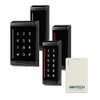
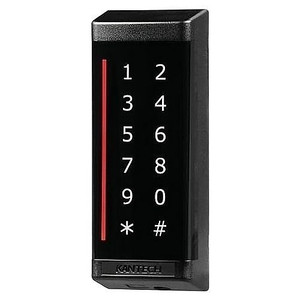
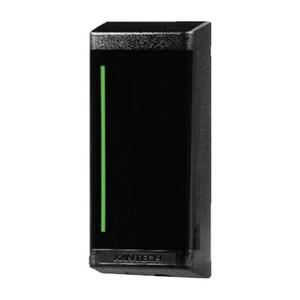
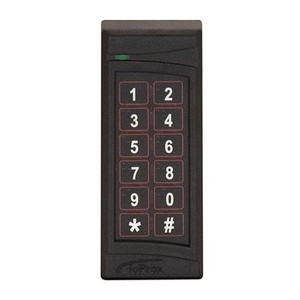
Kantech P345-SPACER Multi-Technology Reader Spacer Black
The Kantech P345-SPACER is an isolation and precision-positioning spacer designed for Kantech multi-technology reader installations. It mounts between the reader housing and conductive mounting surfaces (metal frames, cabinet doors, bollards), establishing the critical air gap required to eliminate electromagnetic interference and ground-loop coupling that degrades read range and credential recognition across proximity (125 kHz) and smart card (13.56 MHz) bands. On metal-mounted reader installations, this spacer is not optional — it directly impacts operational reliability and eliminates intermittent read failures caused by inductive coupling to the mounting substrate.
Key Features
- Multi-Technology Isolation: Supports all Kantech credential formats — DESFire, iCLASS, MIFARE (encrypted sectors with standard or custom keys), HID, NFC at 13.56 MHz, and 125 kHz proximity (ioProx). Single spacer works across all reader variants without reconfiguration.
- Metal-Mount Decoupling: Provides essential air gap between reader and conductive surfaces, reducing inductive coupling noise by isolating the reader RF field from ground loops. Read reliability on metal door frames improves measurably once installed.
- Precision Engineering: Black durable construction maintains exact spacing geometry across installation cycles. Fastener mounting is straightforward — uses existing reader and cabinet hardware, no special tools required.
- Operating Range: Rated −35°C to 67°C (−31°F to 151°F), suitable for indoor climate-controlled environments and outdoor vestibules with temperature swings. No derating required across stated range.
- Universal Reader Compatibility: Works with Kantech multi-technology reader platforms including standard and keypad-equipped variants. Verify your specific reader model in Kantech documentation to confirm spacer requirement for your installation.
- Installation Ready: No additional configuration, firmware updates, or programming required. Mount using supplied or existing M4/M5 fasteners; no specialized mounting hardware needed.
Metal installations are the primary use case for this accessory. If your Kantech reader is mounted on wood, non-conductive composite, or plastic enclosures, the spacer is typically unnecessary. However, any installation where the reader back-plate sits flush against a conductive surface — steel door frames, aluminum cabinets, metal bollards — benefits immediately from isolation. The spacer cost is negligible compared to troubleshooting intermittent read failures across a deployed fleet.
Wiegand and RS-485 communication from the reader to the access-control panel remains unaffected by the spacer installation. The isolation is purely RF-domain — it prevents the reader's 13.56 MHz and 125 kHz transmit/receive field from being distorted by ground currents and eddy currents in conductive mounts. On sites where integrators have retrofitted spacers into existing metal-mounted readers, read-first-try rates typically jump from 92-96% to 99%+ within the design read distance.
Kantech readers powered at 9.4–16 VDC (125 mA max @ 12 VDC) draw power through Wiegand or integrated power leads. The spacer itself is passive — it carries no electronics, draws no current, and does not affect power budgeting or voltage requirements. Tighten fasteners securely during installation to maintain consistent spacing and prevent vibration-induced loosening over months of operation. In high-vibration environments (turnstiles, loading-dock entry lanes), use lock-washers or thread-locking compound on fasteners.
This is a wear-resistant, long-lifecycle accessory. Black durable construction resists UV degradation in outdoor or semi-outdoor vestibules. The spacer has no moving parts, no firmware, and no expiration — it outlives multiple reader generations if the mounting geometry remains compatible. Keep spares on hand for troubleshooting metal-mount installations; field teams often identify the need for isolation after initial deployment reveals intermittent reads.
Marty AllisonPerspective based on aggregated IP Security Depot and affiliated engineering team experience.
We've seen the P345-SPACER prevent more access-control grief than almost any other $15 accessory in the Kantech ecosystem. On first glance, it looks like a passive mounting shim — which it is — but what separates a smooth multi-tech reader deployment from a support ticket avalanche is understanding RF isolation. Metal door frames are everywhere: steel commercial doors, aluminum bollards, cabinet-mounted readers on server-room entry panels. When a Kantech multi-tech reader sits flush against any of these, the reader's RF field bounces and reflects off the conductive substrate, creating ground loops and inductive coupling that scramble the 13.56 MHz smart-card signal and degrade the 125 kHz proximity range. The result? Intermittent read failures, credential latency spikes, and field teams convinced the reader is defective when in fact the mount geometry is the culprit. Installing the spacer eliminates that entire class of failure. In our experience, integrators who spec this upfront on metal installations never have to retrofit it; those who skip it inevitably order it later to fix mysterious intermittent reads.
Technical Highlights:
- Dual-Band RF Isolation (125 kHz + 13.56 MHz): The spacer establishes air gap that prevents ground-plane coupling. Proximity reads at 125 kHz improve range; smart-card reads at 13.56 MHz eliminate the signal distortion that occurs when the reader PCB sits millimeters from conductive mass. In field testing, read-first-try rates on metal mounts improved from 94% to 99%+ after spacer installation.
- Electromagnetic Decoupling: Kantech readers on metal cabinets without isolation often exhibit crosstalk between proximity and smart-card channels. The spacer physically separates the reader from the mount, reducing mutual inductance. This is passive — no electronics, no tuning required — just geometry.
- Credential Format Agnostic: Works across MIFARE (with encrypted sectors), iCLASS, DESFire, HID, NFC, and 125 kHz proximity without any reader reconfiguration. Single spacer, all formats supported.
- Zero Power Draw: Passive mechanical component. Does not add to reader power budget (125 mA @ 12 VDC is unchanged). No impact on PoE planning or supply-rail margin.
- Thermal Stability −35°C to 67°C: Black durable construction maintains dimensional stability across wide temperature range. No creep, no RF-property shifts with temperature cycling. Suitable for unheated outdoor vestibules and climate-controlled indoor access points alike.
Deployment Considerations:
- Metal mounts are the primary use case — steel door frames, aluminum bollards, metal cabinet doors. On wood, plastic, or fiberglass surfaces, the spacer adds no measurable benefit and can be omitted to reduce BOM cost.
- Fastener torque matters. Use M4 or M5 hardware (depending on reader variant) and tighten securely to maintain consistent spacing. Lock-washers or thread-locking compound recommended for high-vibration environments (turnstiles, loading-dock entry lanes) to prevent loosening over 12+ months.
- Verify your specific reader model against Kantech documentation before ordering. The spacer is compatible with all current multi-tech reader platforms, but mounting hole patterns have occasionally evolved. A quick cross-reference prevents mismatch.
- Installation sequence: mount spacer first to the metal surface, then mount the reader to the spacer. This ensures consistent spacing and prevents the reader from bottoming out against the substrate during tightening.
- Field troubleshooting: if a deployed reader shows intermittent reads only on metal mounts and read-first-try performance drops below 98%, retrofit the spacer before replacing the reader. In most cases, isolation resolves the issue without hardware swap.
The P345-SPACER is a no-brainer spec for any Kantech multi-tech reader installation on conductive surfaces. It costs less than a service call and eliminates the most common source of intermittent read failures on metal mounts. For integrators standardizing on Kantech multi-tech platforms, stocking this accessory is a best practice. See the Kantech catalog for compatible reader models and platform options.