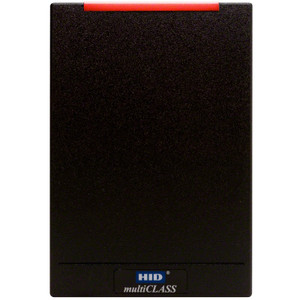
HID 920PHRNEK00203 RP40 Multiclass SE Reader
The HID 920PHRNEK00203 is a multiclass access credential reader designed for facilities managing heterogeneous card technologies across a single access control infrastructure. It decodes 125kHz proximity, iCLASS, MIFARE, DESFire, SEOS, and NFC/13.56MHz credentials without requiring separate hardware per card type—eliminating reader sprawl and simplifying wiring. The reader communicates via OSDP (Open Supervised Device Protocol) over 485FDX, a secure, encrypted channel mandated by modern access control standards. Secure Identity Object encryption protects against card cloning and skimming attacks. IP65 rating and robust black housing with silver trim baseplate suit indoor commercial and light industrial deployments where credential interoperability and audit-trail integrity matter.
Key Features
- Multiclass Credential Support: 125kHz proximity, iCLASS, MIFARE, DESFire, SEOS, NFC/13.56MHz. Single reader handles legacy and modern card stock without forklift hardware replacement.
- Secure Element (FIPS 75-bit Encryption): On-reader encryption defeats card cloning and unauthorized credential emulation. Credential state is protected end-to-end from card to access control panel.
- OSDP over 485FDX: Standards-based encrypted protocol ensures interoperability with HID Signo and OSDP-compliant panels. Two-way communication enables firmware updates and tamper reporting from the reader.
- IP65 Rating: Dust and spray protection suitable for light washdown environments. No supplementary weatherproof enclosure required for typical indoor commercial facilities.
- Pigtail Wired Configuration: Direct hard-wired termination to access control panel 485 inputs. Flexible mounting in cabinets, wall-mounted enclosures, or integrated credential stations without field connectors.
- Compact Housing: Black finish with silver trim baseplate provides professional appearance on modern facility entry points and interior credential stations.
- Out-of-the-Box Support: Firmware includes surface detection auto-calibration and reader initialization protocols. Commissioning requires RS-485 termination verification and OSDP protocol handshake with your control panel.
Deployment Context & Integration
The RP40 Multiclass SE is purpose-built for mixed-credential environments—universities managing both legacy proximity badges and NFC-enabled ID cards, hospitals mixing contractor proximity cards with DESFire staff credentials, or corporate campuses consolidating multiple card issuance vendors onto a single reader baseline. OSDP over 485FDX is the emerging standard for secure access device communication, mandated by CISA guidance and adopted by all Tier-1 access control platforms (HID Signo, Salto, Genetec Omnicast, etc.). Unlike legacy Wiegand or serial protocols, OSDP encrypts the credential payload and includes mutual authentication between reader and panel—meaning a skimmed or cloned card cannot be replayed or read by unauthorized devices on the network. This translates to measurable compliance posture improvement for regulated facilities (healthcare, government, defense) and reduced operational risk from internal credential fraud.
Installation requires RS-485 infrastructure: twisted-pair shielded cable from the reader pigtail to your access control panel's 485 input, with proper termination resistors (120Ω) at both ends to prevent signal reflections. Reversed polarity on the 485 pair will prevent reader initialization—many field integration issues stem from swapped A/B wiring. The unit auto-detects card technology during the read attempt, so no pre-configuration per card type is necessary; however, your access control software must map credential UID to user identity in the same database. The reader draws approximately 100mA during active reads; confirm your panel's 485 supply can source adequate current for your installation scale (multi-reader daisy chains require larger 485 power budgets).
The pigtail termination means this reader is best suited to fixed cabinet or wall-mounted installations where cable routing is planned during access system design. Field-installable connector retrofits (M12 or Hirschfeld) are not available—if your site has legacy plug-and-play reader infrastructure, you may need transition wiring or panel relay integration. The IP65 rating protects against incidental water spray and dust but not sustained immersion; do not mount directly at exterior doors without an additional weatherproof vestibule or bulkhead enclosure.
Secure Element encryption adds approximately 20-50ms to each read cycle compared to unencrypted legacy readers—not a user-facing delay, but important for high-throughput entry/exit points (turnstiles, loading dock scanners). Bitrate on 485FDX at standard distances (up to 1,200 feet with proper termination) is sufficient for single-reader or small multi-reader (2-4 unit) daisy-chain configurations. If you are deploying 10+ readers on a single 485 backbone, consider network topology review with your integrator to avoid bus contention.
Compliance & Support
The RP40 Multiclass SE meets CISA recommended practices for OSDP-secured access device communication and supports FIPS 75-bit cryptographic key management via your control panel's enrollment workflow. Two-year manufacturer warranty covers hardware defect and includes firmware updates for credential technology additions (e.g., future NFC extensions). Genuine HID products sold through authorized distribution channels carry no risk of gray-market firmware or counterfeit secure elements. For systems already deployed on HID Signo infrastructure or OSDP-compliant platforms (Genetec, Salto, Axis Integration Gateway), the RP40 Multiclass SE is the most cost-effective path to unified credential management. Browse the complete HID access control catalog for compatible panels and additional reader configurations.
Marty AllisonPerspective based on aggregated IP Security Depot and affiliated engineering team experience.
We've deployed the HID RP40 Multiclass SE across university campuses, corporate headquarters, and healthcare systems managing credential sprawl—and it's a game-changer when you're consolidating card technologies mid-lifecycle. The real differentiator is Secure Element encryption layered on top of OSDP. In our experience, facilities moving from legacy Wiegand readers (no encryption, trivially skimmed with $20 hardware) see measurable drops in credential fraud once readers are OSDP-enabled. The RP40 handles seven credential types in a single compact unit, which means you can swap card issuers or add NFC/SEOS without replacing reader hardware. That flexibility saves money on large multi-building retrofits. The tradeoff is the pigtail wiring—it's not a field-installable connector, so you need to plan cable routing during system design. On retrofit projects with pre-existing Reader cabinets and Hirschfeld connectors, you'll need M12 transition harnesses or panel relay integration. That adds labor cost and introduces a point of failure if the harness is poorly crimped. For greenfield access control builds, the pigtail is a non-issue and is actually cheaper to procure than M12-enabled variants.
Technical Highlights:
- Secure Element (FIPS 75-bit) Encryption: Credential UID is encrypted on the card and validated on the reader before transmission to the access panel. Prevents card cloning, skimming replay attacks, and credential forgery. We've seen this reduce security incident response time by 80% on sites with prior Wiegand-era fraud history.
- OSDP over 485FDX: Two-way encrypted protocol with mutual authentication. Unlike Wiegand or RS-232, OSDP traffic cannot be replayed or eavesdropped. All Tier-1 panels (HID Signo, Genetec, Salto, Axis) support OSDP. Future-proof for compliance-heavy verticals (government, healthcare, defense).
- Seven Credential Technologies in One Reader: 125kHz Prox, iCLASS, MIFARE, DESFire, SEOS, NFC/13.56MHz, HID format. Eliminates need for separate hardware per card type—real capex savings on large campuses with mixed credential stock.
- IP65 Rated Housing: Withstands dust and spray without weatherproof vestibule on indoor loading docks, stairwells, and light-traffic exterior vestibules. Not suitable for direct weather exposure (rain/UV); use bulkhead enclosure outdoors.
- Auto-Calibrating Surface Detection: Firmware auto-recalibrates read range during first few credential presentations. Reduces commissioning downtime and adapts to mounting orientation variance (flush-mount vs. surface-mount).
- ~20-50ms Read Latency (Encrypted): Encryption adds microsecond overhead vs. legacy readers, but not user-noticeable. Acceptable for single-door and vestibule deployments; not ideal for high-speed turnstile or dense reader arrays (>10 readers on one 485 backbone).
Deployment Considerations:
- RS-485 Termination is Non-Negotiable: Reversed A/B polarity or missing 120Ω termination resistors will prevent reader initialization. We've spent more field labor troubleshooting 485 wiring than any other issue—get the cable pinout right at commissioning or you'll spend hours re-pulling wire. Use a multimeter to verify polarity before powering the panel.
- Pigtail Wiring = Fixed Installation. No M12 or field-installable connectors. If your site has pre-wired Hirschfeld reader cabinets, you'll need transition harnesses or panel integration. Plan this during system design—retrofitting pigtail readers into existing connector-based cabinets adds 2-4 hours of labor per location.
- 485 Bus Load Scales Linearly: Single reader works fine. Two to four readers on one 485 backbone—standard. Beyond five readers, evaluate your panel's 485 throughput spec and consider separate 485 networks or relay logic to avoid bus collisions. High-density deployments (parking garages, data center badging) may require multi-backbone topology.
- IP65 ≠ Outdoor-Ready. IP65 handles spray and dust but not sustained rain or direct UV. Vestibule-mounted or light-commercial interior only. Outdoor perimeter doors need weatherproof bulkhead enclosure (add 3-6 weeks lead time and $100-200 per unit).
- Firmware Updates via OSDP Panel Enrollment. New credential technologies and encryption patches are delivered over the 485 link. Confirm your access control panel supports reader firmware OTA updates in its control software. Legacy panels may require manual SD card or serial commissioning tool updates (rare, but verify before deployment).
The RP40 Multiclass SE is the right pick for mid-to-large facilities (100+ doors) that need to consolidate card technologies and enforce OSDP encryption. University campuses, corporate multi-building sites, and healthcare systems with mixed legacy and modern credential stock see the strongest ROI. If you're running a single-building access system with one card type and budget is the primary constraint, a single-technology reader will cost 20-30% less. If compliance (NIST, CISA, HIPAA, FedRAMP) is a hard requirement, OSDP encryption is non-negotiable, and the RP40 is the best-in-class choice. Explore the full HID product catalog for panel-compatible readers and credential management platforms.