
Hanwha X530L-18GHXM-90 vs Ubiquiti USW-LITE-16-POE: Specification Comparison
Both the Hanwha HV-X530L-18GHXM-90 and the Ubiquiti USW-LITE-16-POE are 16-port managed PoE switches targeting edge network deployments, placing them squarely in the same product class for cross-shopping. The Hanwha delivers multi-gigabit PoE++ with a 720W power budget oriented toward high-draw surveillance endpoints, while the Ubiquiti offers a compact Gigabit PoE+ switch with a 45W budget suited to lighter-load installations. This comparison examines power delivery, switching performance, and physical deployment factors.
In This Guide
- Which switch delivers more PoE power per port and in total?
- How do the two switches compare on throughput, port speed, and forwarding capacity?
- How do form factor, mounting, compliance, and environmental ratings differ between the two?
- Which should you choose: the X530L-18GHXM-90 or the USW-LITE-16-POE?
- Side-by-Side Specs
- FAQ
Which switch delivers more PoE power per port and in total?
The HV-X530L-18GHXM-90 provides PoE++ (802.3bt Class 8) on all 16 data ports, with a 720W total PoE budget and up to 90W per port. This accommodates high-draw endpoints such as PTZ cameras, multi-sensor cameras, access control panels, and powered video encoders without external injectors or midspan equipment.
The USW-LITE-16-POE provides PoE+ (802.3at) on all 16 ports, with a 45W total PoE budget and a per-port maximum of 30W. That aggregate budget is approximately 6.4× smaller than the Hanwha's. In a fully loaded 16-port scenario, the Ubiquiti averages only 2.8W per port before hitting its ceiling, making simultaneous full-load use across all ports impractical.
For surveillance deployments requiring even moderate per-camera power—IR illuminators, heaters, or pan-tilt motors—the Hanwha's per-port and aggregate headroom is substantially larger. The Ubiquiti is more appropriate for environments with sparse PoE loads or where most devices draw well under 30W each and the total load stays under 45W.
How do the two switches compare on throughput, port speed, and forwarding capacity?
The HV-X530L-18GHXM-90 features a 200 Gbps non-blocking switching fabric at 148.8 Mpps, with all 16 data ports supporting multi-speed operation at 100M, 1G, 2.5G, and 5G. It also adds dual 10 Gigabit SFP+ uplinks for fiber aggregation, enabling high-bandwidth backhaul to a core switch or NVR cluster. Latency is specified at 5.23–8.35 µs across speed tiers.
The USW-LITE-16-POE operates with a 32 Gbps non-blocking switching capacity and a 24 Mpps forwarding rate. All 16 ports are fixed at 1 Gbps. No uplink beyond the standard Gigabit ports is specified in the provided data. The switching fabric is approximately 6.25× smaller than the Hanwha's, and no multi-gigabit or fiber uplink capability is documented.
For high-resolution multi-stream camera systems where individual cameras may output 4K or higher bitrates, or where aggregated traffic exceeds 1 Gbps, the Hanwha's 2.5G/5G per-port speeds and 10G uplinks provide meaningful headroom. The Ubiquiti's 1G ports are sufficient for standard IP camera deployments where total uplink demand remains under 1 Gbps.
How do form factor, mounting, compliance, and environmental ratings differ between the two?
The HV-X530L-18GHXM-90 is a rack- and wall-mountable unit measuring 1.73 × 12.72 × 17.36 inches and weighing 13.89 lb. Its country of origin is Singapore. It carries NDAA and TAA compliance, which is a documented procurement requirement for U.S. federal, state, and many local government projects. The housing is white. A 5-year warranty is specified.
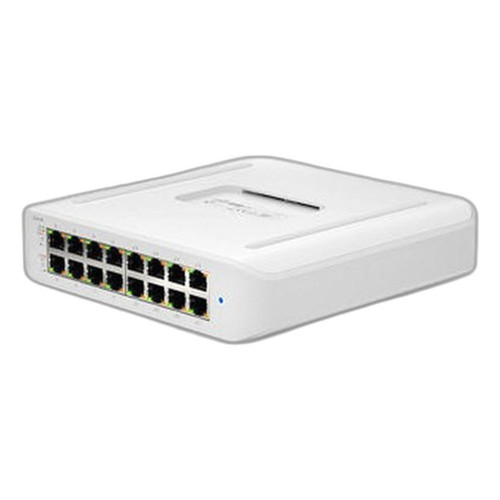
The USW-LITE-16-POE is a compact desktop and wall-mountable unit measuring 192 × 185 × 44 mm (approximately 7.6 × 7.3 × 1.7 inches) and weighing 1.2 kg (2.6 lb). Its polycarbonate enclosure supports an operating temperature range of −15°C to +40°C (5°F to 104°F). It carries NDAA, CE, FCC, IC, and Anatel certifications. Warranty duration is listed only as 'Manufacturer Warranty' without a specific term in the provided specs.
The Ubiquiti's compact footprint and lower weight make it easier to place in shallow wall boxes, small closets, or desktop environments where rack space is unavailable. The Hanwha's rack-mount form factor suits IT-room or structured cabling installations. Both units claim NDAA compliance. The Hanwha's TAA compliance is an additional differentiator for government procurement. No operating temperature range is provided in the Hanwha's specs as supplied.
Which should you choose: the X530L-18GHXM-90 or the USW-LITE-16-POE?
Our take: The HV-X530L-18GHXM-90 is the stronger choice when the deployment requires high-power PoE endpoints, multi-gigabit edge speeds, or government-compliant procurement. Concretely: its 720W PoE budget is 16× the Ubiquiti's 45W, enabling 90W per port versus 30W; its switching fabric is 200 Gbps versus 32 Gbps; and it adds dual 10G SFP+ uplinks absent entirely from the Ubiquiti. Additionally, the Hanwha carries explicit TAA compliance alongside NDAA, while the Ubiquiti lists NDAA and FCC/CE but no TAA status in the provided specs. The USW-LITE-16-POE is the practical choice where PoE loads are light, a compact wall-mount footprint is prioritized, and budget is a primary constraint—its 1G/45W profile matches standard IP camera or VoIP closet installations. Buyers running PTZ cameras, multi-sensor units, or access control on the same switch should select the Hanwha.
Side-by-Side Comparison
Spec-for-spec, from manufacturer data.
| Specification | Hanwha X530L-18GHXM-90 | Ubiquiti USW-LITE-16-POE |
|---|---|---|
| PoE Standard | PoE++ 802.3bt Class 8 | PoE+ 802.3at |
| Total PoE Budget | 720W | 45W |
| Max PoE per Port | 90W | 30W |
| PoE Port Count | 16 | 16 |
| Port Speeds | 100M / 1G / 2.5G / 5G (multi-speed) | 1G (fixed) |
| Uplink Ports | 2 × 10G SFP+ | — |
| Switching Fabric | 200 Gbps non-blocking | 32 Gbps non-blocking |
| Forwarding Rate | 148.8 Mpps | 24 Mpps |
| Latency | 5.23–8.35 µs | — |
| VLAN Support | — | 1,000 VLANs |
| Dimensions | 1.73 × 12.72 × 17.36 in | 192 × 185 × 44 mm (7.6 × 7.3 × 1.7 in) |
| Weight | 13.89 lb (6.3 kg) | 1.2 kg (2.6 lb) |
| Mount Type | Wall; Rack | Desktop; Wall |
| NDAA Compliant | Yes | Yes |
| TAA Compliant | Yes | — |
| Warranty | 5 Years | Manufacturer Warranty (term not specified) |
Frequently Asked Questions
Which should you choose: the X530L-18GHXM-90 or the USW-LITE-16-POE?
The HV-X530L-18GHXM-90 is the stronger choice when the deployment requires high-power PoE endpoints, multi-gigabit edge speeds, or government-compliant procurement. Concretely: its 720W PoE budget is 16× the Ubiquiti's 45W, enabling 90W per port versus 30W; its switching fabric is 200 Gbps versus 32 Gbps; and it adds dual 10G SFP+ uplinks absent entirely from the Ubiquiti. Additionally, the Hanwha carries explicit TAA compliance alongside NDAA, while the Ubiquiti lists NDAA and FCC/CE but no TAA status in the provided specs. The USW-LITE-16-POE is the practical choice where PoE loads are light, a compact wall-mount footprint is prioritized, and budget is a primary constraint—its 1G/45W profile matches standard IP camera or VoIP closet installations. Buyers running PTZ cameras, multi-sensor units, or access control on the same switch should select the Hanwha.
Can either switch power a PTZ camera or multi-sensor camera that draws more than 30W?
Yes—the HV-X530L-18GHXM-90 supports up to 90W per port via PoE++ (802.3bt Class 8), which covers virtually all high-draw PTZ and multi-sensor cameras on the market. The USW-LITE-16-POE is limited to 30W per port (802.3at PoE+) and a 45W total budget, which is insufficient for cameras requiring more than 30W or for running more than one or two mid-draw devices simultaneously.
Is the HV-X530L-18GHXM-90 or USW-LITE-16-POE better for a government or federally funded installation?
The HV-X530L-18GHXM-90 is specified as both NDAA and TAA compliant per the provided specs, satisfying the two most common U.S. government procurement requirements. The USW-LITE-16-POE is listed as NDAA compliant with CE, FCC, IC, and Anatel certifications, but TAA compliance is not stated in the provided specifications. Buyers with TAA obligations should verify Ubiquiti's current TAA status independently before specifying it.
Which switch fits better in a small network closet or on a desktop without rack space?
The USW-LITE-16-POE is the more compact option, measuring approximately 192 × 185 × 44 mm and weighing 1.2 kg with a polycarbonate desktop/wall-mount enclosure. The HV-X530L-18GHXM-90 is a rack-mount form factor at 1.73 × 12.72 × 17.36 inches and 13.89 lb, designed for structured-cabling racks or wall-rack panels. For tight closets or desktop placement without a rack, the Ubiquiti's footprint is substantially more convenient.
More Network Switch Comparisons
- Vivotek GEL-205A-260 vs TP-Link SL1218MP
- Vivotek GEL-205A-260 vs Allied Telesis AT-x530L-18GHXm-10
- Vivotek GEL-205A-260 vs Ubiquiti USW-LITE-16-POE
- Vivotek GEL-205A-260 vs Ubiquiti USW-16-POE
- TP-Link SL1218MP vs Allied Telesis AT-x530L-18GHXm-10
- TP-Link SL1218MP vs Ubiquiti USW-LITE-16-POE
Network Switch Buying Guides
Get a Second Opinion on Your Camera Choice
Share your site layout, coverage goals, and budget. Our team will validate the camera selection, flag anything we would change, and recommend products that match the use case.