
Hanwha GS970M/18PS-R-10 vs Hanwha IGS950/20PS-910: Specification Comparison
Both the Hanwha HV-GS970M/18PS-R-10 and HV-IGS950/20PS-910 are 16-port Gigabit PoE+ managed switches in Hanwha's surveillance-optimized switching line, carrying identical 5-year warranties and white housings. Integrators deploying IP cameras, intercoms, or PoE-powered sensors will evaluate these side-by-side on PoE power budget, uplink architecture, mounting flexibility, and management platform. This comparison draws exclusively from the provided specifications; where a value is absent or internally contradictory, that is noted explicitly.
In This Guide
Which switch delivers more PoE headroom per camera port?
The GS970M/18PS-R-10 carries a clearly stated 247W aggregate PoE budget across its 16 PoE+ (802.3at) access ports, yielding a theoretical average of approximately 15.4W per port — sufficient for mainstream fixed IP cameras and PoE-class intercoms, though insufficient to simultaneously drive all 16 ports at the 802.3at maximum of 30W.
The IGS950/20PS-910 presents a contradictory power figure in its provided specifications: the _Power Type field states '370W total power budget' while the _Power Watts field records '130W.' Because these two values cannot both be correct, a verified number cannot be cited here. Buyers should confirm the actual PoE budget with Hanwha's published datasheet at /content/product-datasheets/HV-IGS950/20PS-910.pdf before deployment planning. Taking the higher 370W figure at face value would imply approximately 23.1W average per port — a meaningful step up for PTZ cameras or thermal imagers cited in the product tagline.
Both switches implement PoE+ (802.3at) on all 16 access ports, so neither supports the higher per-port wattage of PoE++ (802.3bt) for devices exceeding 30W.
How do uplink count and mounting options affect installation planning?
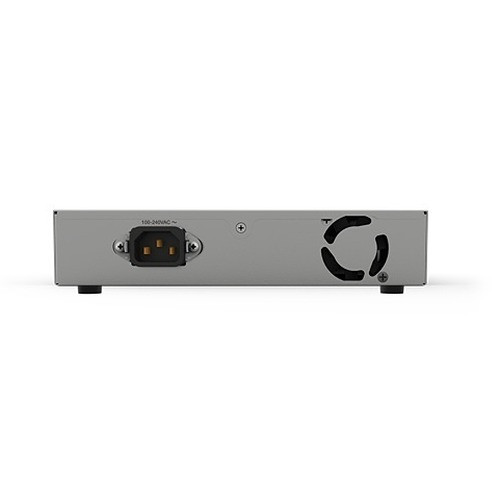
The GS970M/18PS-R-10 provides 2 x SFP uplink ports, enabling fiber or DAC-copper backbone connections without consuming access PoE ports. Its mount type is listed as both Wall and Rack, giving installers flexibility to place it inside an enclosure at a head-end or surface-mount it in a camera-dense wiring closet or junction box.
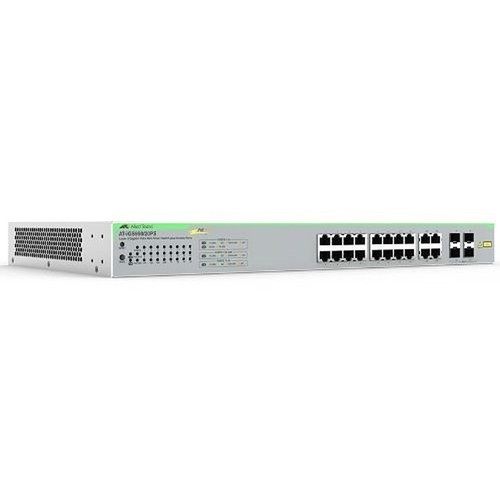
The IGS950/20PS-910 doubles the uplink count with 4 x SFP ports, which is a concrete architectural advantage for installations requiring link aggregation, redundant fiber paths, or multi-switch stacking without consuming access ports. Its mount type is listed as Rack only, making it suited to structured IDF/MDF deployments but not direct wall-mount scenarios.
For distributed surveillance runs where a switch must be mounted near a camera cluster rather than in a rack, the GS970M/18PS-R-10's dual mounting options offer an installation advantage the IGS950/20PS-910 does not share.
Which switch offers stronger management and network integration capabilities?
The GS970M/18PS-R-10 specifies Layer 3 managed switching (per its card bullet) and identifies its management platform as 'FrameworkTM Plus.' It also lists RFC 2819 RMON MIB (groups 1, 2, 3, and 9) under Ethernet Rate, indicating SNMP-based statistics collection for monitoring traffic, utilization, and error events — relevant for integrators who manage switches through a network management system alongside a VMS.
The IGS950/20PS-910 is described as a managed switch in its form factor field, but no management platform name, Layer designation, or MIB specification is provided in the supplied specifications. Whether it supports Layer 3 routing, RMON, or a named management framework cannot be stated from the available data.
Installers requiring VLAN segmentation between camera and corporate traffic, IGMP snooping for multicast streams, or SNMP polling for network operations dashboards should verify the IGS950/20PS-910's Layer 3 support and MIB coverage directly with Hanwha before specifying it in a managed-network environment.
Which should you choose: the GS970M/18PS-R-10 or the IGS950/20PS-910?
Our take: The GS970M/18PS-R-10 is the stronger choice when installation flexibility, confirmed management depth, and a clearly documented PoE budget are the deciding factors. Its 247W PoE budget is unambiguous, its FrameworkTM Plus Layer 3 management platform and RFC 2819 RMON MIB support are spec-confirmed, and its dual wall-and-rack mount makes it deployable in both structured and distributed topologies. The IGS950/20PS-910 holds a potential advantage in two areas — four SFP uplink ports versus two, and a stated 370W PoE figure versus 247W — but a direct contradiction between its 370W and 130W power values in the provided specifications means that PoE headroom advantage cannot be confirmed without consulting the published datasheet. For high-density rack deployments needing maximum fiber uplink paths and higher per-port PoE headroom, the IGS950/20PS-910 warrants further investigation; for wall-mount edge deployments or any project where spec certainty is required prior to bid, the GS970M/18PS-R-10 is the safer specification.
Side-by-Side Comparison
Spec-for-spec, from manufacturer data.
| Specification | Hanwha GS970M/18PS-R-10 | Hanwha IGS950/20PS-910 |
|---|---|---|
| SKU | HV-GS970M/18PS-R-10 | HV-IGS950/20PS-910 |
| Form Factor | Managed Switch | Managed Switch |
| Access Ports | 16 x 1GbE PoE+ | 16 x 1GbE PoE+ |
| PoE Standard | 802.3at (PoE+) | 802.3at (PoE+) |
| Aggregate PoE Budget | 247W (confirmed) | 370W stated / 130W also listed — CONFLICTING; verify datasheet |
| Avg PoE per Port (at stated budget) | ~15.4W | ~23.1W (if 370W) or ~8.1W (if 130W) — unresolved |
| SFP Uplink Ports | 2 | 4 |
| Layer | Layer 3 (per spec) | Not specified in provided specs |
| Management Platform | FrameworkTM Plus | Not specified in provided specs |
| SNMP / RMON MIB | RFC 2819 RMON groups 1,2,3,9 | — |
| Mount Type | Wall and Rack | Rack only |
| Housing Color | White | White |
| Warranty | 5-Year | 5-Year |
| Datasheet | /content/product-datasheets/HV-GS970M/18PS-R-10.pdf | /content/product-datasheets/HV-IGS950/20PS-910.pdf |
Frequently Asked Questions
Which should you choose: the GS970M/18PS-R-10 or the IGS950/20PS-910?
The GS970M/18PS-R-10 is the stronger choice when installation flexibility, confirmed management depth, and a clearly documented PoE budget are the deciding factors. Its 247W PoE budget is unambiguous, its FrameworkTM Plus Layer 3 management platform and RFC 2819 RMON MIB support are spec-confirmed, and its dual wall-and-rack mount makes it deployable in both structured and distributed topologies. The IGS950/20PS-910 holds a potential advantage in two areas — four SFP uplink ports versus two, and a stated 370W PoE figure versus 247W — but a direct contradiction between its 370W and 130W power values in the provided specifications means that PoE headroom advantage cannot be confirmed without consulting the published datasheet. For high-density rack deployments needing maximum fiber uplink paths and higher per-port PoE headroom, the IGS950/20PS-910 warrants further investigation; for wall-mount edge deployments or any project where spec certainty is required prior to bid, the GS970M/18PS-R-10 is the safer specification.
Is the GS970M/18PS-R-10 or IGS950/20PS-910 better for powering PTZ cameras and thermal imagers simultaneously?
PTZ cameras and thermal imagers often draw closer to the 802.3at ceiling of 30W per port. The IGS950/20PS-910's product description claims a 370W aggregate budget for exactly this use case, which would provide more headroom than the GS970M/18PS-R-10's confirmed 247W. However, the IGS950/20PS-910's spec sheet contains a conflicting 130W figure in the Power Watts field. Verify the actual PoE budget in Hanwha's published datasheet before committing either switch to a high-wattage deployment.
Can I wall-mount either switch in a junction box or enclosure near a camera cluster?
Only the GS970M/18PS-R-10 lists wall mount as a supported installation method. The IGS950/20PS-910 is listed as rack-mount only in the provided specifications. If the deployment requires placing a switch close to a camera cluster without access to a rack, the GS970M/18PS-R-10 is the appropriate choice.
Which switch is better for a network that uses fiber backbone and requires redundant uplink paths?
The IGS950/20PS-910 provides four SFP uplink ports, doubling the uplink capacity of the GS970M/18PS-R-10's two SFP ports. Four SFP uplinks support link aggregation, redundant fiber paths, or simultaneous connections to multiple upstream switches without consuming any of the 16 PoE access ports. For fiber-heavy or redundancy-required backbone designs, the IGS950/20PS-910 has the structural advantage — subject to confirming its PoE budget from the datasheet.
More Network Switch Comparisons
- Vivotek GEL-205A-260 vs TP-Link SL1218MP
- Vivotek GEL-205A-260 vs Allied Telesis AT-x530L-18GHXm-10
- Vivotek GEL-205A-260 vs Ubiquiti USW-LITE-16-POE
- Vivotek GEL-205A-260 vs Ubiquiti USW-16-POE
- TP-Link SL1218MP vs Allied Telesis AT-x530L-18GHXm-10
- TP-Link SL1218MP vs Ubiquiti USW-LITE-16-POE
Network Switch Buying Guides
Get a Second Opinion on Your Camera Choice
Share your site layout, coverage goals, and budget. Our team will validate the camera selection, flag anything we would change, and recommend products that match the use case.