
Epson DS-530 vs Epson A41CL16001: Specification Comparison
Both the Epson DS-530 II (B11B261202) and the Epson A41CL16001 are wired desktop document scanners aimed at office workstation use, making them a legitimate cross-shop pair for buyers evaluating throughput, connectivity, and footprint. The DS-530 II targets moderate-to-heavy document archival workflows, while the A41CL16001 is positioned as a compact, bus-powered unit for lighter departmental or personal-business scanning. This comparison covers throughput and duty cycle, connectivity and power, and physical form factor and media handling.

In This Guide
- Which scanner delivers higher throughput and daily duty cycle for your workload?
- How do the two scanners differ in connectivity standard and power delivery?
- Which unit better fits the physical space and media types required at the deployment site?
- Which should you choose: the DS-530 or the A41CL16001?
- Side-by-Side Specs
- FAQ
Which scanner delivers higher throughput and daily duty cycle for your workload?
The DS-530 II is rated at 35 pages per minute (ppm) for both color and monochrome output, with a daily duty cycle of 5,500 scans per day. These figures position it for sustained, mixed-batch document archival in moderate-to-heavy environments.
The A41CL16001 is rated at 30 documents per minute (dpm). No daily duty cycle figure is provided in the available specifications for this model. Buyers who depend on a published duty cycle ceiling to plan shift volumes cannot verify that figure from spec data alone.
On throughput alone, the DS-530 II holds a 5 ppm / dpm advantage. For high-volume or unattended batch jobs, the DS-530 II's documented 5,500-scan daily ceiling provides a concrete planning benchmark the A41CL16001 does not.
How do the two scanners differ in connectivity standard and power delivery?
The DS-530 II uses USB 3.0, which offers higher bus bandwidth than USB 2.0. It requires a powered USB port or host connection; no bus-powered operation is noted in its specifications.
The A41CL16001 uses USB 2.0 and is explicitly described as USB bus-powered, meaning it draws all operating power from the host port without a separate AC adapter. Driver support is documented as TWAIN/WIA for both Windows and macOS.
For installations where cable management and eliminating power bricks matters — laptops, shared workstations, or space-constrained desks — the A41CL16001's bus-powered design is a practical advantage. Where raw data throughput and forward bus compatibility matter, the DS-530 II's USB 3.0 interface is the stronger choice. Driver compatibility (TWAIN/WIA, OS support) is only specified for the A41CL16001; it is not enumerated in the DS-530 II's provided specs.
Which unit better fits the physical space and media types required at the deployment site?
The DS-530 II measures 6.6" x 11.6" x 6.9" and weighs 10 lb. It includes an automatic document feeder (ADF), supports color, grayscale, and monochrome scan modes, and outputs at 600 dpi. Country of origin is Indonesia.
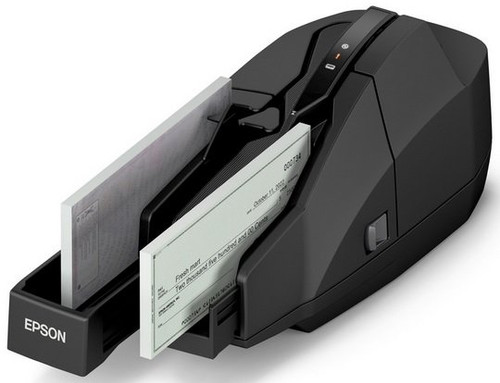
The A41CL16001 measures 17.8" x 11.8" x 9.9" — substantially larger in footprint and height — though its scanner element uses a CIS (Contact Image Sensor). Media support is described as personal and business-size checks, with a paper weight range of approximately 60–120 g/m² (16–32 lb bond). No ADF or optical resolution figure is specified in the provided data.
The DS-530 II occupies a significantly smaller footprint despite its ADF capability. The A41CL16001's larger chassis and check-media callout suggest a different primary use case (check or receipt scanning) rather than general document archival. Buyers should confirm whether an ADF is required; only the DS-530 II explicitly includes one.
Which should you choose: the DS-530 or the A41CL16001?
Our take: The DS-530 II is the stronger choice when the priority is document archival throughput in a compact desktop footprint with a documented daily capacity ceiling. It delivers 35 ppm versus the A41CL16001's 30 dpm — a 17% speed advantage — pairs that with a verified 5,500-scan daily duty cycle (no equivalent figure is available for the A41CL16001), and packages it in a 6.6" x 11.6" x 6.9" chassis versus the A41CL16001's substantially larger 17.8" x 11.8" x 9.9" envelope. Both carry a 1-year warranty. The A41CL16001 holds a meaningful edge for deployments where bus-powered operation is required — no AC adapter, no powered hub — and where check or lightweight media handling (60–120 g/m²) is the primary task. If TWAIN/WIA driver compatibility must be confirmed before purchase, only the A41CL16001 documents it explicitly in the available specs.
Side-by-Side Comparison
Spec-for-spec, from manufacturer data.
| Specification | Epson DS-530 | Epson A41CL16001 |
|---|---|---|
| Product Type | Document Scanner | Document Scanner |
| Scan Speed | 35 ppm (color and monochrome) | 30 dpm |
| Daily Duty Cycle | 5,500 scans/day | — |
| Connectivity | USB 3.0 | USB 2.0 |
| Power | — | USB bus-powered |
| Feeder | ADF (Automatic Document Feeder) | — |
| Optical Resolution | 600 dpi | — |
| Color Modes | Color, Grayscale, Monochrome | — |
| Sensor Type | — | CIS (Contact Image Sensor) |
| Driver Support | — | TWAIN/WIA (Windows and macOS) |
| Mount Type | Desktop | Desktop |
| Dimensions (W x D x H) | 6.6" x 11.6" x 6.9" | 17.8" x 11.8" x 9.9" |
| Weight | 10 lb | — |
| Media / Paper Weight | — | 60–120 g/m² (approx. 16–32 lb bond) |
| Warranty | 1-year | 1-year |
| Country of Origin | Indonesia | — |
Frequently Asked Questions
Which should you choose: the DS-530 or the A41CL16001?
The DS-530 II is the stronger choice when the priority is document archival throughput in a compact desktop footprint with a documented daily capacity ceiling. It delivers 35 ppm versus the A41CL16001's 30 dpm — a 17% speed advantage — pairs that with a verified 5,500-scan daily duty cycle (no equivalent figure is available for the A41CL16001), and packages it in a 6.6" x 11.6" x 6.9" chassis versus the A41CL16001's substantially larger 17.8" x 11.8" x 9.9" envelope. Both carry a 1-year warranty. The A41CL16001 holds a meaningful edge for deployments where bus-powered operation is required — no AC adapter, no powered hub — and where check or lightweight media handling (60–120 g/m²) is the primary task. If TWAIN/WIA driver compatibility must be confirmed before purchase, only the A41CL16001 documents it explicitly in the available specs.
Is the DS-530 II or the A41CL16001 better for a high-volume mailroom scanning checks and mixed documents all day?
The DS-530 II is the better fit for sustained all-day volume: it specifies a 5,500-scan daily duty cycle and 35 ppm throughput, and includes an ADF for batch feeding. The A41CL16001 provides no published daily duty cycle, making capacity planning uncertain. However, if the workload is primarily checks, the A41CL16001's explicit check-media support should be verified against your document dimensions before ruling it out.
Can I run either scanner off a laptop USB port without a separate power supply?
Only the A41CL16001 is specified as USB bus-powered, meaning it operates entirely from the host USB port with no AC adapter required — a practical choice for laptop or mobile-desk deployments. The DS-530 II does not have a bus-powered specification in the provided data, so a powered connection or AC supply should be assumed.
Which scanner takes up less desk space?
The DS-530 II is considerably more compact: 6.6" x 11.6" x 6.9" versus the A41CL16001's 17.8" x 11.8" x 9.9". Despite its smaller footprint, the DS-530 II includes an ADF. The A41CL16001's larger chassis may reflect its check/media-handling design rather than a general document-archival use case.
More Barcode Scanner Comparisons
- Zebra DS8108-SR vs Zebra DS8108-SR
- Zebra DS8108-SR vs Zebra DS8108-HC
- Datalogic 931061345 vs Datalogic 931024111-00053
- Datalogic 931061335 vs Datalogic 931061345
- Datalogic 931061335 vs Datalogic 931024111-00053
- Datalogic 957022201-00053 vs Datalogic 931061345
Barcode Scanner Buying Guides
Get a Second Opinion on Your Camera Choice
Share your site layout, coverage goals, and budget. Our team will validate the camera selection, flag anything we would change, and recommend products that match the use case.