
CyberPower PR2000RT2UC vs CyberPower CP2000PFCRM2U: Specification Comparison
Both units are 2000VA, 2U rackmount, line-interactive sine wave UPS systems from CyberPower targeting small-to-mid server room and network closet installations on 120V North American circuits. They share the same outlet type (NEMA 5-20R) and form factor, making them natural cross-shop candidates. Key divergence points are real watt capacity, input voltage window, surge suppression rating, and management depth — all of which carry significant weight for uptime-critical deployments.
In This Guide
- Which UPS delivers more usable power and how wide is its input voltage tolerance?
- What runtime can each UPS deliver, and how are the batteries managed?
- How do the two units compare on surge protection, management interfaces, and monitoring capabilities?
- Which should you choose: the PR2000RT2UC or the CP2000PFCRM2U?
- Side-by-Side Specs
- FAQ
Which UPS delivers more usable power and how wide is its input voltage tolerance?
The PR2000RT2UC is rated at 2000W output (power factor 1.0), meaning its full 2000VA translates directly to 2000W of real load capacity. The CP2000PFCRM2U carries a 0.6 output power factor, yielding only 1200W from the same 2000VA nameplate — a 40% reduction in usable wattage that matters immediately when sizing against a server or switch load.
Input voltage tolerance is equally divergent. The PR2000RT2UC accepts 75–149V, a 74V window that provides substantial headroom against browndowns and line sags common in older facilities. The CP2000PFCRM2U narrows that window to 82–144V (a 62V range). For sites with chronic undervoltage below 82V, the PR2000RT2UC will ride through on line power where the CP2000PFCRM2U would switch to battery. Input frequency acceptance also differs: PR2000RT2UC handles 47–63Hz versus the CP2000PFCRM2U's tighter 57–63Hz window.
What runtime can each UPS deliver, and how are the batteries managed?
The CP2000PFCRM2U provides explicit, spec-sheet runtime figures: 9 minutes at half load (600W) and 2.2 minutes at full load (1200W), using two internal 12V/9Ah sealed lead-acid batteries. Its batteries are hot-swappable and user-replaceable without powering down the load — a meaningful operational advantage in 24/7 environments.
The PR2000RT2UC spec sheet provided does not state runtime figures, battery chemistry, battery capacity (Ah), or whether batteries are hot-swappable. Buyers requiring a guaranteed runtime figure or confirmed hot-swap capability cannot derive those values from the available PR2000RT2UC specifications and should consult the manufacturer datasheet directly before committing.
How do the two units compare on surge protection, management interfaces, and monitoring capabilities?
Surge suppression favors the PR2000RT2UC at 2430J versus the CP2000PFCRM2U's 1500J — a 62% higher joule rating that offers greater margin against transient events. The PR2000RT2UC also specifies EMI/RFI noise filtering and a noise level of 55.5dB; equivalent figures are not provided for the CP2000PFCRM2U.
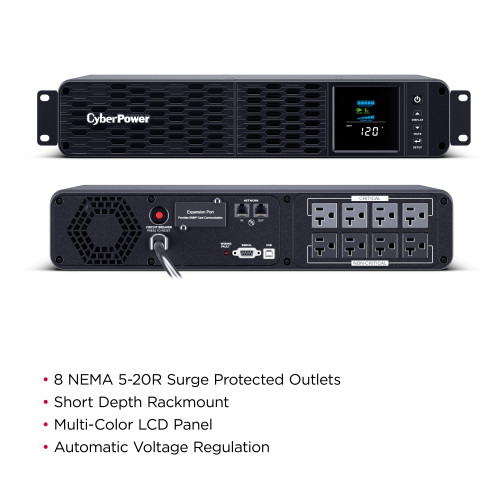
Management depth favors the CP2000PFCRM2U. It includes a multifunction color LCD display, USB, serial DB9, a dry-contact relay port, and an optional SNMP card slot for network management integration. The CP2000PFCRM2U also includes RJ45 Ethernet (10/100/1000) data-line surge protection. The PR2000RT2UC's model name references 'Cloud' management, but the provided spec sheet does not detail cloud management features, display type, or network card expansion. Certifications are documented only for the CP2000PFCRM2U: UL1778, FCC Class B, RoHS, and Energy Star. No certification data is supplied for the PR2000RT2UC.
Which should you choose: the PR2000RT2UC or the CP2000PFCRM2U?
Our take: The PR2000RT2UC is the stronger choice when real watt capacity and input voltage tolerance are the deciding factors. Its 2000W true output (power factor 1.0) versus the CP2000PFCRM2U's 1200W (power factor 0.6) means it can support 67% more actual load on the same VA nameplate — critical when powering high-density servers or PoE switches. Its wider input window (75–149V versus 82–144V) also reduces unnecessary battery cycling on marginal utility power. However, the CP2000PFCRM2U offers concrete runtime data (9 min at 600W), confirmed hot-swap batteries, a color LCD, an SNMP expansion slot, and documented certifications (UL1778, Energy Star) — none of which are confirmed in the PR2000RT2UC spec sheet provided. For managed IT environments requiring verifiable runtime budgets, network monitoring integration, and maintenance-friendly battery replacement, the CP2000PFCRM2U's management feature set warrants serious consideration despite its lower watt ceiling.
Side-by-Side Comparison
Spec-for-spec, from manufacturer data.
| Specification | CyberPower PR2000RT2UC | CyberPower CP2000PFCRM2U |
|---|---|---|
| Topology | Line-Interactive | Line-Interactive with AVR |
| Capacity (VA) | 2000 VA | 2000 VA |
| Capacity (Watts) | 2000 W | 1200 W |
| Output Power Factor | 1.0 | 0.6 |
| Form Factor | 2U Rackmount | 2U Rackmount (19-in EIA) |
| Output Waveform | Sine Wave | Pure Sine Wave |
| Input Voltage Range | 75–149 V | 82–144 V (120 VAC nominal) |
| Input Frequency | 47–63 Hz | 57–63 Hz |
| Output Voltage | 120 V | 120 VAC ± 5% |
| Outlets | 8 x NEMA 5-20R | 8 x NEMA 5-20R |
| Cord Length / Plug | 10 ft cord | 6 ft, NEMA 5-20P |
| Surge Energy Rating | 2430 J | 1500 J |
| Runtime at Half Load | — | 9 min @ 600W |
| Runtime at Full Load | — | 2.2 min @ 1200W |
| Battery | — | 2 x 12V/9Ah SLA, hot-swappable |
| Management Interfaces | — | USB, Serial DB9, SNMP slot (optional), dry contact |
| Display | — | Multifunction color LCD |
| Data Line Protection | — | RJ45 10/100/1000 Ethernet |
| EMI/RFI Filtering | Yes | — |
| Noise Level | 55.5 dB | — |
| Response Time | 6 ms | — |
| Heat Dissipation | 124.5 BTU/h | — |
| Certifications | — | UL1778, FCC Class B, RoHS, Energy Star |
| Operating Temperature | — | 32–104°F (0–40°C) |
| Weight | — | 28.68 lb |
| Dimensions (W x H x D) | — | 17.05 x 3.39 x 10.79 in |
Frequently Asked Questions
Which should you choose: the PR2000RT2UC or the CP2000PFCRM2U?
The PR2000RT2UC is the stronger choice when real watt capacity and input voltage tolerance are the deciding factors. Its 2000W true output (power factor 1.0) versus the CP2000PFCRM2U's 1200W (power factor 0.6) means it can support 67% more actual load on the same VA nameplate — critical when powering high-density servers or PoE switches. Its wider input window (75–149V versus 82–144V) also reduces unnecessary battery cycling on marginal utility power. However, the CP2000PFCRM2U offers concrete runtime data (9 min at 600W), confirmed hot-swap batteries, a color LCD, an SNMP expansion slot, and documented certifications (UL1778, Energy Star) — none of which are confirmed in the PR2000RT2UC spec sheet provided. For managed IT environments requiring verifiable runtime budgets, network monitoring integration, and maintenance-friendly battery replacement, the CP2000PFCRM2U's management feature set warrants serious consideration despite its lower watt ceiling.
I'm powering a 1800W server rack — which unit can actually handle that load?
Only the PR2000RT2UC can. Its power factor of 1.0 means all 2000VA translates to 2000W of real capacity, comfortably above an 1800W load. The CP2000PFCRM2U's 0.6 power factor limits it to 1200W of real output; an 1800W load would exceed its rated capacity and could trigger overload protection or damage connected equipment.
Which UPS gives me longer runtime and easier battery replacement?
The CP2000PFCRM2U is the only model with published runtime specs: 9 minutes at 600W and 2.2 minutes at 1200W, using two 12V/9Ah hot-swappable, user-replaceable batteries. The PR2000RT2UC's provided specifications include no runtime figures, battery Ah rating, or hot-swap confirmation, so a direct runtime comparison cannot be made from the available data.
Which unit integrates better with network monitoring and DCIM tools?
The CP2000PFCRM2U is better documented for network management: it includes USB, serial DB9, a dry-contact relay, an optional SNMP card slot, and RJ45 Ethernet data-line protection. The PR2000RT2UC's name references 'Cloud' management, but no cloud management interface, SNMP capability, or display type is confirmed in the provided spec sheet. Buyers requiring verified SNMP/NMS integration should confirm PR2000RT2UC management features with CyberPower before purchasing.
More UPS Comparisons
- APC by Schneider Electric SMX2000LV vs CyberPower PR2000RTXL2UC
- APC by Schneider Electric SMX2000LV vs CyberPower CP2000PFCRM2U
- APC by Schneider Electric SMX2000LV vs CyberPower PR2000RT2UCN
- APC by Schneider Electric SMX2000LV vs Middle Atlantic UPX-EXPANRUN-OL20
- APC by Schneider Electric SMX2000LV vs APC by Schneider Electric SMX2000LVNCUS
- APC by Schneider Electric SMX2000LV vs APC by Schneider Electric SMX2000RMLV2U
UPS Buying Guides
Get a Second Opinion on Your Camera Choice
Share your site layout, coverage goals, and budget. Our team will validate the camera selection, flag anything we would change, and recommend products that match the use case.