
APC by Schneider Electric SMX2000LV vs APC by Schneider Electric SMX2000LVNCUS: Specification Comparison
Both units are APC Smart-UPS X 2000VA Line-Interactive rack/tower UPS systems designed for IT infrastructure protection at 120V AC. The SMX2000LV is the standard commercial variant while the SMX2000LVNCUS carries TAA (Trade Agreements Act) compliance for federal and government procurement. Both share the same 1800W/1920VA rating and sine-wave output, making them direct cross-shop candidates for installers and IT buyers evaluating power protection for server rooms, network closets, or security head-end equipment.
In This Guide
- How do the two units compare on power capacity, runtime extension, and battery specifications?
- What management interfaces, communication ports, and software integration does each unit provide?
- How do form factor, acoustic output, operating environment, and compliance differ between the two models?
- Which should you choose: the SMX2000LV or the SMX2000LVNCUS?
- Side-by-Side Specs
- FAQ
How do the two units compare on power capacity, runtime extension, and battery specifications?
Both the SMX2000LV and SMX2000LVNCUS are rated identically at 1800W / 1920VA output capacity with a sine-wave waveform, so neither unit outperforms the other at the nameplate level. The SMX2000LV spec sheet provides significantly more battery detail: the internal pack delivers 690 VAh of runtime capacity at a 229W load rating, uses a Lead-Acid battery (replacement: APCRBC143) with a 3–5 year expected life, and recharges in approximately 3 hours. Critically, the SMX2000LV documents a full external battery module (EBM) expansion path — up to 10 SMX120BP modules scaling runtime from 2,070 VAh (1 module) to 14,490 VAh (10 modules).
The SMX2000LVNCUS specification does not disclose battery chemistry, internal VAh rating, recharge time, replacement battery part number, battery life expectancy, or EBM expansion options. Buyers who need to plan runtime budgets, maintenance intervals, or extended-runtime configurations must rely on the SMX2000LV data or seek supplemental documentation for the NCUS variant. The SMX2000LVNCUS does confirm Automatic Voltage Regulation (AVR) with a wide 70–153V input operating window, a spec absent from the SMX2000LV data provided. Both units list 50/60 Hz input frequency compatibility.
What management interfaces, communication ports, and software integration does each unit provide?
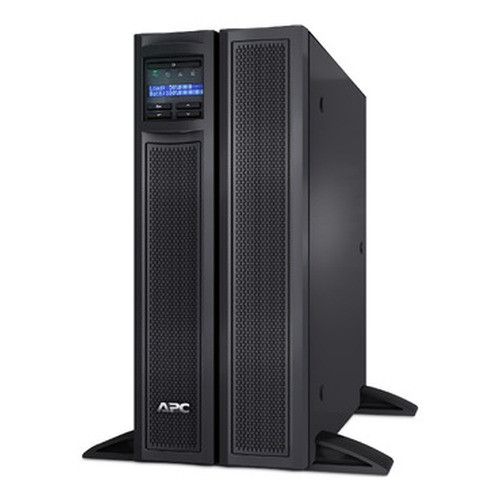
The SMX2000LV specification is comprehensive on management: it includes a USB (HID-compliant) port, a DB9 RS-232 serial port, one SmartSlot expansion bay for optional network management cards, and an EPO (Emergency Power Off) contact closure. The front panel combines an LCD display showing UPS status, load, battery state, and diagnostics alongside LED indicators for online, on-battery, replace-battery, overload, and fault states. Controls include power on/off, menu navigation, self-test, and alarm silence. Remote monitoring, SNMP/web management, firmware updates, and event logging are all supported once an optional Network Management Card (sold separately) is installed. APC PowerChute Network Shutdown is listed as compatible software.
The SMX2000LVNCUS specification confirms web-based management as a built-in feature and lists auto-restart capability. However, it does not enumerate specific physical communication ports (USB, RS-232, SmartSlot), does not name compatible software packages, and does not detail front-panel controls or display type. Installers integrating into monitored environments — particularly those requiring SNMP traps, PowerChute, or EPO wiring — cannot confirm those capabilities from the NCUS spec data alone and should obtain the full datasheet before specifying this unit.
How do form factor, acoustic output, operating environment, and compliance differ between the two models?
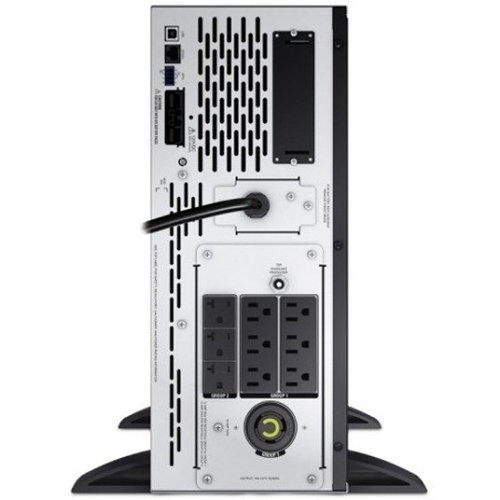
The SMX2000LV occupies 4U of rack space, weighs 85.0 lbs (38.64 kg), and measures 432 mm wide (standard 19-inch rack). Shipped dimensions are 13.0 × 23.06 × 24.94 inches. Acoustic output is 55 dBA, heat dissipation is 203 Btu/h, and the unit operates from 0–10,000 ft altitude, 0–95% relative humidity (non-condensing). Storage temperature spans 5–113°F (−15–45°C) and storage altitude reaches 50,000 ft. Input harmonic distortion is specified at less than 5%. Transfer time is 2–4 ms (4 ms typical, 8 ms maximum).
The SMX2000LVNCUS lists 55 dB noise level and a 540 J surge energy rating — neither figure appears in the SMX2000LV data provided. Output voltage THD is stated as 5%, consistent with the SMX2000LV's 'less than 5%' harmonic distortion figure. Physical dimensions, weight, rack unit count, heat dissipation, altitude, humidity, and transfer time are not disclosed in the NCUS specification. The defining differentiator of the NCUS variant is its TAA compliance designation, which is mandatory for sales to U.S. federal agencies, GSA Schedule orders, and many state/local government contracts. No TAA claim is made for the SMX2000LV.
Which should you choose: the SMX2000LV or the SMX2000LVNCUS?
Our take: The SMX2000LV is the stronger choice for commercial installations where runtime planning, battery expansion, and management depth are primary concerns; the SMX2000LVNCUS is the required choice for government and TAA-mandated procurement. On power protection, both units are electrically equivalent at 1800W / 1920VA with sine-wave output and 55 dB acoustics. The SMX2000LV's specifications, however, disclose a 690 VAh internal battery, a 3-hour recharge time, and an EBM expansion path reaching 14,490 VAh across 10 modules — none of which are documented for the NCUS model. The SMX2000LV also confirms USB, RS-232, SmartSlot, and EPO interfaces plus PowerChute compatibility, whereas the NCUS spec only confirms web-based management and auto-restart. The SMX2000LVNCUS adds a documented 540 J surge rating and a wide 70–153V AVR input window not present in the SMX2000LV data. Specify the NCUS for federal, GSA, or TAA-required projects; specify the SMX2000LV for commercial deployments where extended runtime and full management integration must be verified against published specifications.
Side-by-Side Comparison
Spec-for-spec, from manufacturer data.
| Specification | APC by Schneider Electric SMX2000LV | APC by Schneider Electric SMX2000LVNCUS |
|---|---|---|
| UPS Topology | Line-Interactive | Line-Interactive |
| Rated Output Power (VA) | 1920 VA | 1.92 kVA (1920 VA) |
| Rated Output Power (W) | 1800 W | 1800 W |
| Waveform | Sine wave | Sine |
| Input Voltage (Main) | 120V | — |
| Input Voltage Operating Range | 100–127V (other) | 70–153V (AVR range) |
| Input Connection | NEMA 5-20P | — |
| Output Connections | (6) NEMA 5-15R, (3) NEMA 5-20R, (1) NEMA L5-20R | NEMA 5-15R, NEMA 5-20R, NEMA L5-20R |
| Transfer Time | 2–4 ms (8 ms max) | — |
| Surge Energy Rating | — | 540 J |
| Internal Battery Capacity | 690 VAh | — |
| Battery Recharge Time | 3 hours | — |
| Battery Life Expectancy | 3–5 years | — |
| EBM Expansion (max) | 14,490 VAh (10× SMX120BP) | — |
| Management Interfaces | USB (HID), RS-232 DB9, SmartSlot, EPO | Web-based management (ports not specified) |
| TAA Compliant | No (not stated) | Yes |
| Acoustic Output | 55 dBA | 55 dB |
| Form Factor / Rack Units | Rack/Tower, 4U | Rack/Tower (rack units not specified) |
| Weight | 85.0 lbs (38.64 kg) | — |
| AVR | — | Yes |
| Output Voltage THD | Less than 5% | 5% |
| Compatible Software | APC PowerChute Network Shutdown | — |
Frequently Asked Questions
Which should you choose: the SMX2000LV or the SMX2000LVNCUS?
The SMX2000LV is the stronger choice for commercial installations where runtime planning, battery expansion, and management depth are primary concerns; the SMX2000LVNCUS is the required choice for government and TAA-mandated procurement. On power protection, both units are electrically equivalent at 1800W / 1920VA with sine-wave output and 55 dB acoustics. The SMX2000LV's specifications, however, disclose a 690 VAh internal battery, a 3-hour recharge time, and an EBM expansion path reaching 14,490 VAh across 10 modules — none of which are documented for the NCUS model. The SMX2000LV also confirms USB, RS-232, SmartSlot, and EPO interfaces plus PowerChute compatibility, whereas the NCUS spec only confirms web-based management and auto-restart. The SMX2000LVNCUS adds a documented 540 J surge rating and a wide 70–153V AVR input window not present in the SMX2000LV data. Specify the NCUS for federal, GSA, or TAA-required projects; specify the SMX2000LV for commercial deployments where extended runtime and full management integration must be verified against published specifications.
Which model do I need for a federal government or GSA contract purchase?
The SMX2000LVNCUS is the TAA-compliant variant and is required for U.S. federal agency purchases, GSA Schedule orders, and any procurement governed by the Trade Agreements Act. The SMX2000LV does not carry a TAA compliance designation in the specifications provided.
Can I add external battery modules to extend runtime on either unit?
The SMX2000LV specification explicitly documents compatibility with SMX120BP external battery modules, scaling from 2,070 VAh (1 module) up to 14,490 VAh (10 modules). The SMX2000LVNCUS specification does not disclose EBM compatibility or expansion options. Buyers requiring documented extended-runtime capability should verify this against APC's full NCUS datasheet before specifying that model.
Does the SMX2000LVNCUS support the same management ports and software as the SMX2000LV?
The SMX2000LV specification confirms USB (HID), RS-232 DB9, SmartSlot, EPO contact closure, and APC PowerChute Network Shutdown compatibility. The SMX2000LVNCUS specification only confirms web-based management and auto-restart; it does not enumerate physical ports, SmartSlot availability, or compatible software packages. Installers requiring confirmed SNMP, PowerChute, or EPO support on the NCUS model should consult the full APC product datasheet for that SKU.
More UPS Comparisons
- APC by Schneider Electric SMX2000LV vs CyberPower PR2000RTXL2UC
- APC by Schneider Electric SMX2000LV vs CyberPower CP2000PFCRM2U
- APC by Schneider Electric SMX2000LV vs CyberPower PR2000RT2UCN
- APC by Schneider Electric SMX2000LV vs Middle Atlantic UPX-EXPANRUN-OL20
- APC by Schneider Electric SMX2000LV vs APC by Schneider Electric SMX2000RMLV2U
- CyberPower PR2000RTXL2UC vs Middle Atlantic UPX-EXPANRUN-OL20
UPS Buying Guides
Get a Second Opinion on Your Camera Choice
Share your site layout, coverage goals, and budget. Our team will validate the camera selection, flag anything we would change, and recommend products that match the use case.