
APC by Schneider Electric SMX2000LV vs CyberPower CP2000PFCRM2U: Specification Comparison
Both the APC SMX2000LV and CyberPower CP2000PFCRM2U are rack-mountable, line-interactive UPS units in the 2000VA class designed for IT infrastructure, telecommunications, and security system applications. This comparison evaluates their power delivery and output receptacle configurations, physical footprint and battery characteristics, and management and integration capabilities — the three dimensions that most directly drive a purchasing decision for a B2B installer or IT buyer deploying critical infrastructure protection.
In This Guide
- Which UPS delivers more usable power and how do their output configurations differ?
- How do the two units compare on battery capacity, runtime, and expansion options?
- Which unit offers more comprehensive monitoring, management, and platform integration?
- Which should you choose: the SMX2000LV or the CP2000PFCRM2U?
- Side-by-Side Specs
- FAQ
Which UPS delivers more usable power and how do their output configurations differ?
The APC SMX2000LV is rated at 1800W / 1920VA with an output power factor of approximately 0.94 (1800W ÷ 1920VA). The CyberPower CP2000PFCRM2U is rated at 1200W / 2000VA, yielding an output power factor of 0.60. For loads that draw real power (watts), the APC unit supports 50% more wattage — 1800W versus 1200W — despite its slightly lower VA rating. Buyers powering dense server or camera-system loads should weigh watts, not VA alone.
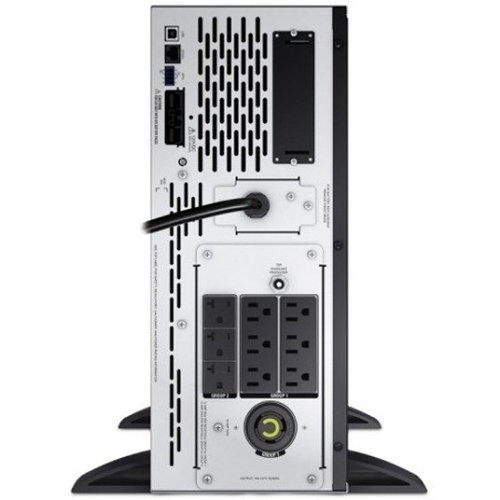
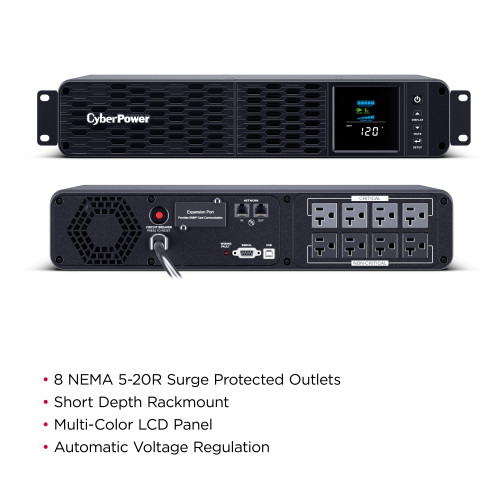
On the output receptacle side, the SMX2000LV provides ten outlets: six NEMA 5-15R, three NEMA 5-20R, and one NEMA L5-20R twist-lock, giving mixed 15A and 20A coverage plus a locking outlet. The CP2000PFCRM2U provides eight NEMA 5-20R outlets exclusively. The APC unit also ships with an NEMA 5-20P input plug on an 8 ft cord; the CyberPower ships with the same plug type but on a 6 ft cord. Neither unit ships with a hardwire input option per the provided specs.
The APC unit specifies that its output frequency syncs to mains at 50/60 Hz ±3 Hz. The CyberPower specifies an input frequency acceptance range of 57–63 Hz but does not state output frequency tolerance in the provided spec data. The APC spec confirms pure sine wave output; the CyberPower spec also confirms pure sine wave (PFC Sinewave series). Both are suitable for active PFC power supplies.
How do the two units compare on battery capacity, runtime, and expansion options?
The SMX2000LV ships with an internal battery rated at 690 VAh and 229W, with a typical recharge time of 3 hours and a stated battery life of 3–5 years. At its rated 1800W full load, APC does not publish a runtime figure in the provided specs; runtime at lower loads is not stated either. Critically, the SMX2000LV supports external battery module expansion via up to 10 SMX120BP packs, scaling runtime capacity from 2,070 VAh (1 module) up to 14,490 VAh (10 modules) — a significant differentiator for applications requiring extended runtime.
The CP2000PFCRM2U ships with two internal 12V/9Ah sealed lead-acid batteries (216 VAh total). Published runtime figures are 9 minutes at 600W (half load) and 2.2 minutes at 1200W (full load). The spec data does not document any external battery expansion capability. Battery replacement is described as hot-swappable and user-replaceable — a maintenance advantage not explicitly confirmed for the APC in the provided specs.
The APC unit specifies replacement battery model APCRBC143. The CyberPower unit's replacement battery model is not stated in the provided spec data. For deployments where runtime beyond single-digit minutes is required — surveillance DVRs, network switches, access control panels — the APC's extensible architecture provides a clear path that the CyberPower, based on available specs, does not.
Which unit offers more comprehensive monitoring, management, and platform integration?
The SMX2000LV includes a USB (HID-compliant) port, a DB9 RS-232 serial port, one SmartSlot for an optional network management card, and an EPO (Emergency Power Off) contact closure. With an optional network management card installed, the unit supports SNMP/web monitoring, remote access, firmware updates, event logging, and APC PowerChute Network Shutdown software integration. The front panel provides a multi-function LCD combined with five LED status indicators and physical controls for power on/off, menu navigation, self-test, and alarm silence.
The CP2000PFCRM2U includes a USB port, a DB9 serial port with one dry contact relay, and an optional SNMP card slot. It also includes RJ45 10/100/1000 Ethernet data line surge protection — a feature not listed for the SMX2000LV in the provided specs. The front panel is described as a multifunction color LCD. Management software compatibility, event logging, and remote access capabilities beyond the optional SNMP card are not specified in the provided data.
The SMX2000LV carries certifications and compliance details that are not enumerated in the provided APC spec data. The CyberPower unit lists UL1778, FCC Class B, RoHS, and Energy Star. The SMX2000LV also specifies an acoustic noise level of 55 dBA, heat dissipation of 203 Btu/h, and an operating altitude up to 10,000 ft — environmental parameters not provided for the CyberPower. APC's EPO contact closure is relevant to data center and IDF/MDF closet deployments requiring coordinated shutdown capability.
Which should you choose: the SMX2000LV or the CP2000PFCRM2U?
Our take: The SMX2000LV is the stronger choice when real-watt capacity and long-term runtime scalability are the primary requirements. It delivers 1800W versus the CP2000PFCRM2U's 1200W — a 50% wattage advantage — and supports up to 10 external battery modules that can extend runtime to 14,490 VAh, while the CyberPower provides no documented expansion path and ships with only 216 VAh of internal capacity (runtime: 9 minutes at 600W). The SMX2000LV also occupies 4U versus the CyberPower's 2U, weighs 85 lb versus 28.68 lb, and costs more rack space and installation effort. The CP2000PFCRM2U is the more practical choice where rack space is constrained, loads stay under 1200W, hot-swap battery maintenance simplicity matters, and an Energy Star certification is required. APC's SmartSlot ecosystem and PowerChute integration give the SMX2000LV the edge in managed enterprise and physical-security server environments; the CyberPower suits lighter-duty edge or branch deployments.
Side-by-Side Comparison
Spec-for-spec, from manufacturer data.
| Specification | APC by Schneider Electric SMX2000LV | CyberPower CP2000PFCRM2U |
|---|---|---|
| UPS Topology | Line Interactive | Line Interactive with AVR |
| Output Waveform | Sine wave | Pure Sine Wave |
| Rated Capacity (VA) | 1920 VA | 2000 VA |
| Rated Capacity (W) | 1800 W | 1200 W |
| Output Power Factor | ~0.94 (derived) | 0.60 |
| Input Plug | NEMA 5-20P | NEMA 5-20P |
| Input Cord Length | 8 ft (2.44 m) | 6 ft |
| Output Receptacles | (6) NEMA 5-15R, (3) NEMA 5-20R, (1) NEMA L5-20R | (8) NEMA 5-20R |
| Form Factor | 4U Rack/Tower | 2U Rack |
| Weight | 85.0 lb (38.64 kg) | 28.68 lb |
| Battery Type | Sealed Lead-Acid | Sealed Lead-Acid (2 x 12V/9Ah) |
| Internal Battery Capacity | 690 VAh / 229 W rated | 216 VAh (derived: 2 × 12V × 9Ah) |
| Runtime at Half Load | Not stated in provided specs | 9 min at 600W |
| External Battery Expansion | Yes — SMX120BP modules (up to 10 packs) | Not stated in provided specs |
| Hot-Swap Battery | Not stated in provided specs | Yes |
| Battery Recharge Time | 3 hours | Not stated in provided specs |
| Management Interfaces | USB, RS-232, SmartSlot (optional NMC), EPO | USB, Serial DB9, SNMP slot (optional) |
| Data Line Protection | Not stated in provided specs | RJ45 10/100/1000 Ethernet |
| Acoustic Noise | 55 dBA | Not stated in provided specs |
| Operating Temperature | Not stated in provided specs | 32–104°F (0–40°C) |
| Certifications | Not stated in provided specs | UL1778, FCC Class B, RoHS, Energy Star |
Frequently Asked Questions
Which should you choose: the SMX2000LV or the CP2000PFCRM2U?
The SMX2000LV is the stronger choice when real-watt capacity and long-term runtime scalability are the primary requirements. It delivers 1800W versus the CP2000PFCRM2U's 1200W — a 50% wattage advantage — and supports up to 10 external battery modules that can extend runtime to 14,490 VAh, while the CyberPower provides no documented expansion path and ships with only 216 VAh of internal capacity (runtime: 9 minutes at 600W). The SMX2000LV also occupies 4U versus the CyberPower's 2U, weighs 85 lb versus 28.68 lb, and costs more rack space and installation effort. The CP2000PFCRM2U is the more practical choice where rack space is constrained, loads stay under 1200W, hot-swap battery maintenance simplicity matters, and an Energy Star certification is required. APC's SmartSlot ecosystem and PowerChute integration give the SMX2000LV the edge in managed enterprise and physical-security server environments; the CyberPower suits lighter-duty edge or branch deployments.
Can the SMX2000LV or CP2000PFCRM2U power more equipment at full load?
The SMX2000LV supports up to 1800W of real load; the CP2000PFCRM2U supports up to 1200W. If your connected equipment draws more than 1200W, the CyberPower will overload and the APC is the only option of the two. Always calculate your load in watts, not VA, especially when powering servers or IP cameras with active PFC power supplies.
Which unit is easier to maintain in a production environment?
The CP2000PFCRM2U explicitly specifies hot-swappable, user-replaceable batteries, which allows a technician to swap cells without powering down connected equipment. The SMX2000LV spec data does not use the term 'hot-swap' for its internal battery; however, it supports external runtime extension via SMX120BP battery modules. For minimizing downtime during battery service, the CyberPower's documented hot-swap capability is a meaningful operational advantage.
Is the SMX2000LV or CP2000PFCRM2U better for larger deployments requiring centralized monitoring?
The SMX2000LV has a more documented management ecosystem: USB, RS-232, SmartSlot for an optional network management card, EPO contact closure, and compatibility with APC PowerChute Network Shutdown and SNMP/web monitoring solutions. The CP2000PFCRM2U also offers USB, serial, and an optional SNMP card slot, but its management software ecosystem and remote-access feature set are not detailed in the provided specs. For large-scale deployments already using APC infrastructure management tools, the SMX2000LV integrates more directly.
More UPS Comparisons
- APC by Schneider Electric SMX2000LV vs CyberPower PR2000RTXL2UC
- APC by Schneider Electric SMX2000LV vs CyberPower PR2000RT2UCN
- APC by Schneider Electric SMX2000LV vs Middle Atlantic UPX-EXPANRUN-OL20
- APC by Schneider Electric SMX2000LV vs APC by Schneider Electric SMX2000LVNCUS
- APC by Schneider Electric SMX2000LV vs APC by Schneider Electric SMX2000RMLV2U
- CyberPower PR2000RTXL2UC vs Middle Atlantic UPX-EXPANRUN-OL20
UPS Buying Guides
Get a Second Opinion on Your Camera Choice
Share your site layout, coverage goals, and budget. Our team will validate the camera selection, flag anything we would change, and recommend products that match the use case.