
CyberPower PR2000RT2UC vs APC by Schneider Electric SMX2000LV: Specification Comparison
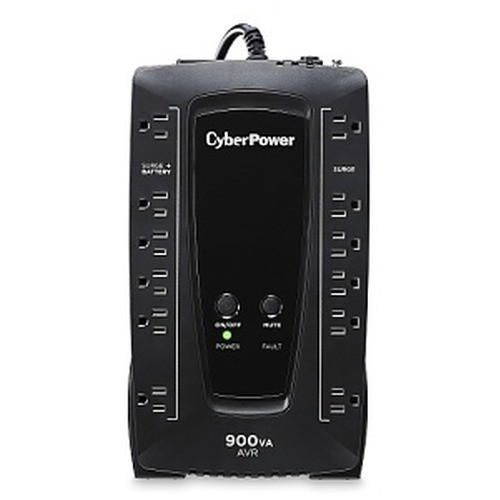
Both the CyberPower PR2000RT2UC and APC SMX2000LV are rack/tower line-interactive sine wave UPS units targeting the 2000VA class for small-to-mid data center, IT closet, and physical-security head-end applications. The CyberPower is rated 2000VA/2000W at 2U, while the APC is rated 1920VA/1800W at 4U. This comparison evaluates their power delivery and efficiency, battery runtime and expandability, and management and integration capabilities.
In This Guide
- Which UPS delivers more usable watts and handles input voltage swings better?
- Which unit offers more runtime, and how easily can it be extended?
- Which unit provides richer monitoring, remote management, and software integration?
- Which should you choose: the PR2000RT2UC or the SMX2000LV?
- Side-by-Side Specs
- FAQ
Which UPS delivers more usable watts and handles input voltage swings better?
The CyberPower PR2000RT2UC is rated at 2000W output with a power factor of 1.0, meaning every volt-amp translates directly to a watt of usable power. The APC SMX2000LV is rated at 1800W output from a 1920VA capacity, yielding a power factor of approximately 0.94. For a load-heavy rack — dense PoE switches, NVRs, or edge servers — the CyberPower's 200W advantage is concrete headroom.
On input voltage tolerance, the CyberPower spec lists an operating range of 75–149V, a span of 74V. The APC spec does not explicitly state a minimum/maximum input voltage range; it lists supported voltages of 100V, 110V, 120V, and 127V but provides no low-cutoff figure. Buyers running circuits in older facilities or regions with known voltage sag cannot directly compare buck/boost range from the provided APC spec.
Transfer time also differs: the CyberPower specifies 6ms response time. The APC lists 2–4ms typical with an 8ms maximum. Both are within safe limits for modern ATX and server power supplies, but the APC's best-case transfer is faster.
Which unit offers more runtime, and how easily can it be extended?
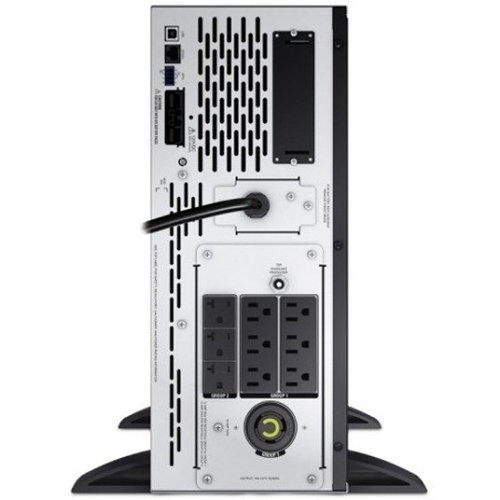
The APC SMX2000LV ships with an internal battery rated at 690VAh and a typical recharge time of 3 hours; battery life is specified at 3–5 years with replacement unit APCRBC143. Critically, APC publishes a documented external battery expansion path: up to 10 SMX120BP packs, scaling from 2,070VAh (1 pack) to 14,490VAh (10 packs). This is a named, quantified expandability spec — directly relevant to deployments requiring 30-plus minutes of runtime.
The CyberPower PR2000RT2UC spec as provided does not include an internal battery capacity figure (VAh), a recharge time, a battery replacement part number, or an external battery expansion option. Buyers who need to calculate or extend runtime cannot do so from the available CyberPower spec data.
For installations where UPS runtime is a primary procurement criterion — such as security head-ends that must sustain recording and access control during extended outages — the APC's documented 690VAh baseline and published expansion modules give it a verifiable advantage on this axis.
Which unit provides richer monitoring, remote management, and software integration?
The APC SMX2000LV includes a USB (HID-compliant) port, a DB9 RS-232 serial port, an EPO (Emergency Power Off) contact closure, and one SmartSlot for an optional network management card. With a card installed, the unit supports SNMP, web monitoring, APC PowerChute Network Shutdown, remote access, firmware updates, and event logging. The front panel provides a multi-function LCD display showing load, battery, voltage, and diagnostics, plus LED status indicators.
The CyberPower PR2000RT2UC spec references 'Cloud' capability in its product name and confirms EMI/RFI filtering and audible alarms, but the provided spec sheet does not enumerate communication ports, software compatibility, network management options, or display type. No USB, serial, SNMP, or management card slot is documented in the supplied data.
For IT and physical-security deployments requiring integration with NMS platforms, building management systems, or remote shutdown software, the APC's fully documented interface stack is a concrete, verifiable advantage over what the CyberPower spec discloses.
Which should you choose: the PR2000RT2UC or the SMX2000LV?
Our take: The PR2000RT2UC is the stronger choice when raw watt output and compact rack footprint are the primary concerns: it delivers 2000W at unity power factor versus the SMX2000LV's 1800W, and occupies 2U versus 4U — meaningful in dense 1U/2U server or NVR racks. Its input range of 75–149V is explicitly specified; the APC's equivalent range is not provided. However, the SMX2000LV leads on every other decision axis supported by the provided specs: its 690VAh internal battery is documented, its recharge time is 3 hours, its expansion path scales to 14,490VAh across 10 external packs, and its management stack (USB, RS-232, SmartSlot, EPO, LCD, PowerChute, SNMP-ready) is fully specified. The CyberPower spec supplies none of those figures. Buyers prioritizing runtime extension, remote monitoring, or integration with SNMP/NMS platforms should specify the SMX2000LV; buyers optimizing for watts-per-rack-unit with a tighter budget footprint may favor the PR2000RT2UC once its battery and management specs are confirmed with CyberPower directly.
Side-by-Side Comparison
Spec-for-spec, from manufacturer data.
| Specification | CyberPower PR2000RT2UC | APC by Schneider Electric SMX2000LV |
|---|---|---|
| UPS Topology | Line-Interactive | Line-Interactive |
| Rated Output (VA) | 2000 VA | 1920 VA |
| Rated Output (Watts) | 2000 W | 1800 W |
| Power Factor | 1.0 | 0.94 (derived) |
| Waveform | Sine wave | Sine wave |
| Form Factor | 2U Rack/Tower | 4U Rack/Tower |
| Transfer Time | 6 ms | 2–4 ms typical; 8 ms max |
| Input Voltage Range | 75–149 V | Not specified in provided data |
| Output Voltage | 120 V | 120 V (also 100/110/127 V) |
| Input Connection | Not specified in provided data | NEMA 5-20P |
| Output Connections | 8× NEMA 5-20R | 6× NEMA 5-15R, 3× NEMA 5-20R, 1× NEMA L5-20R |
| Surge Energy Rating | 2430 J | — |
| Internal Battery Capacity | Not specified in provided data | 690 VAh |
| Battery Recharge Time | Not specified in provided data | 3 hours |
| Battery Expansion | Not specified in provided data | Up to 10× SMX120BP (max 14,490 VAh) |
| Management Interfaces | Not specified in provided data | USB (HID), RS-232, SmartSlot, EPO |
| Acoustic Level | 55.5 dB | 55 dBA |
| Heat Dissipation | 124.5 BTU/h | 203 BTU/h |
| Input Cord Length | 10 ft | 8 ft (2.44 m) |
Frequently Asked Questions
Which should you choose: the PR2000RT2UC or the SMX2000LV?
The PR2000RT2UC is the stronger choice when raw watt output and compact rack footprint are the primary concerns: it delivers 2000W at unity power factor versus the SMX2000LV's 1800W, and occupies 2U versus 4U — meaningful in dense 1U/2U server or NVR racks. Its input range of 75–149V is explicitly specified; the APC's equivalent range is not provided. However, the SMX2000LV leads on every other decision axis supported by the provided specs: its 690VAh internal battery is documented, its recharge time is 3 hours, its expansion path scales to 14,490VAh across 10 external packs, and its management stack (USB, RS-232, SmartSlot, EPO, LCD, PowerChute, SNMP-ready) is fully specified. The CyberPower spec supplies none of those figures. Buyers prioritizing runtime extension, remote monitoring, or integration with SNMP/NMS platforms should specify the SMX2000LV; buyers optimizing for watts-per-rack-unit with a tighter budget footprint may favor the PR2000RT2UC once its battery and management specs are confirmed with CyberPower directly.
Which unit fits better in a 2U rack shelf — the PR2000RT2UC or the SMX2000LV?
The CyberPower PR2000RT2UC is specified as a 2U device. The APC SMX2000LV is specified as a 4U device. If rack space is constrained, the PR2000RT2UC occupies half the vertical space. The APC spec does not provide a 2U configuration option in the supplied data.
Can I add external battery packs to extend runtime beyond the internal battery?
The APC SMX2000LV documents a named expansion path: SMX120BP external battery modules, with up to 10 packs supported, scaling internal capacity from 690VAh up to approximately 14,490VAh. The CyberPower PR2000RT2UC spec as provided does not list any external battery expansion option or part number. Buyers requiring documented runtime extension should verify CyberPower's external battery compatibility separately.
Which UPS integrates better with network monitoring software and SNMP platforms?
The APC SMX2000LV includes USB (HID), RS-232, EPO, and a SmartSlot for an optional network management card; with a card, it supports SNMP, web monitoring, APC PowerChute Network Shutdown, remote access, and event logging. The CyberPower PR2000RT2UC spec does not enumerate communication interfaces, software compatibility, or network management options in the provided data. Buyers requiring verified SNMP or NMS integration should confirm CyberPower's interface spec before purchasing.
More UPS Comparisons
- APC by Schneider Electric SMX2000LV vs CyberPower PR2000RTXL2UC
- APC by Schneider Electric SMX2000LV vs CyberPower CP2000PFCRM2U
- APC by Schneider Electric SMX2000LV vs CyberPower PR2000RT2UCN
- APC by Schneider Electric SMX2000LV vs Middle Atlantic UPX-EXPANRUN-OL20
- APC by Schneider Electric SMX2000LV vs APC by Schneider Electric SMX2000LVNCUS
- APC by Schneider Electric SMX2000LV vs APC by Schneider Electric SMX2000RMLV2U
UPS Buying Guides
Get a Second Opinion on Your Camera Choice
Share your site layout, coverage goals, and budget. Our team will validate the camera selection, flag anything we would change, and recommend products that match the use case.