
CyberPower CP2000PFCRM2U vs APC by Schneider Electric SMX2000LVNCUS: Specification Comparison
Both the CyberPower CP2000PFCRM2U and the APC Smart-UPS X SMX2000LVNCUS are 2000VA-class, line-interactive, pure sine wave rack-mount UPS units targeting IT closets, server rooms, and AV/security infrastructure. The comparison covers runtime and actual watt capacity, outlet configuration and input tolerance, and management depth — the three dimensions that most directly drive a rack UPS purchasing decision in a B2B environment.
In This Guide
- Which unit delivers more usable power and how long will it run your load?
- Does the outlet mix and input voltage window match your facility's wiring and connected equipment?
- What remote monitoring, alerting, and software integration does each unit support?
- Which should you choose: the CP2000PFCRM2U or the SMX2000LVNCUS?
- Side-by-Side Specs
- FAQ
Which unit delivers more usable power and how long will it run your load?
The APC SMX2000LVNCUS holds a meaningful advantage in both watt capacity and nominal VA rating. Its rated output is 1800 W at 1.92 kVA, yielding an output power factor of approximately 0.94. The CyberPower CP2000PFCRM2U is rated 1200 W at 2000 VA, reflecting a 0.6 output power factor — meaning buyers must size loads to 1200 W maximum despite the higher VA number. For watt-dense server and PoE switch loads, the APC delivers 50% more usable watts.
Runtime figures are provided only for the CyberPower unit: 9 minutes at 600 W (half load) and 2.2 minutes at 1200 W (full load), backed by two 12 V/9 Ah sealed lead-acid batteries. The APC specification does not state a battery configuration or runtime figures, so no direct runtime comparison can be made from the available data. Buyers evaluating the APC must consult APC's runtime charts separately.
Does the outlet mix and input voltage window match your facility's wiring and connected equipment?
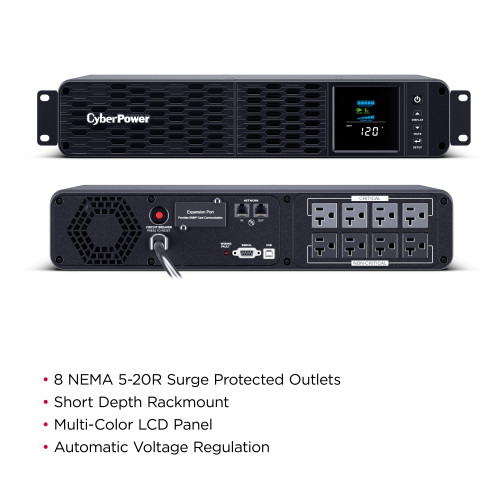
The CyberPower CP2000PFCRM2U provides 8 x NEMA 5-20R outlets (all on battery backup and surge), powered by a NEMA 5-20P input plug on a 6-foot cord. Its input tolerance spans 82–144 VAC. All outlets share a single 20 A circuit type, making it straightforward for environments standardized on 20 A feeds.
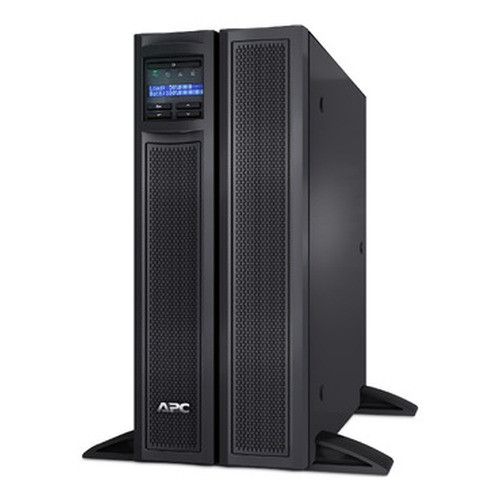
The APC SMX2000LVNCUS offers a mixed outlet bank: NEMA 5-15R, NEMA 5-20R, and NEMA L5-20R receptacles. The spec does not state the count per type or which outlets are on battery vs. surge-only. This mixed configuration accommodates legacy 15 A devices and twist-lock L5-20R loads simultaneously. The APC's input window is wider: 70–153 VAC versus the CyberPower's 82–144 VAC, providing greater tolerance against browndowns. Both units accept 50/60 Hz input; the CyberPower narrows this to 57–63 Hz.
Surge suppression ratings differ substantially: the CyberPower spec states 1500 Joules; the APC states 540 Joules. Both include AVR. Only the CyberPower spec mentions data-line (RJ45 Ethernet) surge protection; the APC spec does not reference data-line protection.
What remote monitoring, alerting, and software integration does each unit support?
The CyberPower CP2000PFCRM2U ships with USB and DB9 serial ports plus one dry-contact relay. An SNMP card slot is present but the card is optional and not included. A multifunction color LCD is onboard. Network/web-based management requires the optional SNMP card purchase. Data-line protection covers RJ45 10/100/1000 Ethernet.
The APC SMX2000LVNCUS lists web-based management as 'Yes' in the provided spec, implying network management capability is available without a separately purchased card — though the spec does not explicitly confirm a built-in NMC versus a card-based solution. Audible alarms (on-battery and low-battery) and auto-restart are confirmed. The APC spec confirms a 55 dB noise level and 5% output voltage THD; neither figure is stated for the CyberPower. The APC's noise rating is relevant for installations in noise-sensitive environments.
For software ecosystem: the CyberPower unit is compatible with CyberPower PowerPanel software (implied by USB/serial ports per standard CyberPower practice, though not explicitly stated in the provided spec). The APC unit integrates with APC/Schneider Electric's PowerChute and EcoStruxure ecosystems, though neither software name appears explicitly in the provided spec data. Buyers should verify software compatibility directly from vendor documentation.
Which should you choose: the CP2000PFCRM2U or the SMX2000LVNCUS?
Our take: The SMX2000LVNCUS is the stronger choice when watt capacity and outlet flexibility are the primary criteria. It delivers 1800 W versus the CP2000PFCRM2U's 1200 W — a 600 W (50%) advantage that matters for dense server or PoE loads. Its input window is broader (70–153 VAC vs. 82–144 VAC), and it includes web-based management per spec without confirmed add-on card cost. The CP2000PFCRM2U is the stronger choice when surge suppression headroom (1500 J vs. 540 J), known runtime figures (9 min at 600 W), hot-swap battery replacement, data-line Ethernet protection, and a standardized 8 x NEMA 5-20R outlet bank are priorities. It also carries UL1778, FCC Class B, RoHS, and Energy Star certifications; the APC spec does not list certifications. Choose the APC for watt-dense, network-managed rack environments; choose the CyberPower for surge-sensitive, 20 A-standardized deployments where hot-swap battery serviceability and documented runtime are required.
Side-by-Side Comparison
Spec-for-spec, from manufacturer data.
| Specification | CyberPower CP2000PFCRM2U | APC by Schneider Electric SMX2000LVNCUS |
|---|---|---|
| UPS Topology | Line Interactive with AVR | Line Interactive with AVR |
| Capacity (VA) | 2000 VA | 1920 VA (1.92 kVA) |
| Capacity (Watts) | 1200 W | 1800 W |
| Output Power Factor | 0.6 | ~0.94 (derived: 1800 W / 1920 VA) |
| Output Waveform | Pure Sine Wave | Sine Wave |
| Input Voltage Range | 82–144 VAC | 70–153 VAC |
| Input Frequency | 57–63 Hz | 50/60 Hz |
| Outlets | 8 x NEMA 5-20R (all battery + surge) | NEMA 5-15R, 5-20R, L5-20R (count per type not stated) |
| Surge Suppression | 1500 J | 540 J |
| Data Line Protection | RJ45 10/100/1000 Ethernet | — |
| Runtime at Half Load | 9 min @ 600 W | — |
| Runtime at Full Load | 2.2 min @ 1200 W | — |
| Battery | 2 x 12 V/9 Ah Sealed Lead-Acid | — |
| Hot-Swap Battery | Yes | — |
| Management Ports | USB, Serial DB9, dry contact relay, SNMP slot (card optional) | Web-based management (built-in or card: not specified) |
| Audible Alarm | — | Yes (on-battery, low-battery) |
| Noise Level | — | 55 dB |
| Output Voltage THD | — | 5% |
| Display | Multifunction color LCD | — |
| Form Factor | 2U Rackmount | Rack/Tower |
| Dimensions (W x H x D in) | 17.05 x 3.39 x 10.79 | — |
| Weight | 28.68 lb | — |
| Operating Temperature | 32–104°F (0–40°C) | — |
| Certifications | UL1778, FCC Class B, RoHS, Energy Star | — |
| Auto-Restart | — | Yes |
Frequently Asked Questions
Which should you choose: the CP2000PFCRM2U or the SMX2000LVNCUS?
The SMX2000LVNCUS is the stronger choice when watt capacity and outlet flexibility are the primary criteria. It delivers 1800 W versus the CP2000PFCRM2U's 1200 W — a 600 W (50%) advantage that matters for dense server or PoE loads. Its input window is broader (70–153 VAC vs. 82–144 VAC), and it includes web-based management per spec without confirmed add-on card cost. The CP2000PFCRM2U is the stronger choice when surge suppression headroom (1500 J vs. 540 J), known runtime figures (9 min at 600 W), hot-swap battery replacement, data-line Ethernet protection, and a standardized 8 x NEMA 5-20R outlet bank are priorities. It also carries UL1778, FCC Class B, RoHS, and Energy Star certifications; the APC spec does not list certifications. Choose the APC for watt-dense, network-managed rack environments; choose the CyberPower for surge-sensitive, 20 A-standardized deployments where hot-swap battery serviceability and documented runtime are required.
Which UPS gives me more actual watts for powering servers — the CP2000PFCRM2U or the SMX2000LVNCUS?
The SMX2000LVNCUS is rated 1800 W versus the CP2000PFCRM2U's 1200 W. Despite the CyberPower's higher 2000 VA figure, its 0.6 output power factor caps usable watts at 1200. If your rack load exceeds 1200 W, the APC is the only option of the two.
Can I replace the battery myself without taking the CP2000PFCRM2U offline?
Yes — the CP2000PFCRM2U specifies hot-swappable, user-replaceable batteries (2 x 12 V/9 Ah sealed lead-acid). The SMX2000LVNCUS spec provided does not state battery type, configuration, or whether hot-swap replacement is supported; consult APC documentation to confirm.
Do both units include network management out of the box, or do I need to buy an add-on card?
The SMX2000LVNCUS spec states 'web-based management: Yes,' which suggests network management capability is present, though the spec does not confirm whether this is built-in or card-based. The CP2000PFCRM2U ships with an SNMP expansion slot only — the SNMP card is optional and not included, so network management requires an additional purchase.
More UPS Comparisons
- APC by Schneider Electric SMX2000LV vs CyberPower PR2000RTXL2UC
- APC by Schneider Electric SMX2000LV vs CyberPower CP2000PFCRM2U
- APC by Schneider Electric SMX2000LV vs CyberPower PR2000RT2UCN
- APC by Schneider Electric SMX2000LV vs Middle Atlantic UPX-EXPANRUN-OL20
- APC by Schneider Electric SMX2000LV vs APC by Schneider Electric SMX2000LVNCUS
- APC by Schneider Electric SMX2000LV vs APC by Schneider Electric SMX2000RMLV2U
UPS Buying Guides
Get a Second Opinion on Your Camera Choice
Share your site layout, coverage goals, and budget. Our team will validate the camera selection, flag anything we would change, and recommend products that match the use case.