
CyberPower BRG1000AVRLCD vs Vertiv GXT5-1000LVRT2UXL: Specification Comparison
Both the CyberPower BRG1000AVRLCD and the Vertiv GXT5-1000LVRT2UXL are 1000VA uninterruptible power supplies targeting small-to-medium IT and security infrastructure. Despite sharing the same VA rating, they differ substantially in topology, form factor, output waveform quality, and power delivery efficiency. This comparison examines the three axes most critical to a UPS purchasing decision: power topology and output quality, physical deployment and scalability, and management capabilities and certifications.
In This Guide
- Which UPS delivers cleaner power and how does topology affect connected equipment?
- How do form factor, outlet count, runtime scalability, and weight affect deployment flexibility?
- What management interfaces, certifications, and warranty terms differentiate these units?
- Which should you choose: the BRG1000AVRLCD or the GXT5-1000LVRT2UXL?
- Side-by-Side Specs
- FAQ
Which UPS delivers cleaner power and how does topology affect connected equipment?
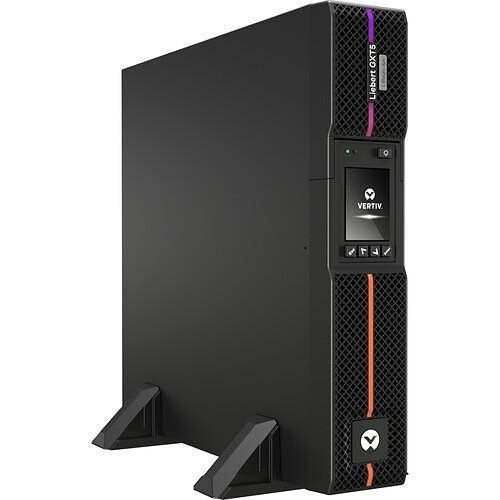
The GXT5-1000LVRT2UXL uses online double-conversion topology, meaning incoming AC is continuously rectified to DC and re-inverted to AC before reaching the load. Transfer time to battery is zero because the inverter is always active. Output is a pure sinewave regulated to ±3% across user-selectable voltages of 110, 115, 120, or 125VAC. This makes it suitable for active PFC power supplies, medical-grade equipment, and any load sensitive to waveform distortion or micro-interruptions.
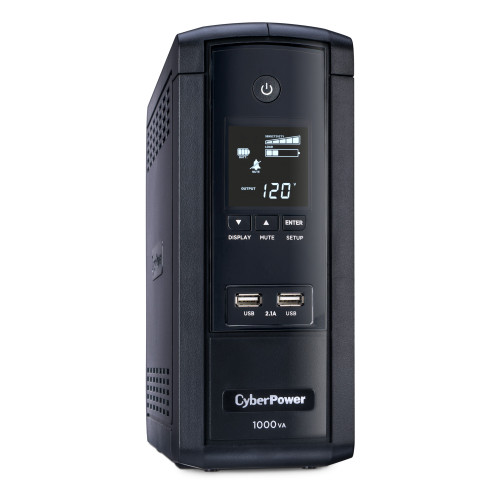
The BRG1000AVRLCD uses line-interactive topology with AVR (single boost, single buck). It passes utility power directly to the load under normal conditions and transfers to battery only when utility falls outside its 90–148VAC input range. Its output waveform is simulated sine wave — not pure sine — which can cause compatibility issues with active PFC power supplies or precision equipment. Voltage regulation is ±5% at 120VAC nominal.
For loads that require waveform fidelity — network switches with active PFC PSUs, IP cameras on PoE injectors, or NVRs — the GXT5's pure sinewave and zero-transfer-time double-conversion represent a meaningful technical advantage over the BRG1000AVRLCD's simulated sinewave and switching-based transfer.
How do form factor, outlet count, runtime scalability, and weight affect deployment flexibility?
The BRG1000AVRLCD is a mini-tower unit measuring 3.9 × 9.7 × 10.2 in and weighing 15 lb (6.8 kg). It provides 10 NEMA 5-15R outlets — 5 with battery backup plus surge, and 5 with surge only — and includes 2 USB-A charging ports (2.1A shared). Runtime is specified at 9 minutes at 50% load (300W) and 1 minute at full 600W load. Its internal 12V/9Ah sealed lead-acid battery is user-replaceable but not hot-swappable. The unit does not support external battery expansion.
The GXT5-1000LVRT2UXL ships as a 2U rack-mount unit that is also convertible to tower orientation, measuring 16.9 × 15.7 × 3.4 in and weighing 37 lbs (16.8 kg). It provides 6 NEMA 5-15R outlets arranged in programmable groups. Runtime scalability is supported via optional external battery cabinets — up to 3 daisy-chained units — which the BRG1000AVRLCD cannot match. Battery replacement is hot-swappable and front-accessible with no tools required.
The BRG1000AVRLCD's 10-outlet count and desktop form factor suit a desk-side or closet deployment with multiple small loads. The GXT5's rack form factor, hot-swap battery access, and external battery scalability favor data-closet or server-room rack installations where runtime extension and serviceability without downtime are operational requirements. Note the GXT5's rated capacity is 1000W (unity power factor) versus the BRG1000AVRLCD's 600W despite both being rated 1000VA.
What management interfaces, certifications, and warranty terms differentiate these units?
The BRG1000AVRLCD offers a USB HID-compliant interface and DB9 serial for UPS management software communication. It includes data-line protection for Ethernet (RJ45) and coaxial (RG6) connections and a multifunction LCD displaying UPS status. It is certified to UL1778, cUL 107.5, FCC Class B, RoHS, and ENERGY STAR. CyberPower backs it with a 5-year limited warranty and a $350,000 connected equipment guarantee. FCC Class B certification indicates suitability for residential as well as commercial environments.
The GXT5-1000LVRT2UXL provides USB and RS-232 serial communications as standard, with an optional Intellislot network card slot for SNMP/web-based remote monitoring — a capability not present on the BRG1000AVRLCD. Its LCD displays load percentage, runtime, voltage, and status. Certifications include TAA compliance, Energy Star 2.0, cULus, FCC Class A, and CE. The FCC Class A rating is specific to commercial/industrial environments. The unit is rated at less than 45 dBA at 1 meter. Warranty is 3-year advanced replacement with batteries included — a shorter term than the CyberPower but with an advance-replacement service model and battery coverage explicitly included.
TAA compliance on the GXT5 makes it eligible for U.S. federal government procurement contracts — a requirement the BRG1000AVRLCD does not meet based on provided specs. The optional Intellislot card on the GXT5 enables network-level remote shutdown and monitoring, which is a meaningful differentiator for managed IT environments. The BRG1000AVRLCD's 5-year warranty term is longer numerically, but the GXT5's advance-replacement service and included battery warranty may offer more practical value in a rack environment.
Which should you choose: the BRG1000AVRLCD or the GXT5-1000LVRT2UXL?
Our take: The GXT5-1000LVRT2UXL is the stronger choice when power quality, rack deployment, and runtime scalability are the primary requirements. Its online double-conversion topology delivers pure sinewave output with zero transfer time, versus the BRG1000AVRLCD's simulated sinewave and switching-based line-interactive transfer — a critical difference for active PFC power supplies and precision loads. The GXT5 also delivers 1000W at unity power factor versus the BRG1000AVRLCD's 600W ceiling despite identical 1000VA ratings, and supports hot-swap batteries plus up to three external battery cabinets for runtime extension the BRG1000AVRLCD cannot provide. The BRG1000AVRLCD is the stronger choice for cost-sensitive desktop or small-office deployments: it offers 10 outlets versus 6, a 5-year warranty versus 3 years, data-line surge protection (RJ45/RG6), and a $350,000 connected equipment guarantee — all in a lighter 15 lb mini-tower form factor suited to non-rack environments with standard resistive or lightly switching loads.
Side-by-Side Comparison
Spec-for-spec, from manufacturer data.
| Specification | CyberPower BRG1000AVRLCD | Vertiv GXT5-1000LVRT2UXL |
|---|---|---|
| Topology | Line Interactive (AVR) | Online Double-Conversion |
| Capacity (VA) | 1000 VA | 1000 VA |
| Capacity (Watts) | 600 W | 1000 W (unity power factor) |
| Output Waveform | Simulated Sine Wave | Pure Sine Wave |
| Output Voltage | 120 VAC ±5% | 110/115/120/125 VAC ±3% (configurable) |
| Input Voltage Range | 90–148 VAC | 60–150 VAC |
| Transfer Time | Not specified (switching) | Zero (always-on inverter) |
| Form Factor | Mini-Tower | 2U Rack / Tower Convertible |
| Outlets | 10 x NEMA 5-15R (5 battery+surge, 5 surge) | 6 x NEMA 5-15R (programmable groups) |
| Battery Type | 12V/9Ah Sealed Lead-Acid, User Replaceable | VRLA, Hot-Swappable, Front-Accessible, No Tools |
| Runtime Scalability | Internal battery only | Internal + up to 3 external battery cabinets |
| Runtime @ 50% Load | 9 minutes | — |
| Management Interfaces | USB HID, DB9 Serial | USB, RS-232, Optional Intellislot Network Card |
| Efficiency | — | Up to 98% (ECO mode), 95% (online mode) |
| Certifications | UL1778, cUL 107.5, FCC Class B, RoHS, ENERGY STAR | TAA, Energy Star 2.0, cULus, FCC Class A, CE |
| Warranty | 5-Year Limited + $350,000 CEG | 3-Year Advanced Replacement, Batteries Included |
Frequently Asked Questions
Which should you choose: the BRG1000AVRLCD or the GXT5-1000LVRT2UXL?
The GXT5-1000LVRT2UXL is the stronger choice when power quality, rack deployment, and runtime scalability are the primary requirements. Its online double-conversion topology delivers pure sinewave output with zero transfer time, versus the BRG1000AVRLCD's simulated sinewave and switching-based line-interactive transfer — a critical difference for active PFC power supplies and precision loads. The GXT5 also delivers 1000W at unity power factor versus the BRG1000AVRLCD's 600W ceiling despite identical 1000VA ratings, and supports hot-swap batteries plus up to three external battery cabinets for runtime extension the BRG1000AVRLCD cannot provide. The BRG1000AVRLCD is the stronger choice for cost-sensitive desktop or small-office deployments: it offers 10 outlets versus 6, a 5-year warranty versus 3 years, data-line surge protection (RJ45/RG6), and a $350,000 connected equipment guarantee — all in a lighter 15 lb mini-tower form factor suited to non-rack environments with standard resistive or lightly switching loads.
Is the BRG1000AVRLCD or GXT5-1000LVRT2UXL better for protecting network switches and NVRs with active PFC power supplies?
The GXT5-1000LVRT2UXL is better suited for that use case. Active PFC power supplies can malfunction or trip on simulated sinewave output, which is what the BRG1000AVRLCD produces. The GXT5 outputs a pure sinewave with ±3% voltage regulation and zero transfer time via double-conversion, making it compatible with active PFC loads. The BRG1000AVRLCD's simulated sinewave and line-interactive switching transfer are specified for use with standard resistive or motor loads.
Can either UPS be rack-mounted in a standard 19-inch equipment rack?
Only the GXT5-1000LVRT2UXL is designed for rack installation. It occupies 2U in a standard 19-inch rack and is also convertible to tower orientation. The BRG1000AVRLCD is a mini-tower form factor only — no rack-mount option is listed in its provided specifications.
Which unit has the longer warranty, and does either warranty cover battery replacement?
The BRG1000AVRLCD carries a 5-year limited warranty, which is longer in term than the GXT5-1000LVRT2UXL's 3-year warranty. However, the GXT5's warranty is specifically described as advanced replacement with batteries included. The BRG1000AVRLCD's warranty is described as limited, and no explicit battery coverage is stated in the provided specifications. Buyers in managed IT environments should weigh the GXT5's advance-replacement service model and battery inclusion against the BRG1000AVRLCD's longer warranty term.
More UPS Comparisons
- CyberPower PR1000RTXL2UC vs APC by Schneider Electric SURT1000RMXLI
- CyberPower PR1000RTXL2UC vs APC by Schneider Electric SMT1000CUS
- CyberPower PR1000RTXL2UC vs Vertiv GXT5-1000LVRT2UXL
- CyberPower PR1000RTXL2UC vs APC by Schneider Electric SMT1000J
- CyberPower PR1000RTXL2UC vs CyberPower CP1000PFCLCD
- CyberPower PR1000RTXL2UC vs CyberPower PR1000LCD
UPS Buying Guides
Get a Second Opinion on Your Camera Choice
Share your site layout, coverage goals, and budget. Our team will validate the camera selection, flag anything we would change, and recommend products that match the use case.