
CyberPower BRG1000AVRLCD vs CyberPower CP1000PFCLCD: Specification Comparison
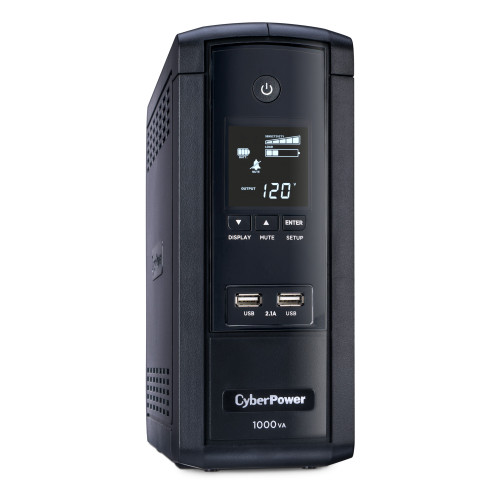
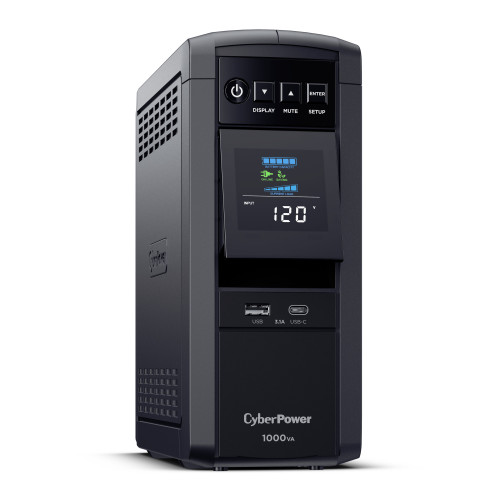
Both the CyberPower BRG1000AVRLCD and CP1000PFCLCD are 1000VA/600W line-interactive mini-tower UPS systems targeting small office, workstation, and network closet installations on 120VAC circuits. They share identical VA/W ratings, form factor, outlet count, and battery chemistry, making them a genuine cross-shop. The key differentiators are output waveform, AVR input range, warranty duration, connected equipment coverage, USB charging ports, and runtime profile — each of which carries real consequences depending on the load type and deployment environment.
In This Guide
- Which UPS delivers cleaner output and wider voltage tolerance for sensitive or active-PFC loads?
- How do the two units compare on runtime, battery specs, and self-test management?
- What differences exist in management interfaces, surge coverage, warranty, and equipment protection guarantees?
- Which should you choose: the BRG1000AVRLCD or the CP1000PFCLCD?
- Side-by-Side Specs
- FAQ
Which UPS delivers cleaner output and wider voltage tolerance for sensitive or active-PFC loads?
Output waveform is the sharpest divide between these two units. The BRG1000AVRLCD produces a simulated sine wave, which is adequate for most resistive loads, basic networking gear, and workstations with conventional power supplies. The CP1000PFCLCD outputs a pure sine wave with total harmonic distortion specified at less than 3% at full load. Pure sine wave output is required — not merely preferred — for loads with active power-factor-corrected (PFC) power supplies, variable-speed motor-driven equipment, and medical or lab instrumentation. Running an active-PFC supply on a simulated sine wave can cause instability, audible buzz, or premature PSU failure. The CP1000PFCLCD is the only safe choice when protecting such loads.
On AVR input voltage range, the BRG1000AVRLCD accepts 90–148 VAC before switching to battery, using a single-boost / single-buck topology. The CP1000PFCLCD covers 88–144 VAC with its buck-boost transformer. The BRG has a slightly wider high-side window (148 vs 144 VAC) while the CP1000PFCLCD edges marginally lower on the low side (88 vs 90 VAC). Neither difference is practically significant for North American 120VAC sites, but installers in areas with chronic under-voltage may favour the CP1000PFCLCD's lower floor. Transfer time is specified only for the CP1000PFCLCD at 4 milliseconds; this spec is absent from the BRG1000AVRLCD's data sheet.
How do the two units compare on runtime, battery specs, and self-test management?
Both units use a 12V/9Ah sealed lead-acid battery and are rated at identical capacity (1000VA/600W), so the battery energy store is nominally the same. However, their specified runtimes differ. The BRG1000AVRLCD is rated at 9 minutes at half load (approximately 300W) and 1 minute at full load (600W). The CP1000PFCLCD is rated at 6 minutes at half load (300W) and 2 minutes at full load (600W). The BRG1000AVRLCD therefore claims a longer half-load runtime (9 vs 6 minutes), while the CP1000PFCLCD claims a longer full-load runtime (2 vs 1 minute). Runtime figures from manufacturers typically reflect different discharge cut-off voltages and test conditions, so these numbers should be treated as directional rather than directly equivalent benchmarks.
Battery self-test is specified for the CP1000PFCLCD as automatic every two weeks, with manual initiation available via the LCD or software. This spec is not listed for the BRG1000AVRLCD. Both units are user-replaceable; the CP1000PFCLCD specifies replacement model RB1270X2C. Both units include a multifunction LCD display for load, voltage, battery, and runtime status. The CP1000PFCLCD additionally specifies fault condition display and an audible alarm for on-battery, low-battery, overload, and fault states; audible alarm specification is absent from the BRG1000AVRLCD's listed specs.
What differences exist in management interfaces, surge coverage, warranty, and equipment protection guarantees?
Both units provide USB HID-compliant management and a serial port for shutdown signalling, and both display load and status via an LCD. The CP1000PFCLCD's serial interface is described as a dry contact relay, which is distinct from the BRG1000AVRLCD's DB9 serial port — relevant when integrating with building management systems or relay-based shutdown hardware. The CP1000PFCLCD explicitly lists PowerPanel software compatibility (Windows, macOS, Linux); the BRG1000AVRLCD does not list compatible software by name in its specification sheet. The CP1000PFCLCD includes USB Type-A and Type-C charging ports; the BRG1000AVRLCD provides two USB Type-A ports rated at 2.1A shared, with no Type-C port specified.
Data line protection differs in scope: the BRG1000AVRLCD protects both Ethernet (RJ45) and coaxial/cable (RG6) lines; the CP1000PFCLCD specifies only RJ45 (1 in / 1 out). Surge suppression energy ratings are 1080 joules (BRG1000AVRLCD) versus 1020 joules (CP1000PFCLCD) — a 60-joule difference that is unlikely to be decision-relevant in practice. The connected equipment guarantee strongly favours the CP1000PFCLCD at $500,000 versus $350,000 for the BRG1000AVRLCD. Conversely, the BRG1000AVRLCD carries a 5-year limited warranty while the CP1000PFCLCD is warranted for only 3 years — a two-year gap that matters for total cost of ownership in supervised deployments.
Which should you choose: the BRG1000AVRLCD or the CP1000PFCLCD?
Our take: The CP1000PFCLCD is the stronger choice when the protected load includes active-PFC power supplies, UPS-aware servers, or any equipment whose manufacturer requires pure sine wave input — the BRG1000AVRLCD's simulated sine wave output disqualifies it for those loads entirely. The CP1000PFCLCD also carries a $150,000 higher connected equipment guarantee ($500,000 vs $350,000) and adds USB Type-C charging absent from the BRG1000AVRLCD. The BRG1000AVRLCD is the stronger choice for conventional office or surveillance workstation loads where simulated sine wave is acceptable: it delivers a longer specified half-load runtime (9 vs 6 minutes), covers both RJ45 and coaxial data lines versus RJ45 only, and provides a 5-year warranty against the CP1000PFCLCD's 3 years — a meaningful total-cost-of-ownership advantage for unmanned or remotely-managed sites where battery and unit replacement scheduling matters.
Side-by-Side Comparison
Spec-for-spec, from manufacturer data.
| Specification | CyberPower BRG1000AVRLCD | CyberPower CP1000PFCLCD |
|---|---|---|
| Capacity | 1000 VA / 600 W | 1000 VA / 600 W |
| Topology | Line Interactive | Line Interactive |
| Output Waveform | Simulated Sine Wave | Pure Sine Wave (<3% THD at full load) |
| AVR Input Range | 90–148 VAC | 88–144 VAC |
| Transfer Time | — | 4 ms |
| Runtime at Half Load (~300W) | 9 minutes | 6 minutes |
| Runtime at Full Load (600W) | 1 minute | 2 minutes |
| Battery | 12V / 9Ah, Sealed Lead-Acid, User-Replaceable | 12V / 9Ah, Sealed Lead-Acid, User-Replaceable (RB1270X2C) |
| Total Outlets | 10 × NEMA 5-15R (5 battery+surge / 5 surge only) | 10 × NEMA 5-15R (5 battery+surge / 5 surge only) |
| Surge Protection | 1080 Joules | 1020 Joules |
| Data Line Protection | RJ45 + RG6 (Coaxial) | RJ45 only (1 in / 1 out) |
| USB Charging Ports | 2 × USB Type-A (2.1A shared) | USB Type-A + USB Type-C |
| Management Interface | USB HID, DB9 Serial | USB HID, Dry Contact Relay Serial |
| Warranty | 5 Year Limited | 3 Year Limited |
| Connected Equipment Guarantee | $350,000 | $500,000 |
| Certifications | UL1778, cUL 107.5, FCC Class B, RoHS, ENERGY STAR | UL1778, cUL 107.3, FCC Class B, RoHS, ENERGY STAR |
Frequently Asked Questions
Which should you choose: the BRG1000AVRLCD or the CP1000PFCLCD?
The CP1000PFCLCD is the stronger choice when the protected load includes active-PFC power supplies, UPS-aware servers, or any equipment whose manufacturer requires pure sine wave input — the BRG1000AVRLCD's simulated sine wave output disqualifies it for those loads entirely. The CP1000PFCLCD also carries a $150,000 higher connected equipment guarantee ($500,000 vs $350,000) and adds USB Type-C charging absent from the BRG1000AVRLCD. The BRG1000AVRLCD is the stronger choice for conventional office or surveillance workstation loads where simulated sine wave is acceptable: it delivers a longer specified half-load runtime (9 vs 6 minutes), covers both RJ45 and coaxial data lines versus RJ45 only, and provides a 5-year warranty against the CP1000PFCLCD's 3 years — a meaningful total-cost-of-ownership advantage for unmanned or remotely-managed sites where battery and unit replacement scheduling matters.
Can I use either UPS with a server or workstation that has an 80 PLUS Platinum or Titanium power supply?
Active-PFC power supplies found in 80 PLUS Platinum and Titanium units require a pure sine wave output to operate reliably on battery. The CP1000PFCLCD produces pure sine wave output (THD <3% at full load) and is suitable for those loads. The BRG1000AVRLCD produces a simulated sine wave; using it with an active-PFC supply may cause instability, audible interference, or PSU damage. For active-PFC loads, only the CP1000PFCLCD is appropriate based on the provided specifications.
Which unit gives me longer battery runtime for a network switch or NVR at typical operating loads?
At half load (approximately 300W), the BRG1000AVRLCD is specified at 9 minutes versus 6 minutes for the CP1000PFCLCD — a 3-minute advantage. At full load (600W), the CP1000PFCLCD is rated at 2 minutes versus 1 minute for the BRG1000AVRLCD. Both use a 12V/9Ah sealed lead-acid battery. If your equipment draws around 50% of rated capacity — typical for a lightly loaded NVR or network stack — the BRG1000AVRLCD's published half-load runtime is longer, though test conditions between manufacturers may differ.
Which UPS has the better warranty and equipment protection coverage?
The BRG1000AVRLCD carries a 5-year limited warranty, two years longer than the CP1000PFCLCD's 3-year limited warranty. However, the CP1000PFCLCD offers a $500,000 connected equipment guarantee versus $350,000 for the BRG1000AVRLCD — a $150,000 difference in coverage for connected gear damaged while on the UPS. The choice depends on whether warranty duration (favour BRG1000AVRLCD) or equipment liability coverage (favour CP1000PFCLCD) is the higher priority for your deployment.
More UPS Comparisons
- CyberPower PR1000RTXL2UC vs APC by Schneider Electric SURT1000RMXLI
- CyberPower PR1000RTXL2UC vs APC by Schneider Electric SMT1000CUS
- CyberPower PR1000RTXL2UC vs Vertiv GXT5-1000LVRT2UXL
- CyberPower PR1000RTXL2UC vs APC by Schneider Electric SMT1000J
- CyberPower PR1000RTXL2UC vs CyberPower CP1000PFCLCD
- CyberPower PR1000RTXL2UC vs CyberPower PR1000LCD
UPS Buying Guides
Get a Second Opinion on Your Camera Choice
Share your site layout, coverage goals, and budget. Our team will validate the camera selection, flag anything we would change, and recommend products that match the use case.