
CyberPower BRG1000AVRLCD vs APC by Schneider Electric SMT1000J: Specification Comparison
Both the CyberPower BRG1000AVRLCD and the APC SMT1000J are 1000 VA line-interactive UPS units targeting desktop and small-rack power protection in the sub-1 kVA class. This comparison evaluates three dimensions most critical to buyers in this segment: power capacity and runtime, output quality and surge protection, and management interfaces plus certifications. The CyberPower is configured for the North American 120 VAC market; the APC SMT1000J is a Japan-localized unit rated for 100 VAC input. Buyers should confirm regional compatibility before purchase.
In This Guide
- Which UPS delivers more usable power and how long will it sustain your load?
- How does each unit protect equipment from power anomalies and surges?
- What management interfaces, software integration, and certifications does each unit offer?
- Which should you choose: the BRG1000AVRLCD or the SMT1000J?
- Side-by-Side Specs
- FAQ
Which UPS delivers more usable power and how long will it sustain your load?
The CyberPower BRG1000AVRLCD is rated at 1000 VA / 600 W, while the APC SMT1000J is rated at 1000 VA / 670 W. The APC therefore offers a higher watt ceiling — 670 W versus 600 W — meaning it can support a heavier resistive or mixed load before hitting capacity.
Runtime figures are available only for the CyberPower: 9 minutes at half load (300 W) and 1 minute at full load (600 W), backed by a 12 V / 9 Ah sealed lead-acid battery that is user-replaceable. The APC SMT1000J spec sheet does not state a runtime figure; its battery recharge time is listed at 4 hours. CyberPower's battery replaceability is explicitly documented; APC's is not stated in the provided specs.
Input voltage range also differs. The BRG1000AVRLCD accepts 90–148 VAC (120 VAC nominal), while the SMT1000J accepts 80–123 VAC (100 VAC nominal, Japan market). The SMT1000J additionally lists an adjustable range of 70–125 VAC. Buyers on a 120 VAC North American circuit cannot use the SMT1000J as specified without a step-down transformer.
How does each unit protect equipment from power anomalies and surges?
Both units use line-interactive topology with AVR (automatic voltage regulation). The CyberPower BRG1000AVRLCD explicitly documents its AVR mechanism as single boost / single buck, operating across its 90–148 VAC input range. The APC SMT1000J does not specify its AVR boost/buck topology in the provided specs.
Output waveform is a key differentiator: the BRG1000AVRLCD produces a simulated (stepped approximation) sine wave, while the SMT1000J produces a true sine wave. Active PFC power supplies found in modern servers and some workstations are sensitive to non-sinusoidal waveforms and are generally better served by a true sine wave output.
Surge suppression ratings diverge significantly. The BRG1000AVRLCD is rated at 1080 joules and also includes data-line protection via RJ45 (Ethernet) and RG6 (coaxial) ports. The SMT1000J is rated at 459 joules — less than half — and no data-line protection ports are listed in the provided specs. The BRG1000AVRLCD also carries a $350,000 connected equipment guarantee; no equivalent figure is stated for the SMT1000J.
What management interfaces, software integration, and certifications does each unit offer?
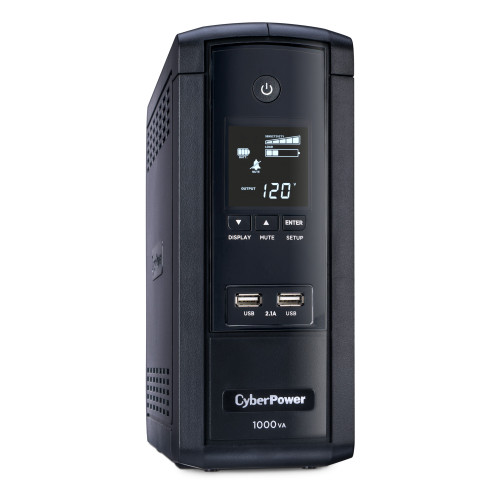
The CyberPower BRG1000AVRLCD provides a USB HID-compliant port and a DB9 serial port for management, along with a multifunction LCD panel displaying operational status. It is compatible with PowerPanel software (implied by USB HID compliance per CyberPower's product family) and carries UL 1778, cUL 107.5, FCC Class B, RoHS, and ENERGY STAR certifications.
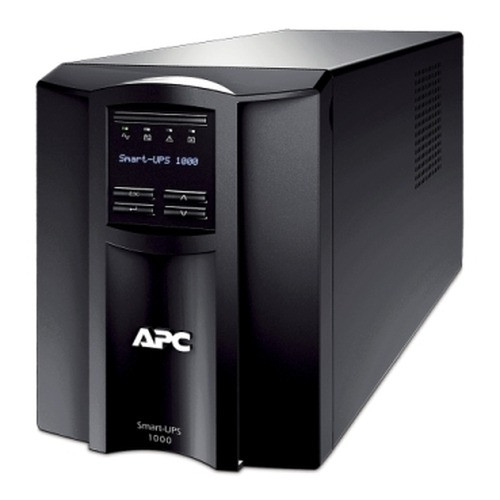
The APC SMT1000J provides one USB Type-A port and one SmartSlot expansion bay, which accepts APC's optional network management cards for SNMP/web-based remote monitoring. The SmartSlot is a significant differentiator for IT environments requiring network-level UPS management without a locally connected host. Its listed certifications are UL 1449, VCCI Class A ITE, RoHS Exemption 7b, and REACH. A DB9 serial port is not mentioned in the provided specs.
Noise is specified only for the SMT1000J at 45 dBA; no acoustic figure is provided for the BRG1000AVRLCD. Warranty terms differ: the BRG1000AVRLCD carries a 5-year limited warranty versus the SMT1000J's 2-year limited warranty.
Which should you choose: the BRG1000AVRLCD or the SMT1000J?
Our take: The BRG1000AVRLCD is the stronger choice when the deployment is on a 120 VAC North American circuit and cost-of-ownership, surge protection depth, and warranty length are priorities. Its 1080-joule surge rating is more than double the SMT1000J's 459 joules, its 5-year warranty is 2.5 times longer than the SMT1000J's 2 years, and it adds data-line protection (RJ45/RG6) not documented on the SMT1000J. However, the SMT1000J holds three meaningful advantages: a higher watt capacity (670 W vs. 600 W), a true sine wave output suited to active-PFC power supplies, and a SmartSlot expansion bay for network management cards — features absent from the BRG1000AVRLCD. Runtime for the SMT1000J is not stated in the provided specs, preventing a direct comparison. The SMT1000J is also a Japan-market 100 VAC unit and is not suitable for direct use on a 120 VAC North American circuit.
Side-by-Side Comparison
Spec-for-spec, from manufacturer data.
| Specification | CyberPower BRG1000AVRLCD | APC by Schneider Electric SMT1000J |
|---|---|---|
| Capacity (VA) | 1000 VA | 1000 VA |
| Capacity (Watts) | 600 W | 670 W |
| Topology | Line Interactive | Line Interactive |
| Output Waveform | Simulated Sine Wave | True Sine Wave |
| AVR Type | Single Boost / Single Buck | — |
| Nominal Input Voltage | 120 VAC | 100 VAC (Japan) |
| Input Voltage Range | 90–148 VAC | 80–123 VAC |
| Total Outlets | 10 x NEMA 5-15R | 8 x NEMA 5-15 |
| Battery Backup Outlets | 5 | — |
| Surge Only Outlets | 5 | — |
| Surge Energy Rating | 1080 Joules | 459 Joules |
| Data Line Protection | RJ45 / RG6 | — |
| Runtime @ Half Load | 9 min (300 W) | — |
| Runtime @ Full Load | 1 min (600 W) | — |
| Battery Recharge Time | — | 4 hours |
| Battery | 12V / 9Ah SLA, User Replaceable | Lead Acid (size/Ah not stated) |
| Management Interface | USB HID, DB9 Serial | USB Type-A, SmartSlot (1 bay) |
| Display | Multifunction LCD | LCD |
| Certifications | UL 1778, cUL 107.5, FCC Class B, RoHS, ENERGY STAR | UL 1449, VCCI Class A, RoHS Exemption 7b, REACH |
| Warranty | 5-Year Limited | 2-Year Limited |
| Connected Equipment Guarantee | $350,000 | — |
| Noise Level | — | 45 dBA |
| Weight | 15 lb (6.8 kg) | 50.2 lb |
| Form Factor | Mini-Tower | — |
Frequently Asked Questions
Which should you choose: the BRG1000AVRLCD or the SMT1000J?
The BRG1000AVRLCD is the stronger choice when the deployment is on a 120 VAC North American circuit and cost-of-ownership, surge protection depth, and warranty length are priorities. Its 1080-joule surge rating is more than double the SMT1000J's 459 joules, its 5-year warranty is 2.5 times longer than the SMT1000J's 2 years, and it adds data-line protection (RJ45/RG6) not documented on the SMT1000J. However, the SMT1000J holds three meaningful advantages: a higher watt capacity (670 W vs. 600 W), a true sine wave output suited to active-PFC power supplies, and a SmartSlot expansion bay for network management cards — features absent from the BRG1000AVRLCD. Runtime for the SMT1000J is not stated in the provided specs, preventing a direct comparison. The SMT1000J is also a Japan-market 100 VAC unit and is not suitable for direct use on a 120 VAC North American circuit.
Can I use the APC SMT1000J in the United States on a standard 120 VAC outlet?
Based on the provided specs, the SMT1000J is a Japan-localized unit with a nominal input voltage of 100 VAC and an input range of 80–123 VAC. A standard US 120 VAC circuit is at the upper edge of that range and may exceed it under normal voltage swings. APC's own localization designation confirms this unit is intended for the Japanese market. Use with a 120 VAC supply is not supported by the documented specs and would require verification with APC.
Will either of these UPS units work safely with a server that has an active PFC power supply?
The APC SMT1000J outputs a true sine wave, which is the waveform recommended for active PFC power supplies. The CyberPower BRG1000AVRLCD outputs a simulated (stepped approximation) sine wave. Many active PFC supplies will operate on a simulated sine wave under battery power, but compatibility varies by supply manufacturer. For guaranteed compatibility with active PFC loads, the SMT1000J's true sine wave output is the documented safer choice.
Which unit is better for a network-monitored equipment room where IT staff need remote UPS visibility?
The APC SMT1000J includes one SmartSlot expansion bay, which accepts APC's optional network management cards (sold separately), enabling SNMP and web-based remote monitoring. The CyberPower BRG1000AVRLCD provides USB HID and DB9 serial interfaces, which require a locally connected host running management software. No equivalent expansion slot is listed for the BRG1000AVRLCD in the provided specs. For environments requiring standalone network-level UPS monitoring without a dedicated host, the SMT1000J's SmartSlot is the relevant differentiator.
More UPS Comparisons
- CyberPower PR1000RTXL2UC vs APC by Schneider Electric SURT1000RMXLI
- CyberPower PR1000RTXL2UC vs APC by Schneider Electric SMT1000CUS
- CyberPower PR1000RTXL2UC vs Vertiv GXT5-1000LVRT2UXL
- CyberPower PR1000RTXL2UC vs APC by Schneider Electric SMT1000J
- CyberPower PR1000RTXL2UC vs CyberPower CP1000PFCLCD
- CyberPower PR1000RTXL2UC vs CyberPower PR1000LCD
UPS Buying Guides
Get a Second Opinion on Your Camera Choice
Share your site layout, coverage goals, and budget. Our team will validate the camera selection, flag anything we would change, and recommend products that match the use case.