
Comnet CNGE24MSS2-OB vs Comnet CNGE24MS: Specification Comparison
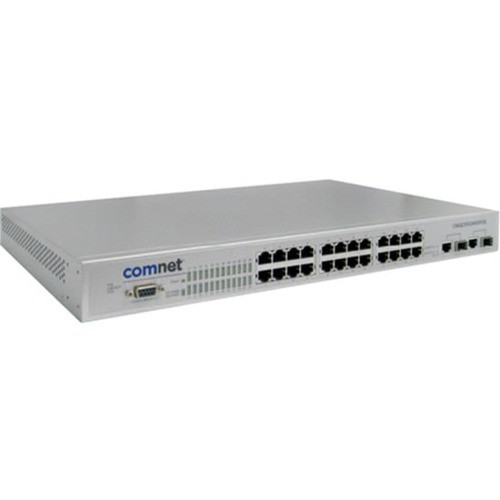
Both the Comnet CNGE24MSS2-OB and the Comnet CNGE24MS are hardened, 24-port managed Gigabit Ethernet switches sharing an identical port count — 16 x 10/100/1000Base-TX copper plus 8 x 100/1000 Mbps SFP slots — and both target industrial and physical-security network deployments where redundancy and environmental tolerance are primary concerns. The comparison below evaluates the three dimensions that most directly drive purchase decisions in this segment: port architecture and throughput capacity, environmental and power specifications, and network redundancy plus security management capabilities.
In This Guide
- Which switch offers greater throughput capacity and port flexibility?
- Which unit is better suited to harsh physical environments and what are the power requirements?
- Which switch provides stronger network redundancy and security management for surveillance infrastructure?
- Which should you choose: the CNGE24MSS2-OB or the CNGE24MS?
- Side-by-Side Specs
- FAQ
Which switch offers greater throughput capacity and port flexibility?
Both units deliver an identical physical port layout: 16 x 10/100/1000Base-TX copper ports and 8 x 100/1000 Mbps SFP slots, for a total of 24 ports. Jumbo frame support is identical on both models at 9.6K bytes/MTU, meaning neither unit imposes a disadvantage for high-bitrate video streams that benefit from larger frame sizes.
The CNGE24MS provides concrete switching fabric figures: 48 Gbps switching bandwidth and 7 μs switching latency, with an 8,000-entry MAC address table and support for up to 256 VLANs. The CNGE24MSS2-OB does not publish switching bandwidth, latency, MAC table size, or VLAN count in the provided specifications, leaving those parameters unverifiable for that model. Buyers requiring confirmed throughput headroom should note this gap before specifying the CNGE24MSS2-OB in high-density deployments.
Which unit is better suited to harsh physical environments and what are the power requirements?
The CNGE24MSS2-OB is rated for operation from -40°C to +75°C. The CNGE24MS is rated -40°C to +70°C — a 5°C narrower upper bound. For installations in high-ambient enclosures, rooftop cabinets, or industrial spaces where heat build-up is a concern, the CNGE24MSS2-OB's higher ceiling provides additional margin.
Power input differs materially. The CNGE24MS specifies a universal AC input of 100–240 VAC with 25 W consumption, a storage temperature range of -40°C to +85°C, humidity tolerance of 5%–95% non-condensing, physical dimensions of 30 x 16.5 x 8.8 cm, and a weight of 2.4 kg. The CNGE24MSS2-OB accepts DC or AC input — an advantage in field cabinets or transportation installations where DC bus power is available — but the provided specs do not state wattage, exact voltage ranges, humidity rating, dimensions, or weight. The CNGE24MS also publishes an MTBF figure exceeding 100,000 hours; the CNGE24MSS2-OB does not provide an MTBF figure in the supplied specifications.
Which switch provides stronger network redundancy and security management for surveillance infrastructure?
The CNGE24MSS2-OB explicitly lists an Optical Bypass Function (2 duplex / 4 simplex ports), which allows traffic to pass through the switch passively if the unit loses power or fails — a critical capability for ring topologies where a single node failure must not break the loop. The CNGE24MS does not list an optical bypass function in its specifications.
Redundancy protocol support diverges in breadth. The CNGE24MS enumerates C-Ring, Legacy Ring, C-Chain, MRP, Fast Recovery, MSTP, RSTP, and STP. The CNGE24MSS2-OB lists MSTP, RSTP, IEC 62439-2 MRP, and IEEE 1588v2 (Precision Time Protocol), but does not mention C-Ring, C-Chain, or Legacy Ring. The CNGE24MSS2-OB specifies a C-Ring recovery time of less than 30 ms; the CNGE24MS does not publish a recovery-time figure.
On security, the CNGE24MS lists Device Binding, Port-Based Network Access Control, RADIUS, SNMPv3, and HTTPS/SSH. The CNGE24MSS2-OB specifies Web-based and CLI management but does not enumerate specific security protocols in the provided specifications. Both models are presented as rack-mountable managed switches; neither spec set mentions PoE capability, and neither lists PoE port counts.
Which should you choose: the CNGE24MSS2-OB or the CNGE24MS?
Our take: The CNGE24MSS2-OB is the stronger choice when optical bypass redundancy, a wider operating temperature ceiling (+75°C vs +70°C), DC power input compatibility, and IEEE 1588v2 precision timing are required — for example, in transportation, utility, or mission-critical ring networks where passive failover and time synchronization matter. The CNGE24MS, by contrast, is the stronger choice when confirmed switching fabric capacity (48 Gbps, 7 μs latency), published MTBF (>100,000 hours), a broader named redundancy protocol list (C-Ring, C-Chain, Legacy Ring included), and explicit security feature enumeration (RADIUS, SNMPv3, HTTPS/SSH) are required for procurement documentation or compliance sign-off. The CNGE24MSS2-OB leaves switching bandwidth, latency, MAC table size, VLAN count, wattage, and security protocols unspecified in the provided data, which complicates head-to-head validation for throughput-sensitive or security-audited environments.
Side-by-Side Comparison
Spec-for-spec, from manufacturer data.
| Specification | Comnet CNGE24MSS2-OB | Comnet CNGE24MS |
|---|---|---|
| SKU | CNGE24MSS2-OB | CNGE24MS |
| Copper Ports | 16 x 10/100/1000Base-TX | 16 x 10/100/1000Base-TX |
| SFP Ports | 8 x 100/1000 Mbps | 8 x 100/1000Base-Fx |
| Switching Bandwidth | — | 48 Gbps |
| Switching Latency | — | 7 μs |
| MAC Table Size | — | 8,000 entries |
| Max VLANs | — | 256 |
| Jumbo Frame / MTU | 9.6K bytes | 9.6K bytes |
| Optical Bypass | Yes (2 duplex / 4 simplex) | — |
| Redundancy Protocols | MSTP, RSTP, MRP (IEC 62439-2), IEEE 1588v2 | C-Ring, Legacy Ring, C-Chain, MRP, Fast Recovery, MSTP, RSTP, STP |
| Ring Recovery Time | < 30 ms | — |
| Operating Temperature | -40°C to +75°C | -40°C to +70°C |
| Storage Temperature | — | -40°C to +85°C |
| Humidity | — | 5%–95% non-condensing |
| Power Input | DC or AC | 100–240 VAC |
| Power Consumption | — | 25 W |
| MTBF | — | > 100,000 hours |
| Security Features | — | Device Binding, 802.1X, RADIUS, SNMPv3, HTTPS/SSH |
| Management Interface | Web-based, CLI | — |
| Form Factor | 19" rack mountable | — |
| Dimensions | — | 30 x 16.5 x 8.8 cm |
| Weight | — | 2.4 kg |
Frequently Asked Questions
Which should you choose: the CNGE24MSS2-OB or the CNGE24MS?
The CNGE24MSS2-OB is the stronger choice when optical bypass redundancy, a wider operating temperature ceiling (+75°C vs +70°C), DC power input compatibility, and IEEE 1588v2 precision timing are required — for example, in transportation, utility, or mission-critical ring networks where passive failover and time synchronization matter. The CNGE24MS, by contrast, is the stronger choice when confirmed switching fabric capacity (48 Gbps, 7 μs latency), published MTBF (>100,000 hours), a broader named redundancy protocol list (C-Ring, C-Chain, Legacy Ring included), and explicit security feature enumeration (RADIUS, SNMPv3, HTTPS/SSH) are required for procurement documentation or compliance sign-off. The CNGE24MSS2-OB leaves switching bandwidth, latency, MAC table size, VLAN count, wattage, and security protocols unspecified in the provided data, which complicates head-to-head validation for throughput-sensitive or security-audited environments.
Does the CNGE24MSS2-OB or the CNGE24MS support C-Ring fast-recovery ring topology?
Based on the provided specifications, only the CNGE24MS explicitly lists C-Ring as a supported redundancy protocol. The CNGE24MSS2-OB lists MSTP, RSTP, IEC 62439-2 MRP, and IEEE 1588v2 but does not mention C-Ring or C-Chain in its specifications. If your ring topology requires Comnet's proprietary C-Ring protocol, the CNGE24MS is the confirmed option from the data available.
Can the CNGE24MSS2-OB run on DC power in a field cabinet?
Yes — the CNGE24MSS2-OB specifies DC or AC input, making it compatible with DC-bus installations such as field enclosures, transit vehicles, and utility substations. The CNGE24MS specifies 100–240 VAC input only; DC compatibility is not listed for that model in the provided specifications.
Which switch is better documented for security-compliance procurement reviews?
The CNGE24MS provides a more complete security feature list in the supplied specifications: Device Binding, Port-Based Network Access Control, RADIUS, SNMPv3, and HTTPS/SSH are all named. The CNGE24MSS2-OB lists Web-based and CLI management but does not enumerate specific security protocols in the provided data. For procurement reviews requiring explicit security-feature documentation, the CNGE24MS offers more immediately verifiable detail.
More Network Switch Comparisons
- TP-Link S5500-24GP4XF vs NETGEAR GS728TP-300NAS
- TP-Link S5500-24GP4XF vs Comnet CNGE24FX12TX12MSPOE
- TP-Link S5500-24GP4XF vs Ubiquiti USW-24
- TP-Link S5500-24GP4XF vs Ubiquiti USW-ENTERPRISEXG-24
- TP-Link S5500-24GP4XF vs TP-Link SL2428P
- TP-Link S5500-24GP4XF vs TP-Link SG3428XPP-M2
Network Switch Buying Guides
Get a Second Opinion on Your Camera Choice
Share your site layout, coverage goals, and budget. Our team will validate the camera selection, flag anything we would change, and recommend products that match the use case.