
Code Blue SLNP0048 vs TP-Link SG105PP-M2: Specification Comparison
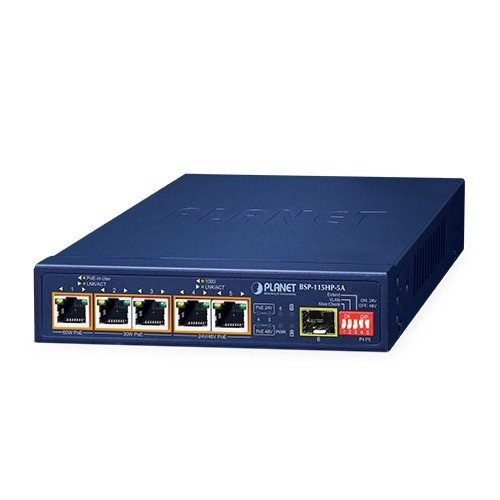
Both the Code Blue SLNP0048 and TP-Link TL-SG105PP-M2 are unmanaged 5-port PoE switches targeting edge deployments where powered endpoints need to share a single consolidation point. The Code Blue unit is purpose-built for emergency-communication and life-safety clusters, while the TP-Link is a general-purpose 2.5G multi-gigabit desktop switch with a higher PoE standard. This comparison evaluates the three dimensions that matter most to installers choosing between them: PoE capability and power budget, port speed and throughput, and physical deployment flexibility.
In This Guide
- Which switch delivers more PoE power, and to how many ports?
- How do the two switches compare on port speed and switching throughput?
- Which switch fits more physical installation scenarios, and what are the environmental limits?
- Which should you choose: the SLNP0048 or the SG105PP-M2?
- Side-by-Side Specs
- FAQ
Which switch delivers more PoE power, and to how many ports?
The TP-Link TL-SG105PP-M2 specifies 4 PoE++ ports conforming to 802.3bt (up to 90 W per port) with a stated PoE budget of 65 W and a total power consumption of 123 W. The switch also supports the lower 802.3af/at standards, making it backward-compatible with standard PoE and PoE+ devices.
The Code Blue SLNP0048 is rated PoE+ (802.3at, 30 W per port maximum) across all 5 ports. No aggregate PoE power budget figure is provided in the supplied specifications. Because the SLNP0048 is designed to feed Code Blue endpoints specifically, per-port PoE class and total budget constraints for mixed third-party loads are not documented in the available data.
For installations requiring 802.3bt (Type 3/4) power delivery — such as high-wattage PTZ cameras or Wi-Fi 6E access points — only the TP-Link specifies that standard. For Code Blue life-safety endpoint clusters where 802.3at suffices, the SLNP0048 covers all 5 ports at PoE+ without a documented per-port exclusion.
How do the two switches compare on port speed and switching throughput?
The TP-Link TL-SG105PP-M2 provides 5 ports at 2.5G Multi-Gigabit (2,500 Mbps), with a documented switching capacity of 19 Gbps and a forwarding rate listed at up to 119.0 Mpps. One port is designated as a non-PoE uplink, leaving 4 ports for powered devices.
The Code Blue SLNP0048 specifications do not state a port link speed, switching capacity, or forwarding rate. The product is described as delivering 'PoE+ power and data to five Code Blue endpoints,' but no throughput figures are provided in the supplied data. Buyers requiring a documented throughput specification for network-planning purposes cannot derive one from the available SLNP0048 specs.
For bandwidth-intensive applications — multi-megapixel camera streams, NVR uplinks, or high-density wireless — the TP-Link's 2.5G per-port speed and 19 Gbps fabric are documented and quantifiable. The SLNP0048 cannot be evaluated on this axis without additional manufacturer data.
Which switch fits more physical installation scenarios, and what are the environmental limits?
The Code Blue SLNP0048 supports four mounting configurations per its specs: wall, pole, recessed, and rack. This breadth directly addresses life-safety clusters in towers, refuge areas, and enclosures — the use case its bullets explicitly call out. No operating temperature range or IP rating is provided in the supplied specifications.
The TP-Link TL-SG105PP-M2 supports wall and rack mounting and is rated for 0–50 °C (32–122 °F) operating temperature. Its dimensions are 294 × 180 × 44 mm. No IP or NEMA ingress-protection rating is stated in the supplied specifications. The unit is designated a desktop switch.
The SLNP0048's pole and recessed mounting options extend it to outdoor enclosures and flush-mount applications not supported by the TP-Link's documented mount types. However, without an operating temperature rating for the SLNP0048, an installer cannot confirm suitability for non-climate-controlled spaces purely from the provided specs. The TP-Link's 0–50 °C rating covers most indoor IT-room and light-commercial environments.
Which should you choose: the SLNP0048 or the SG105PP-M2?
Our take: The SLNP0048 is the stronger choice when the installation is an all-Code Blue emergency-communication cluster requiring pole, recessed, or tower-enclosure mounting and where 802.3at per port is sufficient for every endpoint. The TL-SG105PP-M2 is the stronger choice for general IP-security deployments: it documents 2.5G per-port speed and a 19 Gbps switching fabric versus no throughput spec for the SLNP0048, supports 802.3bt (PoE++) against the SLNP0048's PoE+ ceiling, and provides a verified 0–50 °C operating range that the SLNP0048 spec sheet omits entirely. The TP-Link is also limited to wall and rack mounting; the SLNP0048 adds pole and recessed options. Buyers outfitting Code Blue life-safety clusters should specify the SLNP0048 for its purpose-built compatibility; buyers deploying multi-gigabit cameras, Wi-Fi 6 APs, or mixed-vendor PoE++ endpoints should select the TL-SG105PP-M2 based on its documented power and speed specifications.
Side-by-Side Comparison
Spec-for-spec, from manufacturer data.
| Specification | Code Blue SLNP0048 | TP-Link SG105PP-M2 |
|---|---|---|
| Brand | Code Blue | TP-Link |
| MPN | SLNP0048 | TL-SG105PP-M2 |
| Total Ports | 5 | 5 |
| PoE Port Count | 5 | 4 (1 non-PoE uplink) |
| PoE Standard | PoE+ (802.3at) | PoE++ (802.3bt / 802.3af / 802.3at) |
| PoE Budget | — | 65 W |
| Port Speed | — | 2.5G Multi-Gigabit per port |
| Switching Capacity | — | 19 Gbps |
| Forwarding Rate | — | Up to 119.0 Mpps |
| Managed | — | Unmanaged |
| Mount Types | Wall; Pole; Recessed; Rack | Wall; Rack |
| Dimensions | — | 294 × 180 × 44 mm |
| Operating Temp | — | 0–50 °C (32–122 °F) |
| Power Supply Input | 12–24 V DC | 100–240 VAC, 50/60 Hz |
| Max Power Consumption | — | 123 W |
| PoE Auto Recovery | — | Yes |
Frequently Asked Questions
Which should you choose: the SLNP0048 or the SG105PP-M2?
The SLNP0048 is the stronger choice when the installation is an all-Code Blue emergency-communication cluster requiring pole, recessed, or tower-enclosure mounting and where 802.3at per port is sufficient for every endpoint. The TL-SG105PP-M2 is the stronger choice for general IP-security deployments: it documents 2.5G per-port speed and a 19 Gbps switching fabric versus no throughput spec for the SLNP0048, supports 802.3bt (PoE++) against the SLNP0048's PoE+ ceiling, and provides a verified 0–50 °C operating range that the SLNP0048 spec sheet omits entirely. The TP-Link is also limited to wall and rack mounting; the SLNP0048 adds pole and recessed options. Buyers outfitting Code Blue life-safety clusters should specify the SLNP0048 for its purpose-built compatibility; buyers deploying multi-gigabit cameras, Wi-Fi 6 APs, or mixed-vendor PoE++ endpoints should select the TL-SG105PP-M2 based on its documented power and speed specifications.
Can the SLNP0048 power non-Code Blue devices like standard IP cameras or access points?
The SLNP0048 specs describe it as delivering PoE+ power to 'Code Blue endpoints' specifically. No documentation in the provided specs confirms or denies compatibility with third-party 802.3at devices. Installers should verify with Code Blue directly before connecting non-Code Blue loads.
Does the TL-SG105PP-M2 have enough PoE budget for four high-wattage cameras?
The TP-Link specifies a PoE budget of 65 W across its 4 PoE++ ports. At 802.3bt Type 3 (up to ~60 W per port), the 65 W aggregate budget realistically powers one or two high-wattage devices simultaneously, or four standard PoE (802.3af, ~15 W) devices. Plan the load per the 65 W budget ceiling documented in the specs.
Is either switch managed or does either support VLANs for segmenting camera traffic?
Neither switch is managed per the provided specifications. The TP-Link is explicitly listed as unmanaged with no VLAN or QoS configuration documented. No management capability is stated for the SLNP0048 either. Both are plug-and-play only; VLAN segmentation would require an upstream managed switch.
More Network Switch Comparisons
- TP-Link ES205GP vs Ubiquiti USW-FLEX
- TP-Link ES205GP vs Ubiquiti USW-FLEX-MINI
- TP-Link ES205GP vs Ubiquiti USW-FLEX-3
- TP-Link ES205GP vs Ubiquiti USW-FLEX-MINI-3
- TP-Link ES205GP vs TP-Link SG105PP-M2
- TP-Link SG105PP-M2 vs Ubiquiti USW-FLEX
Network Switch Buying Guides
Get a Second Opinion on Your Camera Choice
Share your site layout, coverage goals, and budget. Our team will validate the camera selection, flag anything we would change, and recommend products that match the use case.