
Brother TD4420DNC vs Sato WWCT04241-NDR: Specification Comparison
Both the Brother TD4420DNC and the Sato CT4-LX (WWCT04241-NDR) are direct thermal desktop label and receipt printers targeting commercial printing environments. They share the same print speed, display size, and form factor, making them a natural cross-shop for buyers evaluating desktop thermal printers for retail, warehouse, or logistics applications. Key differentiators include print resolution, ribbon/transfer capability, RFID encoding, wireless connectivity, memory, and media width range — each of which may be decisive depending on the deployment's labeling standards and infrastructure requirements.

In This Guide
- How do the print engine specs — resolution, method, and media handling — differ between these two printers?
- Which printer offers broader connectivity and does either unit support RFID encoding?
- How do memory, display, operating environment, and physical specs compare for long-run and multi-user deployments?
- Which should you choose: the TD4420DNC or the WWCT04241-NDR?
- Side-by-Side Specs
- FAQ
How do the print engine specs — resolution, method, and media handling — differ between these two printers?
The Brother TD4420DNC prints exclusively via Direct Thermal at 203 dpi, with a maximum print width of 4.27 inches and a paper width range of 0.75 to 4.65 inches. It supports labels, tags, wristbands, and receipts, and includes an integrated cutter for automated media separation. Its programming language support spans ZPL II, CPCL, Raster Graphics, and ESC P text templates.
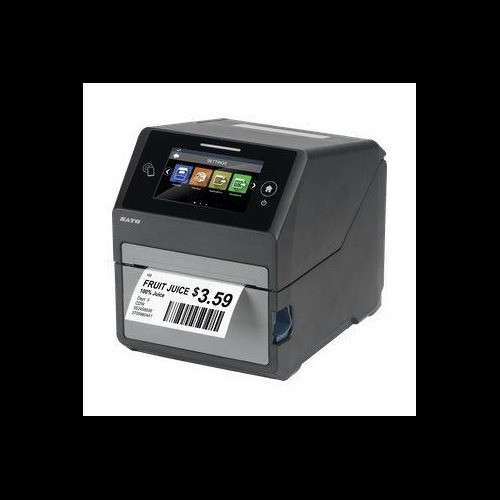
The Sato CT4-LX supports both Direct Thermal and Thermal Transfer printing at a stated 305 dpi (note: the '_Print_Resolution' field also lists 203, creating a spec conflict — the tilde-prefixed marketing spec and Card Bullet 1 cite 305 dpi, which is used here as the primary value). Its maximum print width is 4.09 inches and media width range is 1 to 4.1 inches. Thermal Transfer capability means the Sato can use ribbon-based printing for longer-lasting labels on synthetic or coated media, an option the Brother lacks entirely. Maximum ribbon length is 984 ft (300 m). No integrated cutter is listed in the Sato's specs.
Which printer offers broader connectivity and does either unit support RFID encoding?
The Brother TD4420DNC provides USB, Serial, and Ethernet LAN ports. No wireless connectivity — Wi-Fi or Bluetooth — is listed in its specifications. Serial port availability is relevant for legacy POS and industrial controller integrations that still use RS-232.
The Sato CT4-LX offers Ethernet, Wi-Fi, Bluetooth, and USB. The addition of Wi-Fi and Bluetooth gives the Sato flexibility for mobile cart deployments, warehouse zones without fixed Ethernet drops, or pairing with handheld devices. Critically, the Sato also integrates a UHF RFID encoder operating at 860–960 MHz EPC Class 1 Gen 2 — a capability entirely absent from the Brother. This makes the Sato capable of simultaneously printing a human-readable label and encoding a corresponding RFID inlay in a single pass, which is mandatory in supply chains governed by GS1 or retailer RFID compliance mandates. The Brother has no RFID capability listed.
How do memory, display, operating environment, and physical specs compare for long-run and multi-user deployments?
The Brother TD4420DNC carries 64 MB Flash (40 MB usable for templates/databases) and 256 MB SDRAM. Its display is a 4.3-inch screen; display type (color vs. monochrome, touch vs. button-driven) is not specified in the provided data. It weighs 5.3 lbs (2.41 kg) and measures 7.08 W x 9.50 D x 6.10 H inches. Operating temperature is not listed in the provided specs.
The Sato CT4-LX carries 4 GB Flash, 1 GB DDR3 RAM, and 2 GB user storage — substantially more memory at every tier. Its display is explicitly a 4.3-inch full-color touchscreen, enabling on-printer job management, format selection, and status monitoring without a host PC. It weighs 7.3 lbs (3.3 kg) and measures 7.0 W x 9.375 D x 8.4375 H inches — slightly taller but marginally narrower and shallower. Operating temperature is rated 32°F to 104°F (0°C to 40°C). Power input is AC 100–240V, 50/60Hz. The Brother's power spec and operating temperature are not provided. The Sato's 1-year warranty is explicitly stated; the Brother lists only 'Manufacturer Warranty' with no duration specified.
Which should you choose: the TD4420DNC or the WWCT04241-NDR?
Our take: The TD4420DNC is the stronger choice when the deployment requires serial-port legacy POS integration, automated media cutting, and a lower-complexity direct thermal setup without ribbon management. However, on most technical dimensions the Sato CT4-LX (WWCT04241-NDR) is the more capable unit: it offers 305 dpi versus 203 dpi for sharper barcodes and fine-print labels, adds Wi-Fi and Bluetooth alongside Ethernet where the Brother is wired-only, and integrates UHF RFID encoding (860–960 MHz EPC C1G2) that the Brother entirely lacks. Memory is also significantly deeper — 4 GB Flash and 1 GB DDR3 versus 64 MB Flash and 256 MB SDRAM — relevant for large format libraries and high-volume batch queues. Choose the Brother TD4420DNC for cutter-dependent receipt or label workflows on wired networks with legacy serial devices. Choose the Sato CT4-LX for RFID-compliance mandates, wireless deployments, thermal transfer durability requirements, or environments needing a full-color touchscreen operator interface.
Side-by-Side Comparison
Spec-for-spec, from manufacturer data.
| Specification | Brother TD4420DNC | Sato WWCT04241-NDR |
|---|---|---|
| Print Method | Direct Thermal only | Direct Thermal / Thermal Transfer |
| Print Resolution | 203 dpi | 305 dpi |
| Print Speed | 8 ips | 8 ips |
| Max Print Width | 4.27" | 4.09" |
| Media Width Range | 0.75" – 4.65" | 1" – 4.1" |
| Connectivity | USB, Serial, Ethernet LAN | USB, Ethernet, Wi-Fi, Bluetooth |
| RFID Capability | — | UHF 860–960 MHz EPC C1G2 |
| Integrated Cutter | Yes | Not specified |
| Display | 4.3" | 4.3" Full-Color Touchscreen |
| Flash Memory | 64 MB (40 MB usable) | 4 GB |
| RAM | 256 MB SDRAM | 1 GB DDR3 |
| User Storage | — | 2 GB |
| Max Ribbon Length | — | 984 ft (300 m) |
| Weight | 5.3 lbs (2.41 kg) | 7.3 lbs (3.3 kg) |
| Dimensions (W x D x H) | 7.08" x 9.50" x 6.10" | 7.0" x 9.375" x 8.4375" |
| Warranty | Manufacturer Warranty (duration not specified) | 1-year Warranty |
Frequently Asked Questions
Which should you choose: the TD4420DNC or the WWCT04241-NDR?
The TD4420DNC is the stronger choice when the deployment requires serial-port legacy POS integration, automated media cutting, and a lower-complexity direct thermal setup without ribbon management. However, on most technical dimensions the Sato CT4-LX (WWCT04241-NDR) is the more capable unit: it offers 305 dpi versus 203 dpi for sharper barcodes and fine-print labels, adds Wi-Fi and Bluetooth alongside Ethernet where the Brother is wired-only, and integrates UHF RFID encoding (860–960 MHz EPC C1G2) that the Brother entirely lacks. Memory is also significantly deeper — 4 GB Flash and 1 GB DDR3 versus 64 MB Flash and 256 MB SDRAM — relevant for large format libraries and high-volume batch queues. Choose the Brother TD4420DNC for cutter-dependent receipt or label workflows on wired networks with legacy serial devices. Choose the Sato CT4-LX for RFID-compliance mandates, wireless deployments, thermal transfer durability requirements, or environments needing a full-color touchscreen operator interface.
Can either the TD4420DNC or the WWCT04241-NDR print RFID labels?
Only the Sato WWCT04241-NDR (CT4-LX) supports RFID encoding. It integrates a UHF encoder operating at 860–960 MHz EPC Class 1 Gen 2, allowing simultaneous label printing and RFID inlay encoding in one pass. The Brother TD4420DNC has no RFID capability listed in its specifications.
Which printer is better for a warehouse using Wi-Fi carts or Bluetooth mobile devices?
The Sato CT4-LX (WWCT04241-NDR) supports Ethernet, Wi-Fi, Bluetooth, and USB. The Brother TD4420DNC is limited to USB, Serial, and Ethernet LAN — no wireless interfaces are listed. For Wi-Fi cart or Bluetooth-paired deployments, the Sato is the only option of the two based on the provided specifications.
Does either printer include a built-in cutter, and which supports thermal transfer ribbon printing?
The Brother TD4420DNC includes an integrated label cutter, which is not listed for the Sato CT4-LX. Conversely, only the Sato CT4-LX supports Thermal Transfer printing (in addition to Direct Thermal), with a maximum ribbon length of 984 ft (300 m) — enabling longer-lasting labels on synthetic media. The Brother is Direct Thermal only, requiring no ribbon but also offering no ribbon-based durability option.
More Label Printer Comparisons
- Brother TD4550DNWB vs Sato WWCT04241-WCN
- Brother TD4550DNWB vs Sato WWCT04241-NDR
- Brother TD4550DNWB vs Sato WT212-404CW-EX1-2
- Brother TD4550DNWB vs Sato WWCT04441-WDR
- Brother TD4550DNWB vs Brother TD4420DNC
- Brother TD4550DNWB vs Brother TD4410D
Label Printer Buying Guides
Get a Second Opinion on Your Camera Choice
Share your site layout, coverage goals, and budget. Our team will validate the camera selection, flag anything we would change, and recommend products that match the use case.