
Brother TD4410D vs Sato WWCT04441-WDR: Specification Comparison
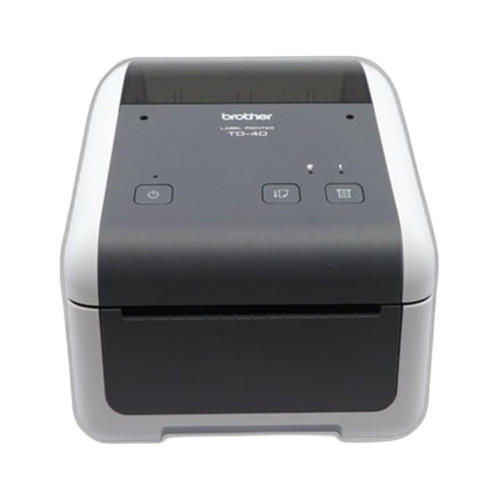
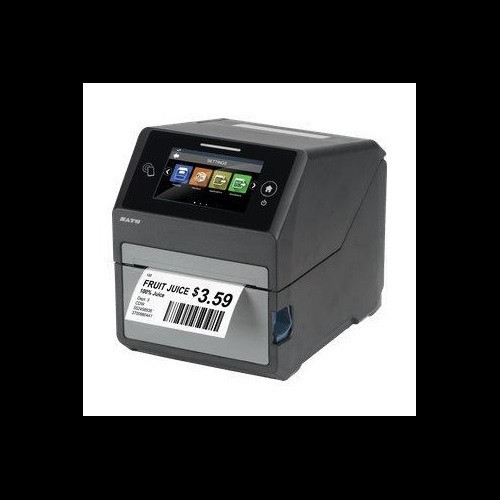
Both the Brother TD4410D and the Sato CT4-LX (WWCT04441-WDR) are direct thermal desktop label printers targeting label, tag, and barcode printing workloads in warehouse, logistics, retail, and asset-management environments. Both share the same 8 ips print speed and desktop form factor, but they diverge sharply on resolution, connectivity, RFID capability, memory architecture, and display interface — dimensions that materially affect which platform fits a given deployment.
In This Guide
- Which printer delivers higher output quality and broader media flexibility?
- Which printer integrates more broadly with modern network and smart-label infrastructure?
- Which printer better fits existing software ecosystems and long-term scalability?
- Which should you choose: the TD4410D or the WWCT04441-WDR?
- Side-by-Side Specs
- FAQ
Which printer delivers higher output quality and broader media flexibility?
The Sato CT4-LX is specified at 305 dpi (per datasheet and card bullets), giving it a clear resolution advantage over the Brother TD4410D's 203 dpi. For applications demanding fine-pitch barcodes, small human-readable text, or GS1 DataMatrix symbols at reduced label sizes, the CT4-LX's higher dot density produces sharper output without scaling up label dimensions. Note: the CT4-LX spec sheet also lists a '203' under Print Resolution in one field — the datasheet value of 305 dpi and the product SKU suffix are the authoritative figures used here; buyers should confirm with the datasheet.
On media width, the TD4410D accepts a broader range — 0.75" to 4.65" paper width with a 4.27" maximum print width — versus the CT4-LX's 1" to 4.1" media width and 4.09" maximum print width. The TD4410D therefore handles narrower specialty labels (down to 0.75") and wider stock (up to 4.65" feed) that the CT4-LX cannot. Both units run at 8 ips. The CT4-LX additionally supports thermal transfer printing with ribbons up to 984 feet long, enabling durable resin/wax printing on synthetic substrates — a capability the TD4410D's direct-thermal-only design does not provide.
For wristbands, receipts, and standard GS1 shipping labels at moderate density, the TD4410D's 203 dpi is sufficient. For pharmaceutical, electronics, or compliance labels requiring high-density symbologies or small-pitch printing, the CT4-LX's 305 dpi is the specified differentiator.
Which printer integrates more broadly with modern network and smart-label infrastructure?
Connectivity is where the two products diverge most substantially. The Brother TD4410D offers USB 2.0 and a 9-pin Serial port — adequate for direct-connect POS, WMS terminals, and legacy logistics stacks, but it provides no wired Ethernet, no Wi-Fi, and no Bluetooth as specified.
The Sato CT4-LX lists USB, Ethernet, Wi-Fi, and Bluetooth as standard connectivity options, supporting both wired network integration and wireless placement flexibility without additional adapters. For shared-printer deployments, print-server environments, or mobile cart applications, the CT4-LX's four-interface portfolio eliminates the USB-only constraint of the TD4410D.
The CT4-LX also incorporates HF/NFC RFID encoding at 13.56 MHz with SATO RF Analyze, which auto-tunes the antenna for each inlay type. This enables simultaneous print-and-encode workflows for smart labels, asset tags, and NFC-enabled media — a capability entirely absent from the TD4410D's spec sheet. Organizations running RFID-based inventory, access control badge printing, or NFC consumer engagement labels must select the CT4-LX; the TD4410D has no RFID specification at all.
The CT4-LX further includes a 4.3" full-color touchscreen display, enabling on-device job management, status monitoring, and menu navigation. The TD4410D's spec sheet lists no onboard display.
Which printer better fits existing software ecosystems and long-term scalability?
The Brother TD4410D specifies 64 MB Flash (40 MB available for templates and databases) and 256 MB SDRAM. The Sato CT4-LX specifies 4 GB Flash, 1 GB DDR3 RAM, and 2 GB user storage — a memory architecture roughly two orders of magnitude larger by flash capacity. This supports larger resident font libraries, more stored label templates, firmware headroom, and RFID inlay databases without host-side dependency.
On programming language compatibility, the TD4410D documents support for ZPL II, CPCL, Raster Graphics, and ESC/P (Text Template) — a multi-language profile that enables drop-in replacement or parallel operation in mixed Zebra/Honeywell/Epson label ecosystems. The CT4-LX's spec sheet does not enumerate supported programming languages in the provided data; buyers integrating into ZPL-only or CPCL-dependent WMS environments should verify CT4-LX language emulation with Sato before specifying.
Weight and footprint are also relevant on crowded workbenches: the TD4410D weighs 4.58 lbs at 7.08" W × 8.82" D × 6.10" H; the CT4-LX weighs 7.3 lbs at 7.0" W × 9.375" D × 8.4375" H. The CT4-LX is heavier and taller but similarly narrow. Both are desktop-only; neither spec sheet documents a wall- or rack-mount option. The CT4-LX specifies an operating range of 32°F–104°F (0°C–40°C) and AC 100–240V 50/60Hz; the TD4410D's operating temperature and power input are not stated in the provided specs.
Which should you choose: the TD4410D or the WWCT04441-WDR?
Our take: The CT4-LX (WWCT04441-WDR) is the stronger choice when the deployment requires RFID encoding, network connectivity, or higher print resolution. Its 305 dpi output exceeds the TD4410D's 203 dpi, its four-interface connectivity (USB, Ethernet, Wi-Fi, Bluetooth) versus the TD4410D's USB-and-Serial-only profile enables network-shared and wireless deployments, and its 13.56 MHz HF/NFC RFID encoder with RF Analyze covers smart-label workflows the TD4410D cannot address at all. Memory is also dramatically larger: 4 GB Flash and 1 GB DDR3 versus 64 MB Flash and 256 MB SDRAM. Conversely, the TD4410D is the stronger choice for cost-sensitive, direct-connect POS or WMS workloads running ZPL II or CPCL software stacks — its documented multi-language support, wider media range (0.75" to 4.65"), and lighter 4.58 lb chassis are practical advantages where RFID and networking are unnecessary.
Side-by-Side Comparison
Spec-for-spec, from manufacturer data.
| Specification | Brother TD4410D | Sato WWCT04441-WDR |
|---|---|---|
| Print Method | Direct Thermal only | Direct Thermal / Thermal Transfer |
| Print Resolution | 203 dpi | 305 dpi |
| Print Speed | 8 ips | 8 ips |
| Max Print Width | 4.27" | 4.09" |
| Media Width Range | 0.75" – 4.65" | 1" – 4.1" |
| Max Ribbon Length | — | 984 ft |
| Connectivity | USB, Serial | USB, Ethernet, Wi-Fi, Bluetooth |
| RFID | — | 13.56 MHz HF/NFC with RF Analyze |
| Display | — | 4.3" full-color touchscreen |
| Flash Memory | 64 MB (40 MB user) | 4 GB |
| RAM | 256 MB SDRAM | 1 GB DDR3 |
| User Storage | — | 2 GB |
| Programming Languages | ZPL II, CPCL, Raster, ESC/P | Not specified in provided data |
| Weight | 4.58 lbs | 7.3 lbs |
| Dimensions (W × D × H) | 7.08" × 8.82" × 6.10" | 7.0" × 9.375" × 8.4375" |
| Warranty | Manufacturer Warranty (duration not specified) | 1-year Warranty |
Frequently Asked Questions
Which should you choose: the TD4410D or the WWCT04441-WDR?
The CT4-LX (WWCT04441-WDR) is the stronger choice when the deployment requires RFID encoding, network connectivity, or higher print resolution. Its 305 dpi output exceeds the TD4410D's 203 dpi, its four-interface connectivity (USB, Ethernet, Wi-Fi, Bluetooth) versus the TD4410D's USB-and-Serial-only profile enables network-shared and wireless deployments, and its 13.56 MHz HF/NFC RFID encoder with RF Analyze covers smart-label workflows the TD4410D cannot address at all. Memory is also dramatically larger: 4 GB Flash and 1 GB DDR3 versus 64 MB Flash and 256 MB SDRAM. Conversely, the TD4410D is the stronger choice for cost-sensitive, direct-connect POS or WMS workloads running ZPL II or CPCL software stacks — its documented multi-language support, wider media range (0.75" to 4.65"), and lighter 4.58 lb chassis are practical advantages where RFID and networking are unnecessary.
Can the TD4410D or WWCT04441-WDR print RFID smart labels?
Only the Sato CT4-LX (WWCT04441-WDR) supports RFID encoding. It is specified with a 13.56 MHz HF/NFC RFID encoder and SATO RF Analyze for antenna auto-tuning. The Brother TD4410D has no RFID capability listed in its specifications; it cannot encode smart labels.
Which printer works better in a networked or multi-user environment?
The Sato CT4-LX (WWCT04441-WDR) is the specified choice for networked deployments. It lists Ethernet, Wi-Fi, Bluetooth, and USB as connectivity options. The Brother TD4410D specifies only USB and Serial interfaces — no Ethernet or wireless connectivity is documented, making it a direct-connect-only printer.
Does the Brother TD4410D support ZPL II for Zebra-based WMS integrations?
Yes. The TD4410D explicitly lists ZPL II, CPCL, Raster Graphics, and ESC/P (Text Template) as supported programming languages, enabling drop-in use in environments built around Zebra or Honeywell label software. The Sato CT4-LX's supported programming languages are not enumerated in the provided specifications; buyers should confirm language emulation compatibility with Sato before deploying in a ZPL-dependent workflow.
More Label Printer Comparisons
- Brother TD4550DNWB vs Sato WWCT04241-WCN
- Brother TD4550DNWB vs Sato WWCT04241-NDR
- Brother TD4550DNWB vs Sato WT212-404CW-EX1-2
- Brother TD4550DNWB vs Sato WWCT04441-WDR
- Brother TD4550DNWB vs Brother TD4420DNC
- Brother TD4550DNWB vs Brother TD4410D
Label Printer Buying Guides
Get a Second Opinion on Your Camera Choice
Share your site layout, coverage goals, and budget. Our team will validate the camera selection, flag anything we would change, and recommend products that match the use case.