
APC by Schneider Electric SYH6K6RMT-TF3 vs Vertiv GXT5-6000MVRT4UXLN: Specification Comparison
Both the APC Symmetra RM SYH6K6RMT-TF3 and the Vertiv GXT5-6000MVRT4UXLN are rack-mountable, online double-conversion 6 kVA UPS systems targeted at data center and critical IT infrastructure buyers. Each offers sealed lead-acid battery backup, management interfaces, and standard rack form factors. This comparison evaluates their power delivery and efficiency, physical and environmental characteristics, and connectivity and management capabilities to help installers and IT procurement teams select the right unit for their deployment.
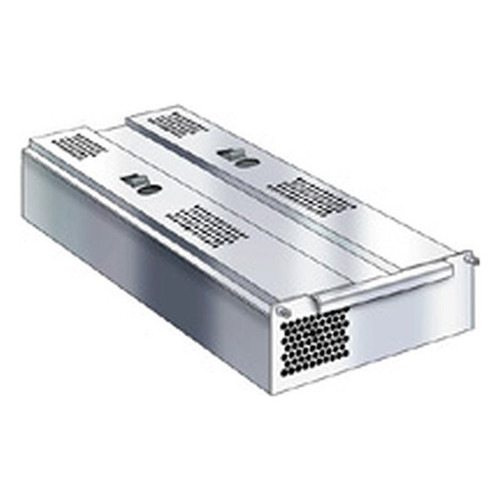
In This Guide
- How do the SYH6K6RMT-TF3 and GXT5-6000MVRT4UXLN compare on power delivery, efficiency, and output flexibility?
- How do the two units compare on physical footprint, weight, battery characteristics, and operating environment?
- Which unit offers broader management, interface, and integration options for IT and facilities teams?
- Which should you choose: the SYH6K6RMT-TF3 or the GXT5-6000MVRT4UXLN?
- Side-by-Side Specs
- FAQ
How do the SYH6K6RMT-TF3 and GXT5-6000MVRT4UXLN compare on power delivery, efficiency, and output flexibility?
Both units are rated at 6,000 VA, but they diverge significantly on watt output and voltage architecture. The APC SYH6K6RMT-TF3 delivers 4,200 W at its 6 kVA rating, implying a power factor of 0.7. The Vertiv GXT5-6000MVRT4UXLN is rated at 6,000 W — a full unity power factor — meaning it can deliver 43% more real power (watts) from the same VA rating under resistive or near-unity loads.
On input, the APC unit specifies a 60 Hz input frequency but does not publish an input voltage range in the provided specs. The Vertiv accepts a typical 208 VAC input with a wide range of 176–280 VAC, and its output is user-configurable at 208/120 VAC. The APC provides discrete NEMA receptacles (4x L5-20R, 2x L6-20R), while the Vertiv uses hardwired input/output with optional POD (Power Output Distribution) modules.
Efficiency data is provided only for the Vertiv: up to 98% in Active ECO Mode and up to 95% in online double-conversion mode. No efficiency figure is published in the APC specs. Buyers with aggressive PUE targets will find the Vertiv's documented efficiency advantage material; the APC's efficiency cannot be compared on the basis of provided data alone.
How do the two units compare on physical footprint, weight, battery characteristics, and operating environment?
The Vertiv GXT5-6000MVRT4UXLN occupies 6.8 in (H) × 16.9 in (W) × 25.6 in (D) at a weight of 125.6 lb (approximately 57 kg). Physical dimensions are not provided in the APC SYH6K6RMT-TF3 specs, but its published weight of 176.8 kg (approximately 389.8 lb) is more than three times heavier than the Vertiv — a significant floor-loading and logistics consideration for rack installations.
Both units share an identical operating temperature range of 0–40 °C and both use Sealed Lead Acid (VRLA) battery technology, though the Vertiv spec does not explicitly confirm battery chemistry in the provided data. The APC spec adds storage temperature (−15 to 45 °C), operating relative humidity (0–95%), and storage relative humidity (0–95%); equivalent environmental envelope data is not provided for the Vertiv beyond its operating temperature.
The APC SYH6K6RMT-TF3 explicitly documents a 3-hour battery recharge time and hot-swap battery capability, as well as Emergency Power Off (EPO) and audible alarms. The Vertiv spec does not state recharge time, hot-swap status, EPO availability, or audible alarm features in the provided data — buyers requiring confirmed hot-swap or EPO on the Vertiv should verify against the full datasheet.
Which unit offers broader management, interface, and integration options for IT and facilities teams?
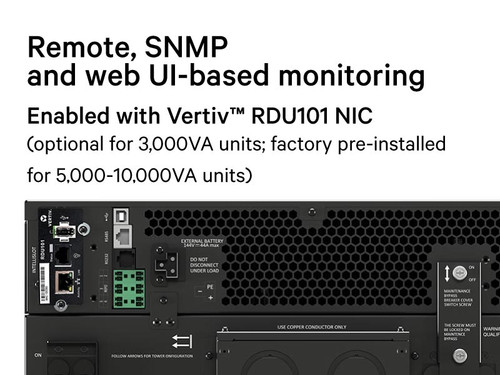
The Vertiv GXT5-6000MVRT4UXLN ships with a factory pre-installed Vertiv RDU101 SNMP/Webcard, enabling SNMP and web-based management out of the box with no additional card purchase. Its interface suite includes USB, RS-485, RS-232, a terminal block, and an external battery connector. Protocol support covers SNMP and web management, plus serial for out-of-band access. A full-color graphic LCD with gravity-sensing orientation provides local status visibility during installation and operation.
The APC SYH6K6RMT-TF3 provides a DB-9 RS-232 port and an RJ-45 interface. No SNMP card, network management capability, or LCD display is mentioned in the provided specs. Buyers integrating into NMS or DCIM platforms should note that network management on the APC unit may require a separately purchased SmartSlot network card, which is not confirmed in the provided specifications.
On certifications, the APC holds CSA, FCC Part 15 Class A, and UL 1778. The Vertiv carries UL 1778, c-UL, ENERGY STAR 2.0, RoHS2, and REACH. The Vertiv's ENERGY STAR 2.0 certification and RoHS2/REACH compliance are relevant for government procurement, sustainability mandates, and deployments in regulated environments. The APC's FCC Part 15 Class A listing addresses conducted/radiated emissions — the Vertiv's equivalent EMC certification is not stated in the provided specs.
Which should you choose: the SYH6K6RMT-TF3 or the GXT5-6000MVRT4UXLN?
Our take: The GXT5-6000MVRT4UXLN is the stronger choice when real power output, energy efficiency, and built-in network management are the primary decision criteria. It delivers 6,000 W versus the SYH6K6RMT-TF3's 4,200 W — 43% more usable watts from the same 6 kVA rating — making it materially better suited to modern server loads operating near unity power factor. Its documented efficiency reaches 98% in ECO mode and 95% online; no equivalent figure is available for the APC unit. The Vertiv also ships with an SNMP/Webcard and color LCD standard, while network management on the APC requires verification of additional hardware. Conversely, the SYH6K6RMT-TF3's 176.8 kg weight versus the Vertiv's 57 kg raises significant structural concerns; the Vertiv is far easier to rack. The APC unit does explicitly confirm hot-swap batteries, EPO, and discrete NEMA receptacles — useful for legacy branch-circuit wiring. The SYH6K6RMT-TF3 is better suited to existing APC-ecosystem sites with legacy receptacle requirements; the Vertiv fits modern high-density, network-managed, efficiency-conscious data center deployments.
Side-by-Side Comparison
Spec-for-spec, from manufacturer data.
| Specification | APC by Schneider Electric SYH6K6RMT-TF3 | Vertiv GXT5-6000MVRT4UXLN |
|---|---|---|
| VA Rating | 6,000 VA | 6,000 VA |
| Watt Output | 4,200 W | 6,000 W |
| Power Factor | 0.70 (derived) | 1.00 (derived) |
| Topology | Not stated in provided specs | Online double-conversion |
| Input Voltage Range | Not stated in provided specs | 176–280 VAC (typical 208 VAC) |
| Output Voltage | Not stated in provided specs | 208/120 VAC (user-configurable) |
| Input Frequency | 60 Hz | Not stated in provided specs |
| Efficiency | Not stated in provided specs | Up to 98% ECO / 95% online |
| Weight | 176.8 kg (389.8 lb) | 125.6 lb (57.0 kg) |
| Height | Not stated in provided specs | 6.8 in |
| Battery Technology | VRLA (Sealed Lead Acid) | Not stated in provided specs |
| Battery Recharge Time | 3 hours | Not stated in provided specs |
| Hot-Swap Battery | Yes | Not stated in provided specs |
| EPO | Yes | Not stated in provided specs |
| Interfaces | DB-9 RS-232, RJ-45 | SNMP/Webcard (factory), USB, RS-485, RS-232, terminal block, ext. battery connector |
| Certifications | CSA, FCC Part 15 Class A, UL 1778 | UL 1778, c-UL, ENERGY STAR 2.0, RoHS2, REACH |
Frequently Asked Questions
Which should you choose: the SYH6K6RMT-TF3 or the GXT5-6000MVRT4UXLN?
The GXT5-6000MVRT4UXLN is the stronger choice when real power output, energy efficiency, and built-in network management are the primary decision criteria. It delivers 6,000 W versus the SYH6K6RMT-TF3's 4,200 W — 43% more usable watts from the same 6 kVA rating — making it materially better suited to modern server loads operating near unity power factor. Its documented efficiency reaches 98% in ECO mode and 95% online; no equivalent figure is available for the APC unit. The Vertiv also ships with an SNMP/Webcard and color LCD standard, while network management on the APC requires verification of additional hardware. Conversely, the SYH6K6RMT-TF3's 176.8 kg weight versus the Vertiv's 57 kg raises significant structural concerns; the Vertiv is far easier to rack. The APC unit does explicitly confirm hot-swap batteries, EPO, and discrete NEMA receptacles — useful for legacy branch-circuit wiring. The SYH6K6RMT-TF3 is better suited to existing APC-ecosystem sites with legacy receptacle requirements; the Vertiv fits modern high-density, network-managed, efficiency-conscious data center deployments.
Is the SYH6K6RMT-TF3 or GXT5-6000MVRT4UXLN better for high-density modern server loads?
The GXT5-6000MVRT4UXLN is better suited to high-density modern server loads. It delivers 6,000 W at unity power factor, versus the SYH6K6RMT-TF3's 4,200 W at 0.7 power factor. Modern servers and storage devices commonly operate at or near unity power factor, meaning the Vertiv unit provides 43% more usable real power from the same 6 kVA rating. The APC unit's lower watt rating could result in premature overload on dense compute racks.
Does either UPS include network management out of the box, or do I need to buy an add-on card?
The Vertiv GXT5-6000MVRT4UXLN includes a factory pre-installed RDU101 SNMP/Webcard with SNMP and web management enabled at no additional cost. The APC SYH6K6RMT-TF3 provides only a DB-9 RS-232 and RJ-45 interface in the provided specifications; network management capability is not confirmed in the provided specs and may require a separately purchased SmartSlot card. Buyers should verify APC network management options before purchase if SNMP integration is required.
Which unit is easier to install in a standard equipment rack given weight and size constraints?
The Vertiv GXT5-6000MVRT4UXLN is substantially easier to rack-install. It weighs 125.6 lb (approximately 57 kg) and occupies a known 6.8 in rack height. The APC SYH6K6RMT-TF3 weighs 176.8 kg (approximately 389.8 lb) — more than three times heavier — and its rack-unit height is not stated in the provided specifications. The APC unit's extreme weight has significant implications for floor loading, lifting equipment requirements, and rack structural ratings.
More UPS Comparisons
- APC by Schneider Electric SYH6K6RMT vs CyberPower OL6KRTHW
- APC by Schneider Electric SYH6K6RMT vs CyberPower OL6KRTHD
- APC by Schneider Electric SYH6K6RMT vs Vertiv GXT5-6000MVRT4UXLN
- APC by Schneider Electric SYH6K6RMT vs Vertiv GXT5-6KL630RT5UXLN
- APC by Schneider Electric SYH6K6RMT vs APC by Schneider Electric SYH6K6RMI
- APC by Schneider Electric SYH6K6RMT vs APC by Schneider Electric SYH6K6RMT-TF3
UPS Buying Guides
Get a Second Opinion on Your Camera Choice
Share your site layout, coverage goals, and budget. Our team will validate the camera selection, flag anything we would change, and recommend products that match the use case.