
APC by Schneider Electric SUVTP15KF2B4S vs APC by Schneider Electric E3SUPS15KFBS: Specification Comparison
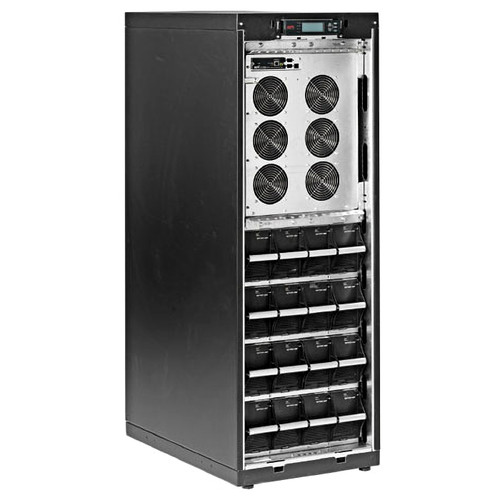
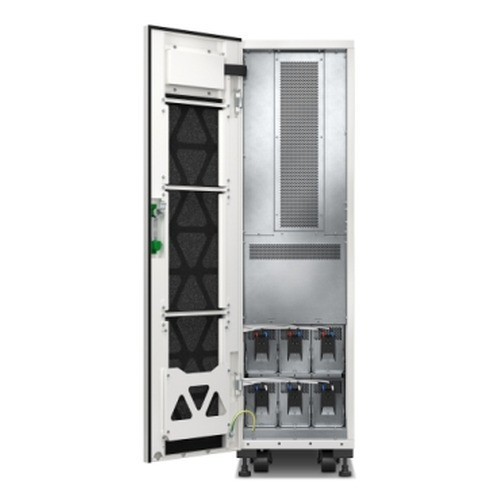
Both the SUVTP15KF2B4S and E3SUPS15KFBS are APC by Schneider Electric 15 kVA uninterruptible power supply units targeting critical infrastructure and electrical-room deployments. The Smart-UPS VT (SUVTP15KF2B4S) is a rackmount, single-phase-output unit with an expandable battery module design, while the Easy UPS 3S (E3SUPS15KFBS) is a floor-standing, three-phase double-conversion online UPS with internal battery slots. Buyers cross-shopping at the 15 kVA tier will find meaningful differences in topology, phase configuration, input voltage range, and physical form factor.
In This Guide
- Which unit delivers cleaner, more reliable output power — and how does topology affect that?
- What are the input power requirements and how does phase configuration affect installation suitability?
- How do the two units compare on operating environment limits, battery design, and connectivity options?
- Which should you choose: the SUVTP15KF2B4S or the E3SUPS15KFBS?
- Side-by-Side Specs
- FAQ
Which unit delivers cleaner, more reliable output power — and how does topology affect that?
The E3SUPS15KFBS specifies a double-conversion online topology, which continuously regenerates the output waveform from the DC bus, providing zero transfer time and output voltage tolerance of ±1.5%. Output harmonic distortion is stated at less than 3% for linear loads. The SUVTP15KF2B4S does not specify its UPS topology in the provided data; its output THD is stated at 5%, and no output voltage tolerance figure is given.
On rated power, both units match at 15 kVA. The SUVTP15KF2B4S lists 12,000 W (0.8 power factor), while the E3SUPS15KFBS lists 15,000 W at a 1.0 implied power factor (rated 15 kVA / 15 kW). The E3SUPS15KFBS also specifies load power factor range of 0.9 leading to 0.9 lagging and a Cos Phi of 0.99, neither of which is provided for the SUVTP15KF2B4S.
The SUVTP15KF2B4S reports 93% efficiency. The E3SUPS15KFBS does not supply a comparable percentage efficiency figure in the provided specs; the field labeled 'Efficiency At Full Load' contains a voltage range value (304–477 V), which does not represent an efficiency percentage and cannot be used for comparison.
What are the input power requirements and how does phase configuration affect installation suitability?
The E3SUPS15KFBS is a three-phase input / three-phase output (3:3) unit. It accepts 380 V, 400 V, or 415 V AC three-phase input, with a maximum input current of 28 A and input harmonic distortion of less than 3% at full load. Output is stated as 208 V AC (also 380 V / 415 V listed as other output voltages). Output frequency is 60 Hz. This unit is intended for electrical-room installation with three-phase infrastructure.
The SUVTP15KF2B4S is described as a 208 V unit in its product name and lists a single AC outlet as its output configuration, suggesting single-phase or line-to-line output from a three-phase source — however, the provided specs do not explicitly state input phase count, input voltage, input current, or input frequency, limiting direct comparison on those axes.
Form factor also diverges significantly. The SUVTP15KF2B4S is a rackmount unit (color: black) with expandable battery modules (starts with 2, expandable to 4). The E3SUPS15KFBS is floor-standing (dimensions: 140 cm height; weight: 112 kg; color: white RAL 9003) with 3 empty internal battery slots and 0 included battery modules, requiring separate battery purchase. Its packaged weight is 145 kg.
How do the two units compare on operating environment limits, battery design, and connectivity options?
Operating temperature is 0–40 °C for the SUVTP15KF2B4S and a maximum of 40 °C (104 °F) for the E3SUPS15KFBS — effectively equivalent upper bounds. Storage temperature differs: the SUVTP15KF2B4S is rated to –50 °C storage minimum, while the E3SUPS15KFBS is rated to –15 °C. Operating altitude for the SUVTP15KF2B4S is 0–999.9 m; the E3SUPS15KFBS states 0–3,333 ft (approximately 0–1,016 m) — comparable ranges. Non-operating altitude is 0–15,000 m for the SUVTP15KF2B4S and 0–15,240 m (49,212.6 ft) for the E3SUPS15KFBS. Both specify 0–95% relative humidity (non-condensing) for operating and storage.
Both units use VRLA (sealed lead acid) battery technology. The SUVTP15KF2B4S provides a battery recharge time of 5 hours; no recharge time is specified for the E3SUPS15KFBS. Battery voltage is 240 V DC for the E3SUPS15KFBS and is not specified for the SUVTP15KF2B4S. The E3SUPS15KFBS has a DC system voltage of 120 V DC listed separately.
For connectivity, the SUVTP15KF2B4S includes 1 serial port. The E3SUPS15KFBS offers an optional network management card 3 (NMC3) but no connectivity is included as standard; no serial port is mentioned. The SUVTP15KF2B4S also includes Emergency Power Off (EPO) and audible alarms — neither feature is referenced in the E3SUPS15KFBS spec data provided. The E3SUPS15KFBS specifies IP20 enclosure protection and an acoustic level of 60 dBA; neither figure is provided for the SUVTP15KF2B4S. Heat dissipation for the E3SUPS15KFBS is 852 W; no figure is given for the SUVTP15KF2B4S.
Which should you choose: the SUVTP15KF2B4S or the E3SUPS15KFBS?
Our take: The E3SUPS15KFBS is the stronger choice when the installation requires three-phase power distribution, double-conversion online topology, and tighter output conditioning in an electrical-room environment. Its explicitly stated double-conversion architecture eliminates transfer time entirely, and its output THD of less than 3% (versus 5% for the SUVTP15KF2B4S) delivers cleaner power to sensitive loads. Its rated output power is 15 kW versus the SUVTP15KF2B4S's 12,000 W — a 25% difference in actual watt capacity at the same kVA rating. Conversely, the SUVTP15KF2B4S is the appropriate choice for rackmount deployments in single-phase 208 V environments where an EPO circuit, a serial management port, and a documented 93% efficiency figure are required, and where the modular battery-expansion design (2 to 4 modules) aligns with a tiered capital-expenditure strategy. Neither unit ships with batteries included; both require separate battery procurement.
Side-by-Side Comparison
Spec-for-spec, from manufacturer data.
| Specification | APC by Schneider Electric SUVTP15KF2B4S | APC by Schneider Electric E3SUPS15KFBS |
|---|---|---|
| Rated Power (kVA) | 15 kVA | 15 kVA |
| Rated Power (W) | 12,000 W | 15,000 W |
| UPS Topology | — | Double conversion online |
| Phase Configuration | — | 3-phase input / 3-phase output |
| Input Voltage | 208 V (name reference only) | 380 / 400 / 415 V AC 3-phase |
| Output Voltage | 208 V (name reference) | 208 V AC (also 380 / 415 V) |
| Output THD | 5% | < 3% (linear load) |
| Efficiency | 93% | — |
| Battery Technology | Sealed Lead Acid (VRLA) | VRLA |
| Battery Recharge Time | 5 h | — |
| Form Factor | Rackmount | Floor-standing |
| Color | Black | White (RAL 9003) |
| Weight | — | 112 kg |
| Operating Temperature | 0 – 40 °C | Up to 40 °C (104 °F) |
| Operating Altitude | 0 – 999.9 m | 0 – 3,333 ft (~1,016 m) |
| Connectivity | 1 serial port; EPO | Optional NMC3 (not included) |
| Acoustic Level | — | 60 dBA |
| Heat Dissipation | — | 852 W |
| IP Protection | — | IP20 |
| Included Battery Modules | 2 (expandable to 4) | 0 (3 empty slots) |
Frequently Asked Questions
Which should you choose: the SUVTP15KF2B4S or the E3SUPS15KFBS?
The E3SUPS15KFBS is the stronger choice when the installation requires three-phase power distribution, double-conversion online topology, and tighter output conditioning in an electrical-room environment. Its explicitly stated double-conversion architecture eliminates transfer time entirely, and its output THD of less than 3% (versus 5% for the SUVTP15KF2B4S) delivers cleaner power to sensitive loads. Its rated output power is 15 kW versus the SUVTP15KF2B4S's 12,000 W — a 25% difference in actual watt capacity at the same kVA rating. Conversely, the SUVTP15KF2B4S is the appropriate choice for rackmount deployments in single-phase 208 V environments where an EPO circuit, a serial management port, and a documented 93% efficiency figure are required, and where the modular battery-expansion design (2 to 4 modules) aligns with a tiered capital-expenditure strategy. Neither unit ships with batteries included; both require separate battery procurement.
Is the SUVTP15KF2B4S or E3SUPS15KFBS better for a data center rack environment?
The SUVTP15KF2B4S is the rackmount-form-factor unit and is explicitly spec'd for rack installation. The E3SUPS15KFBS is a floor-standing unit (140 cm tall, 112 kg) designed for electrical rooms. If your deployment is rack-based, the SUVTP15KF2B4S is the appropriate fit; the E3SUPS15KFBS is not a rack unit per the provided specifications.
Which UPS provides cleaner output power for sensitive equipment?
The E3SUPS15KFBS specifies a double-conversion online topology with output harmonic distortion of less than 3% and output voltage tolerance of ±1.5%. The SUVTP15KF2B4S lists output THD of 5%, and its topology is not stated in the provided specs. Based on available spec data, the E3SUPS15KFBS offers the lower distortion figure.
Do either of these units include batteries in the box?
Neither unit includes batteries as standard. The SUVTP15KF2B4S ships with 2 battery modules and is expandable to 4; the product name references starting battery configuration. The E3SUPS15KFBS lists 0 included battery modules and 3 empty battery slots, requiring separate battery module purchase before the unit is operational.
More UPS Comparisons
- APC by Schneider Electric E3SUPS15KFBS vs Vertiv GXT5-15KMVRT11UXLN
- APC by Schneider Electric E3SUPS15KFBS vs APC by Schneider Electric SURT15KRMXLT-1TF10K
- APC by Schneider Electric E3SUPS15KFBS vs APC by Schneider Electric SUVTP15KF2B2S
- APC by Schneider Electric SURT15KRMXLT-1TF10K vs Vertiv GXT5-15KMVRT11UXLN
- APC by Schneider Electric SURT15KRMXLT-1TF10K vs APC by Schneider Electric SUVTP15KF2B2S
- APC by Schneider Electric SUVTP15KF2B2S vs Vertiv GXT5-15KMVRT11UXLN
UPS Buying Guides
Get a Second Opinion on Your Camera Choice
Share your site layout, coverage goals, and budget. Our team will validate the camera selection, flag anything we would change, and recommend products that match the use case.