
APC by Schneider Electric E3SUPS15KFBS vs APC by Schneider Electric SURT15KRMXLT-1TF10K: Specification Comparison
Both the E3SUPS15KFBS and the SURT15KRMXLT-1TF10K are 15 kVA double-conversion online UPS systems from APC by Schneider Electric, placing them in the same capacity tier for critical infrastructure power protection. The E3SUPS15KFBS is a tower-format three-phase unit from the Easy UPS 3S line designed for electrical room deployment, while the SURT15KRMXLT-1TF10K is a rack-mounted Smart-UPS RT bundle that includes an integrated step-down transformer for mixed 208 V/120 V output. A buyer choosing between them is weighing form factor, output topology, battery configuration, and load capacity against deployment environment.
In This Guide
- How do the real-power output and efficiency specs differ between the E3SUPS15KFBS and the SURT15KRMXLT-1TF10K?
- What are the key physical, installation, and battery differences that affect deployment planning?
- How do connectivity, environmental ratings, and surge/noise protection compare for data center and IT applications?
- Which should you choose: the E3SUPS15KFBS or the SURT15KRMXLT-1TF10K?
- Side-by-Side Specs
- FAQ
How do the real-power output and efficiency specs differ between the E3SUPS15KFBS and the SURT15KRMXLT-1TF10K?
Both units are rated at 15,000 VA, but their watt ratings diverge significantly. The E3SUPS15KFBS is rated at 15 kW with a 0.9 power factor (leading and lagging), while the SURT15KRMXLT-1TF10K is rated at 12,000 W maximum configurable — a 20% reduction in real-power capacity at the same VA rating, implying an effective power factor ceiling of 0.8.
Efficiency compounds this gap. The SURT15KRMXLT-1TF10K specifies 93% efficiency at full load. The E3SUPS15KFBS does not provide a comparable percentage figure in the supplied specs — only a voltage range entry is listed under that field (304–477 V), which appears to be a data entry error rather than an efficiency rating. Buyers requiring a verified full-load efficiency number for energy cost modeling cannot confirm one for the E3SUPS15KFBS from the provided data.
Output harmonic distortion also differs: the E3SUPS15KFBS specifies less than 3% THD on a linear load, while the SURT15KRMXLT-1TF10K specifies less than 5% harmonic distortion. For sensitive power-quality-critical loads, the E3SUPS15KFBS's lower distortion threshold is the stronger spec on paper.
What are the key physical, installation, and battery differences that affect deployment planning?
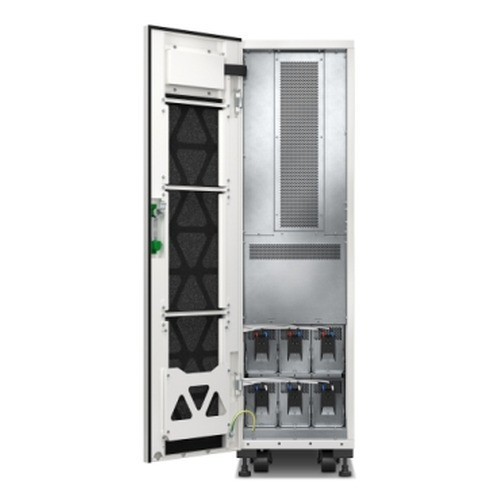
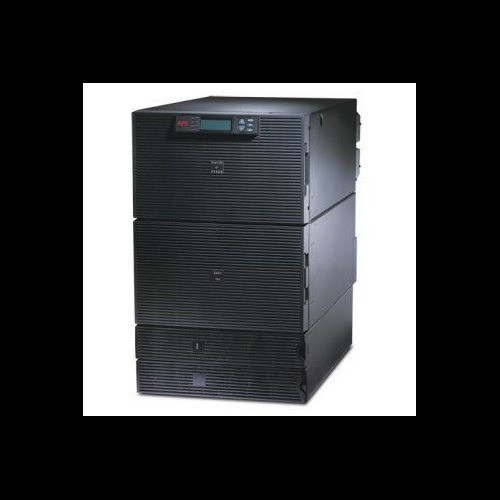
Form factor is the sharpest divide. The SURT15KRMXLT-1TF10K is rack-mounted at 16U and ships with 4 battery modules already installed, reporting a net weight of 347.73 kg (766.61 lb) and physical dimensions of 70.8 cm H × 43.2 cm W × 77.3 cm D. It is designed for standard 19-inch rack infrastructure. The E3SUPS15KFBS is a floor-standing tower (140 cm tall, 112 kg net weight without batteries) targeted at electrical room installation. It ships with zero battery modules and has 3 empty battery slots — external battery modules must be purchased and installed separately before the unit can provide runtime.
Runtime readiness out of the box therefore favors the SURT15KRMXLT-1TF10K, which includes 4 RBC units and specifies a 2.5-hour typical recharge time. Battery voltage also differs: the E3SUPS15KFBS operates at 240 V DC bus, while the SURT15KRMXLT-1TF10K uses a split ±192 V battery referenced to neutral. The SURT15KRMXLT-1TF10K further specifies battery life at 3–5 years; no equivalent figure is provided for the E3SUPS15KFBS.
The E3SUPS15KFBS supports three-phase 380/400/415 V input, appropriate for international electrical room distribution panels. The SURT15KRMXLT-1TF10K takes 208 V single-phase input (2PH + G hardwire) with the bundled step-down transformer enabling 120 V output — a fundamentally different input architecture suited to US data center row power.
How do connectivity, environmental ratings, and surge/noise protection compare for data center and IT applications?
Output connectivity is a critical differentiator for IT deployments. The SURT15KRMXLT-1TF10K provides a rich receptacle complement: 2× NEMA L5-20R, 4× NEMA L6-20R, 2× NEMA L6-30R, and 2× NEMA L14-30R, plus a 4-wire hardwire output — directly serving rack-mounted IT equipment at both 120 V and 208 V simultaneously. The E3SUPS15KFBS specifies no output receptacles in the provided data; it targets hardwired electrical room distribution rather than direct device connection.
Network management differs by generation. The SURT15KRMXLT-1TF10K ships with a pre-installed SmartSlot Network Management Card 2 (NMC2). The E3SUPS15KFBS supports an optional Network Management Card 3 (NMC3) but does not include one. NMC3 is the current-generation card with broader cloud and IPv6 support; NMC2 is an older platform. The SURT15KRMXLT-1TF10K also specifies full-time multi-pole noise filtering, IEEE surge let-through of 0.3%, and zero-clamping response time — none of these surge/filtering parameters are provided for the E3SUPS15KFBS.
Operating altitude favors the SURT15KRMXLT-1TF10K at 0–10,000 ft versus 0–3,333 ft (or up to 4,921 ft per the secondary spec entry) for the E3SUPS15KFBS — relevant for high-altitude deployments. Both units share IP20 protection, 0–95% non-condensing relative humidity tolerance, and a maximum operating temperature of 40°C (104°F). The SURT15KRMXLT-1TF10K specifies a warranty of 2 years repair or replace; no warranty term is listed in the E3SUPS15KFBS specs. Acoustic output favors the SURT15KRMXLT-1TF10K at 50 dBA versus 60 dBA for the E3SUPS15KFBS.
Which should you choose: the E3SUPS15KFBS or the SURT15KRMXLT-1TF10K?
Our take: The SURT15KRMXLT-1TF10K is the stronger choice when the deployment is a US-based IT data center or server room requiring rack-mount form factor, immediate battery-backed runtime, and direct receptacle outputs at both 120 V and 208 V. It ships with 4 battery modules already installed versus 0 for the E3SUPS15KFBS, delivers a specified 93% full-load efficiency (no comparable figure is available for the E3SUPS15KFBS), and operates at altitudes up to 10,000 ft versus approximately 3,333–4,921 ft. Its pre-installed NMC2 card and detailed surge specs (0.3% IEEE let-through, zero-clamping) add immediate remote manageability and power conditioning out of the box. Conversely, the E3SUPS15KFBS is the correct selection for three-phase electrical room infrastructure operating on 380/400/415 V international distribution panels, where its 15 kW real-power rating (versus 12 kW for the SURT) and lower THD specification (less than 3% versus less than 5%) are material advantages for non-IT critical loads.
Side-by-Side Comparison
Spec-for-spec, from manufacturer data.
| Specification | APC by Schneider Electric E3SUPS15KFBS | APC by Schneider Electric SURT15KRMXLT-1TF10K |
|---|---|---|
| Rated Power (VA) | 15 kVA | 15,000 VA |
| Rated Power (W) | 15 kW | 12,000 W |
| Output Power Factor | 0.9 leading/lagging | Not specified |
| UPS Topology | Double conversion online | Double Conversion Online |
| Form Factor | Tower (floor-standing) | Rack-mounted (16U) |
| Main Input Voltage | 380/400/415 V AC (3-phase) | 208 V (single-phase 2PH+G) |
| Output Voltage | 208 V AC | 120 V / 208 V |
| Output Receptacles | Not specified | 2× L5-20R, 4× L6-20R, 2× L6-30R, 2× L14-30R |
| Efficiency at Full Load | Not specified in provided data | 93% |
| Output THD | < 3% (linear load) | < 5% |
| Included Battery Modules | 0 (3 empty slots) | 4 modules pre-installed |
| Battery Type | VRLA | Lead-Acid |
| Network Management | Optional NMC3 (not included) | NMC2 (pre-installed) |
| Operating Altitude | 0–3,333 ft (up to 4,921 ft per secondary spec) | 0–10,000 ft |
| Acoustic Level | 60 dBA | 50 dBA |
| Net Weight | 112 kg (without batteries) | 347.73 kg |
Frequently Asked Questions
Which should you choose: the E3SUPS15KFBS or the SURT15KRMXLT-1TF10K?
The SURT15KRMXLT-1TF10K is the stronger choice when the deployment is a US-based IT data center or server room requiring rack-mount form factor, immediate battery-backed runtime, and direct receptacle outputs at both 120 V and 208 V. It ships with 4 battery modules already installed versus 0 for the E3SUPS15KFBS, delivers a specified 93% full-load efficiency (no comparable figure is available for the E3SUPS15KFBS), and operates at altitudes up to 10,000 ft versus approximately 3,333–4,921 ft. Its pre-installed NMC2 card and detailed surge specs (0.3% IEEE let-through, zero-clamping) add immediate remote manageability and power conditioning out of the box. Conversely, the E3SUPS15KFBS is the correct selection for three-phase electrical room infrastructure operating on 380/400/415 V international distribution panels, where its 15 kW real-power rating (versus 12 kW for the SURT) and lower THD specification (less than 3% versus less than 5%) are material advantages for non-IT critical loads.
Which unit is ready to provide runtime immediately after installation — the E3SUPS15KFBS or the SURT15KRMXLT-1TF10K?
The SURT15KRMXLT-1TF10K ships with 4 battery modules pre-installed and specifies a 2.5-hour typical recharge time, so it can deliver runtime as soon as it is connected and charged. The E3SUPS15KFBS ships with 0 battery modules and has 3 empty battery slots — compatible external battery modules must be purchased and installed separately before any runtime is available.
Can the E3SUPS15KFBS or the SURT15KRMXLT-1TF10K support IT equipment that needs both 120 V and 208 V receptacle outputs?
The SURT15KRMXLT-1TF10K includes a bundled step-down transformer and provides a full complement of NEMA receptacles at both voltage levels (L5-20R at 120 V and L6-20R/L6-30R/L14-30R at 208 V), making it suited to mixed-voltage IT rack environments. The E3SUPS15KFBS specifies a 208 V AC output voltage but lists no receptacle outputs in the provided specifications; it is intended for hardwired electrical room distribution rather than direct device connection.
Is the E3SUPS15KFBS or SURT15KRMXLT-1TF10K better for deployments at high altitude, such as a facility above 5,000 feet?
The SURT15KRMXLT-1TF10K specifies an operating altitude of 0–10,000 ft, which accommodates high-altitude facilities. The E3SUPS15KFBS specifies a maximum operating elevation of either 3,333 ft or 4,921 ft depending on which spec field is used — both are below 5,000 ft, making the SURT15KRMXLT-1TF10K the appropriate choice for high-altitude sites based on the provided data.
More UPS Comparisons
- APC by Schneider Electric E3SUPS15KFBS vs Vertiv GXT5-15KMVRT11UXLN
- APC by Schneider Electric E3SUPS15KFBS vs APC by Schneider Electric SUVTP15KF2B2S
- APC by Schneider Electric SURT15KRMXLT-1TF10K vs Vertiv GXT5-15KMVRT11UXLN
- APC by Schneider Electric SURT15KRMXLT-1TF10K vs APC by Schneider Electric SUVTP15KF2B2S
- APC by Schneider Electric SUVTP15KF2B2S vs Vertiv GXT5-15KMVRT11UXLN
- APC by Schneider Electric G35T15KH4B4S vs Vertiv GXT5-15KMVRT11UXLN
UPS Buying Guides
Get a Second Opinion on Your Camera Choice
Share your site layout, coverage goals, and budget. Our team will validate the camera selection, flag anything we would change, and recommend products that match the use case.