
APC by Schneider Electric E3SUPS15KFBS vs APC by Schneider Electric SUVTP15KF2B2S: Specification Comparison
Both the E3SUPS15KFBS (Easy UPS 3S) and the SUVTP15KF2B2S (Smart-UPS VT) are APC by Schneider Electric three-phase, 15 kVA uninterruptible power supply units targeting data center, electrical room, and critical infrastructure applications. While they share a common power rating and vendor lineage, they belong to distinct product families with differing topologies, form factors, input/output voltage profiles, and management capabilities — all of which are directly relevant to an integrator or IT buyer selecting a UPS for a specific rack, room, or building infrastructure.
In This Guide
- How do the power topology, input/output voltage, and efficiency specs compare for site compatibility?
- What do the battery architecture and runtime specs reveal about backup endurance and field serviceability?
- How do physical footprint, environmental ratings, and remote management capabilities differ between the two units?
- Which should you choose: the E3SUPS15KFBS or the SUVTP15KF2B2S?
- Side-by-Side Specs
- FAQ
How do the power topology, input/output voltage, and efficiency specs compare for site compatibility?
The E3SUPS15KFBS is specified as a double-conversion online UPS — the gold standard for zero-transfer-time protection — with a rated output of 15 kVA / 15 kW at a power factor of 1.0 implied by equal kVA and kW ratings, and a stated output voltage of 208 V AC. Its input accepts three-phase voltage across 380 V, 400 V, and 415 V AC, with a maximum input current of 28 A and input harmonic distortion of less than 3% at full load. Output voltage tolerance is held to ±1.5%, and output harmonic distortion is stated as less than 3% on linear loads. Cos phi (input power factor correction) is listed at 0.99, indicating near-unity PFC. Heat dissipation is specified at 852 W.
The SUVTP15KF2B2S carries the same 15 kVA load capacity but its specifications do not state UPS topology — double-conversion, line-interactive, or otherwise is not confirmed in the provided data. Its input voltage is listed at 220 V AC (single value, implying a different input regime than the E3SUPS15KFBS's 380–415 V three-phase range), and input current is 40 A — significantly higher than the 28 A of the E3SUPS15KFBS. Output voltage is listed as both 120 V AC and 208 V AC, offering dual-voltage output capability not present in the E3SUPS15KFBS spec sheet. No efficiency, power factor, or harmonic distortion figures are provided for the SUVTP15KF2B2S in the supplied specifications.
What do the battery architecture and runtime specs reveal about backup endurance and field serviceability?
The E3SUPS15KFBS ships with zero included battery modules — it has three empty battery slots and is designed to accept external VRLA battery modules (battery voltage 240 V DC, DC system voltage 120 V DC). Runtime is therefore entirely dependent on which battery modules the installer provisions; no runtime figure is stated in the provided specifications. This is a common configuration for electrical-room frame UPS units where runtime is scaled at installation. Battery type is VRLA (Valve-Regulated Lead-Acid).
The SUVTP15KF2B2S provides explicit runtime data: 10 minutes at full load and 28.1 minutes at half load. Battery chemistry is lead acid. Typical recharge time is stated at 5 hours. The model designation ('2B' in the SKU) suggests two internal battery modules are included. This runtime transparency makes load-planning straightforward for the buyer, though no battery voltage, slot count, or expansion path is provided in the available specifications.
How do physical footprint, environmental ratings, and remote management capabilities differ between the two units?
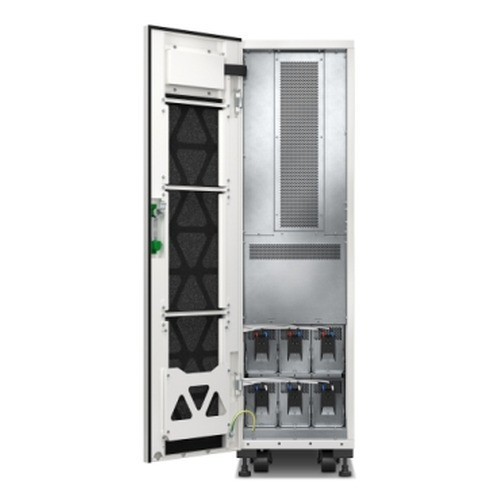
The E3SUPS15KFBS is a floor-standing unit with a height of 140 cm and a shipping weight of 145 kg (unit weight 112 kg). Package dimensions are 164 cm H × 56.3 cm W × 101.4 cm L. Its IP protection rating is IP20. Operating altitude is listed as 0–3,333 ft (with a separate maximum operating elevation of 4,921 ft), and storage altitude reaches 15,240 m. Acoustic output is 60 dBA. The unit is rated for operating temperatures up to 40°C and relative humidity up to 95% non-condensing. Connectivity is via optional Network Management Card 3 (NMC3) — SNMP/network management is not included by default. Certifications listed are CE, EAC, and RCM. Color is White (RAL 9003).
The SUVTP15KF2B2S is a tower form factor measuring 59" H × 14" W × 32" D and weighs 873 lb (approximately 396 kg) — substantially heavier, reflecting its integrated battery configuration. It includes an automatic bypass switch and a manual static maintenance bypass — neither of which is specified for the E3SUPS15KFBS in the provided data. SNMP management is listed as included (SNMP Manageable), with a SmartSlot expansion slot for additional management cards. No IP rating, operating temperature range, altitude rating, acoustic level, or certifications are provided in the SUVTP15KF2B2S spec sheet. Warranty is stated as 1 year; no warranty term is listed for the E3SUPS15KFBS.
Which should you choose: the E3SUPS15KFBS or the SUVTP15KF2B2S?
Our take: The E3SUPS15KFBS is the stronger choice when the installation requires a confirmed double-conversion online topology, a higher-voltage three-phase input infrastructure (380–415 V), and a modular battery architecture sized at the time of deployment. Key spec deltas: the E3SUPS15KFBS draws only 28 A input current versus 40 A for the SUVTP15KF2B2S — relevant to panel capacity planning; it specifies input harmonic distortion below 3% and a 0.99 cos phi, whereas the SUVTP15KF2B2S provides no harmonic or power factor data; and it weighs 112 kg versus approximately 396 kg for the SUVTP15KF2B2S, a critical factor for floor-load and logistics. Conversely, the SUVTP15KF2B2S is the clearer fit when the site requires known runtime figures (10 min full / 28.1 min half load), dual-voltage output (120 V and 208 V AC), built-in SNMP management without an add-on card, and an integrated manual maintenance bypass. Buyers on a 220 V AC single-value input environment should note the SUVTP15KF2B2S's stated input voltage aligns to that infrastructure.
Side-by-Side Comparison
Spec-for-spec, from manufacturer data.
| Specification | APC by Schneider Electric E3SUPS15KFBS | APC by Schneider Electric SUVTP15KF2B2S |
|---|---|---|
| Rated Power | 15 kVA / 15 kW | 15 kVA / not stated in kW |
| UPS Topology | Double conversion online | Not specified in provided specs |
| Input Voltage | 380 / 400 / 415 V AC (3-phase) | 220 V AC |
| Input Phase | Three-phase | Not specified in provided specs |
| Maximum Input Current | 28 A | 40 A |
| Output Voltage | 208 V AC | 120 V AC and 208 V AC |
| Output Frequency | 60 Hz | 60 Hz |
| Input Harmonic Distortion | < 3% at full load | — |
| Output Voltage Tolerance | ±1.5% | — |
| Cos Phi (Input PF) | 0.99 | — |
| Battery Type | VRLA | Lead Acid |
| Included Battery Modules | 0 (3 empty slots) | Included (runtime specified) |
| Runtime at Full Load | — | 10 minutes |
| Runtime at Half Load | — | 28.1 minutes |
| Battery Recharge Time | — | 5 hours |
| Network Management | Optional NMC3 (not included) | SNMP Manageable (included); SmartSlot |
| Maintenance Bypass | — | Manual Static |
| Automatic Bypass | — | Yes |
| Form Factor | Floor-standing | Tower |
| Unit Weight | 112 kg | 873 lb (~396 kg) |
| Dimensions (H) | 140 cm | 59 in (149.9 cm) |
| IP Rating | IP20 | — |
| Acoustic Level | 60 dBA | — |
| Heat Dissipation | 852 W | — |
| Max Operating Temp | 40°C | — |
| Operating Altitude | 0–3,333 ft (max 4,921 ft) | — |
| Certifications | CE, EAC, RCM | — |
| Warranty | — | 1 Year |
Frequently Asked Questions
Which should you choose: the E3SUPS15KFBS or the SUVTP15KF2B2S?
The E3SUPS15KFBS is the stronger choice when the installation requires a confirmed double-conversion online topology, a higher-voltage three-phase input infrastructure (380–415 V), and a modular battery architecture sized at the time of deployment. Key spec deltas: the E3SUPS15KFBS draws only 28 A input current versus 40 A for the SUVTP15KF2B2S — relevant to panel capacity planning; it specifies input harmonic distortion below 3% and a 0.99 cos phi, whereas the SUVTP15KF2B2S provides no harmonic or power factor data; and it weighs 112 kg versus approximately 396 kg for the SUVTP15KF2B2S, a critical factor for floor-load and logistics. Conversely, the SUVTP15KF2B2S is the clearer fit when the site requires known runtime figures (10 min full / 28.1 min half load), dual-voltage output (120 V and 208 V AC), built-in SNMP management without an add-on card, and an integrated manual maintenance bypass. Buyers on a 220 V AC single-value input environment should note the SUVTP15KF2B2S's stated input voltage aligns to that infrastructure.
Which unit includes batteries out of the box — the E3SUPS15KFBS or the SUVTP15KF2B2S?
Based on the provided specifications, the E3SUPS15KFBS ships with zero included battery modules and has three empty battery slots — batteries must be ordered and installed separately, giving the integrator flexibility to size runtime. The SUVTP15KF2B2S includes battery modules (indicated by its SKU suffix '2B') and specifies runtime of 10 minutes at full load and 28.1 minutes at half load, making it ready to operate on delivery without additional battery procurement.
Do I need an add-on card for network management with either of these UPS units?
Yes, for the E3SUPS15KFBS: the spec sheet states connectivity is via 'Optional network management card 3,' meaning SNMP or network management is not included and requires a separately purchased NMC3 card. The SUVTP15KF2B2S lists 'SNMP Manageable' as a standard feature and includes a SmartSlot expansion slot, so basic network management is available without an additional card purchase.
Is the E3SUPS15KFBS or SUVTP15KF2B2S better suited to a data center with a 380–415 V three-phase feed?
The E3SUPS15KFBS is explicitly rated for three-phase input at 380 V, 400 V, and 415 V AC — making it the appropriate match for that infrastructure. The SUVTP15KF2B2S lists its input voltage as 220 V AC with no three-phase range specified in the provided data, so its suitability for a 380–415 V three-phase feed cannot be confirmed from the available specifications. An integrator should consult the full SUVTP15KF2B2S datasheet before deploying it on higher three-phase input.
More UPS Comparisons
- APC by Schneider Electric E3SUPS15KFBS vs Vertiv GXT5-15KMVRT11UXLN
- APC by Schneider Electric E3SUPS15KFBS vs APC by Schneider Electric SURT15KRMXLT-1TF10K
- APC by Schneider Electric SURT15KRMXLT-1TF10K vs Vertiv GXT5-15KMVRT11UXLN
- APC by Schneider Electric SURT15KRMXLT-1TF10K vs APC by Schneider Electric SUVTP15KF2B2S
- APC by Schneider Electric SUVTP15KF2B2S vs Vertiv GXT5-15KMVRT11UXLN
- APC by Schneider Electric G35T15KH4B4S vs Vertiv GXT5-15KMVRT11UXLN
UPS Buying Guides
Get a Second Opinion on Your Camera Choice
Share your site layout, coverage goals, and budget. Our team will validate the camera selection, flag anything we would change, and recommend products that match the use case.