
APC by Schneider Electric SRT3000XLT vs Panduit U03N11L: Specification Comparison
Both the APC SRT3000XLT and the Panduit U03N11L are rack-mount UPS units rated at 3000VA/2700W, placing them in the same capacity class for protecting IT and physical-security infrastructure. However, they differ substantially in UPS topology, input voltage, output receptacle type, and feature depth. This comparison examines the three dimensions most critical to an installer or IT buyer evaluating a 3000VA rack UPS: topology and power quality, input/output voltage and connectivity, and battery and management capabilities.
In This Guide
- Which UPS topology delivers cleaner power and better load protection?
- Are the input voltage, plug type, and output receptacles compatible with the target installation?
- What do the battery, runtime extension, and management options look like for each unit?
- Which should you choose: the SRT3000XLT or the U03N11L?
- Side-by-Side Specs
- FAQ
Which UPS topology delivers cleaner power and better load protection?
The APC SRT3000XLT uses Double Conversion Online topology, meaning the load runs continuously from a pure sine-wave inverter with less than 2% harmonic distortion and a 3:1 crest factor. There is zero transfer time to battery because the inverter is always active. The SRT3000XLT also specifies an internal automatic and manual bypass and a sync-to-mains output frequency of 50/60 Hz ±3 Hz.
The Panduit U03N11L uses Line-Interactive topology with AVR (Automatic Voltage Regulation). Line-interactive designs regulate voltage without switching to battery for minor sags or surges, but the load does transfer to battery during deeper disturbances, incurring a brief transfer gap. The U03N11L spec lists multi-stage surge protection rated at 480–600J per bank (described as typical). Waveform type, harmonic distortion, and crest factor are not specified for the U03N11L.
For loads sensitive to power quality — network video recorders, servers, or edge-compute appliances — the SRT3000XLT's always-on double-conversion path eliminates transfer-time risk entirely. The U03N11L's line-interactive approach is adequate for less sensitive loads and generally results in lower heat and energy losses under normal grid conditions.
Are the input voltage, plug type, and output receptacles compatible with the target installation?
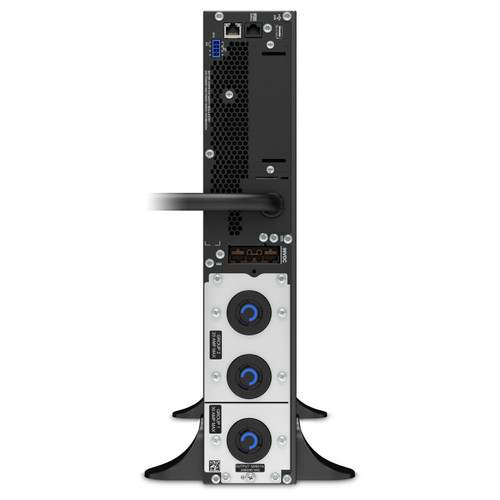
The SRT3000XLT is a 208V/240V unit. Its input connection is NEMA L6-20P (a 20A, 208/240V twist-lock plug) on a 10 ft cord, and its outputs are (2) NEMA L6-20R and (1) NEMA L6-30R — all 208/240V receptacles. It is explicitly noted as configurable for 208 or 240V nominal output. This makes it suited to equipment rooms or data centers fed from 208V three-phase panels, not standard 120V branch circuits.
The Panduit U03N11L is specified at 120V AC input (typical) with a NEMA L5-30P or hardwire input connection. Its output receptacles are IEC C13 (quantity not specified in the provided data). This is a standard 120V unit intended for typical North American rack environments served by 120V circuits.
These two units are NOT interchangeable at the branch-circuit level. A buyer must match the UPS input voltage to the available panel voltage. The SRT3000XLT requires a 208V or 240V feed; the U03N11L requires a 120V feed. Output device compatibility also differs: equipment with NEMA L6-x connectors pairs with the APC; equipment with IEC C13 inlets pairs with the Panduit. Confirming the facility's panel voltage and equipment inlet types is the critical first step before selecting either unit.
What do the battery, runtime extension, and management options look like for each unit?
The SRT3000XLT ships with one lead-acid battery module at 96V/497 VAh runtime capacity, with a rated charge power of 165W and a typical recharge time of 3 hours. Battery life is specified at 3–5 years. Replacement batteries are APCRBC152 and SRT96RMBPUS. Critically, the unit supports up to 10 external battery packs (SRT96BP), scaling runtime capacity from the base 497 VAh up to 10,437 VAh. One free expansion slot is noted. Runtime extension is a documented, quantified feature.
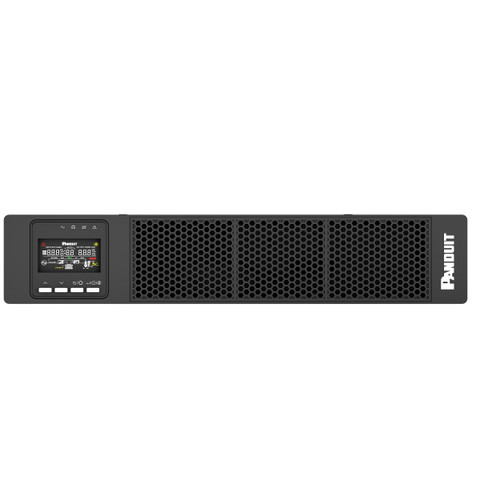
The Panduit U03N11L specifies a sealed lead-acid, hot-swappable battery with front-panel access. Hot-swap capability means battery replacement does not require powering down the protected load — a meaningful operational advantage. Runtime extension options, battery voltage, VAh capacity, and recharge time are not specified in the provided data. An optional SNMP/HTTP network management card slot is listed, and a front-panel LCD displays voltage, load, runtime, and faults.
The SRT3000XLT provides quantified runtime-extension scalability and detailed battery specs. The U03N11L's hot-swap battery is an operationally convenient feature absent from the SRT3000XLT's spec sheet. Both units offer optional network management; the SRT3000XLT specifies audible and visible alarms prioritized by severity, while the U03N11L lists an LCD display with runtime and fault data. Neither unit's spec sheet provides runtime curves at specific loads, so direct runtime comparison cannot be made from the data provided.
Which should you choose: the SRT3000XLT or the U03N11L?
Our take: The SRT3000XLT is the stronger choice when the installation is fed from a 208V or 240V panel and load protection quality is paramount. Its double-conversion online topology eliminates transfer time entirely versus the U03N11L's line-interactive design, its harmonic distortion is spec'd at less than 2% versus not specified for the U03N11L, and it supports documented runtime extension to 10,437 VAh via up to 10 external battery packs versus no quantified extension path for the U03N11L. Conversely, the U03N11L is the correct unit for 120V installations — the SRT3000XLT simply cannot be used on a 120V branch circuit. The U03N11L's hot-swappable front-access battery provides a maintenance advantage not listed for the SRT3000XLT. Select the SRT3000XLT for 208V data-center or IDF closet deployments demanding zero-transfer-time power conditioning; select the U03N11L for 120V rack environments where battery hot-swap and a lower-cost line-interactive topology are sufficient.
Side-by-Side Comparison
Spec-for-spec, from manufacturer data.
| Specification | APC by Schneider Electric SRT3000XLT | Panduit U03N11L |
|---|---|---|
| UPS Topology | Double Conversion Online | Line-Interactive with AVR |
| Capacity (VA) | 3000VA | 3000VA |
| Capacity (Watts) | 2700W | 2700W |
| Input Voltage | 208V (also 240V) | 120V AC (typical) |
| Input Connection | NEMA L6-20P | NEMA L5-30P or Hardwire |
| Output Voltage | 208V (configurable 240V) | 120V AC (implied; not explicitly stated) |
| Output Receptacles | (2) NEMA L6-20R, (1) NEMA L6-30R | IEC C13 (quantity not specified) |
| Waveform | Sine wave | Not specified |
| Harmonic Distortion | Less than 2% | Not specified |
| Battery Type | Lead-Acid | Sealed Lead-Acid, Hot-Swappable |
| Battery Hot-Swap | Not specified | Yes, front-access |
| Runtime Extension | Up to 10 ext. packs (10,437 VAh max) | Not specified |
| Bypass | Internal Automatic and Manual | Not specified |
| Network Management | Not specified in provided data | Optional SNMP/HTTP card slot |
| Display / Alarms | Audible and visible alarms, severity-prioritized | Front-panel LCD (voltage, load, runtime, faults) |
| Form Factor | Rack-mounted with kit (vertical) | 2U Rack-Mount |
| Weight | 69.00 lb (31.3 kg) | Not specified |
| Acoustic Level | 55 dBA | Not specified |
Frequently Asked Questions
Which should you choose: the SRT3000XLT or the U03N11L?
The SRT3000XLT is the stronger choice when the installation is fed from a 208V or 240V panel and load protection quality is paramount. Its double-conversion online topology eliminates transfer time entirely versus the U03N11L's line-interactive design, its harmonic distortion is spec'd at less than 2% versus not specified for the U03N11L, and it supports documented runtime extension to 10,437 VAh via up to 10 external battery packs versus no quantified extension path for the U03N11L. Conversely, the U03N11L is the correct unit for 120V installations — the SRT3000XLT simply cannot be used on a 120V branch circuit. The U03N11L's hot-swappable front-access battery provides a maintenance advantage not listed for the SRT3000XLT. Select the SRT3000XLT for 208V data-center or IDF closet deployments demanding zero-transfer-time power conditioning; select the U03N11L for 120V rack environments where battery hot-swap and a lower-cost line-interactive topology are sufficient.
Can I use either of these UPS units on a standard 120V outlet in my server room?
Only the Panduit U03N11L is specified for 120V AC input. The APC SRT3000XLT requires a 208V or 240V input connection (NEMA L6-20P plug) and cannot be used on a standard 120V branch circuit. Verify your panel's available voltage before ordering either unit.
Which unit lets me extend runtime if I need more battery backup time?
The APC SRT3000XLT has a documented, quantified runtime-extension system: up to 10 external SRT96BP battery packs scaling from the base 497 VAh to 10,437 VAh. The Panduit U03N11L's spec sheet does not list runtime extension options or external battery pack compatibility, so that capability cannot be confirmed from the provided data.
Does either UPS support hot-swappable batteries to avoid downtime during battery replacement?
The Panduit U03N11L specifies a sealed lead-acid, hot-swappable battery with front-panel access, meaning the battery can be replaced without powering down the protected load. The APC SRT3000XLT's spec sheet does not list hot-swap battery capability; battery replacement procedures for the SRT3000XLT should be confirmed in APC's installation documentation before assuming load continuity during service.
More UPS Comparisons
- APC by Schneider Electric SMT3000RMI2U vs Vertiv GXT5-3000LVRT2UXL
- APC by Schneider Electric SMT3000RMI2U vs Panduit U03N11L
- APC by Schneider Electric SMT3000RMI2U vs Panduit U03N12L
- APC by Schneider Electric SMT3000RMI2U vs Panduit U03S12V
- APC by Schneider Electric SMT3000RMI2U vs APC by Schneider Electric SRT3000XLT
- APC by Schneider Electric SMT3000RMI2U vs APC by Schneider Electric SRT3000XLW-IEC
UPS Buying Guides
Get a Second Opinion on Your Camera Choice
Share your site layout, coverage goals, and budget. Our team will validate the camera selection, flag anything we would change, and recommend products that match the use case.