
APC by Schneider Electric SMX750I vs Vertiv GXT5-750LVRT2UXL: Specification Comparison
Both the APC Smart-UPS SMX750I and the Vertiv Liebert GXT5-750LVRT2UXL are 750 VA, 2U rack/tower-convertible UPS units aimed at IT infrastructure protection in server rooms, network closets, and edge deployments. The comparison centers on three axes that drive purchasing decisions in this class: UPS topology and power quality, outlet configuration and load capacity, and management, battery serviceability, and certifications. Buyers cross-shopping these two will find meaningful differences in topology, voltage region, and battery architecture.
In This Guide
- Which UPS topology delivers better power quality and what does that mean for connected loads?
- How do rated capacity, outlet count, and output voltage differ between these two units?
- Which unit offers more flexibility in battery serviceability, remote management, and regulatory certifications?
- Which should you choose: the SMX750I or the GXT5-750LVRT2UXL?
- Side-by-Side Specs
- FAQ
Which UPS topology delivers better power quality and what does that mean for connected loads?
The SMX750I uses a Line Interactive topology with a sine wave output. In line interactive designs, the inverter corrects voltage sags and swells without switching to battery, but the connected load does draw from utility power during normal operation. APC specifies a true sine wave output, which is compatible with active PFC power supplies common in modern servers.
The GXT5-750LVRT2UXL uses True Online Double Conversion topology. In this design the load runs continuously from the inverter, which regenerates a clean sine wave from rectified input at all times. Transfer time to battery is zero because no transfer occurs — the inverter never disconnects. Vertiv specifies a power factor of 0.9 to 1.0 on the output, meaning the full 750 W of real power is available at unity power factor. In Active ECO mode efficiency reaches up to 98%, though ECO mode reintroduces a brief transfer time similar to line interactive operation.
For loads that are sensitive to frequency variation, harmonic distortion, or micro-interruptions, the double conversion topology of the GXT5-750LVRT2UXL provides a higher degree of isolation. The SMX750I's line interactive topology is adequate for most standard IT loads but does not provide the same degree of input-to-output isolation.
How do rated capacity, outlet count, and output voltage differ between these two units?
Both units are rated at 750 VA. However, the SMX750I is rated at 600 W (0.8 power factor), while the GXT5-750LVRT2UXL is rated at 750 W (0.9–1.0 power factor). This means the Vertiv unit can deliver 25% more real power at the same VA rating — a material difference when connected loads have high power factors, as modern server power supplies typically do.
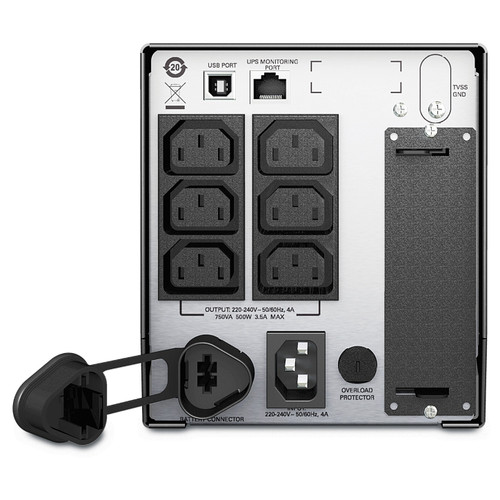
The SMX750I provides 10 battery-backed outlets (connector type not specified in the provided specs beyond count). The GXT5-750LVRT2UXL provides 6 NEMA 5-15R outlets, of which 4 are programmable (individually controllable load shedding) and 2 are non-programmable.
Voltage region is a hard compatibility boundary: the SMX750I outputs 230 V AC and is designed for international/European markets. The GXT5-750LVRT2UXL outputs 110/115/120/125 VAC (user-configurable) and accepts a NEMA 5-15P input plug, making it a North American 120 V unit. These two products are not interchangeable across regions.
Which unit offers more flexibility in battery serviceability, remote management, and regulatory certifications?
The SMX750I's provided specs describe the battery as maintenance-free, sealed, and spill-proof lead acid chemistry. No hot-swap capability or external battery cabinet expansion is stated in the supplied specifications.
The GXT5-750LVRT2UXL specifies hot-swappable internal batteries and supports external battery cabinet expansion — both explicitly documented. Hot-swap allows battery replacement without powering down connected loads, a significant operational advantage in environments where downtime is not acceptable.
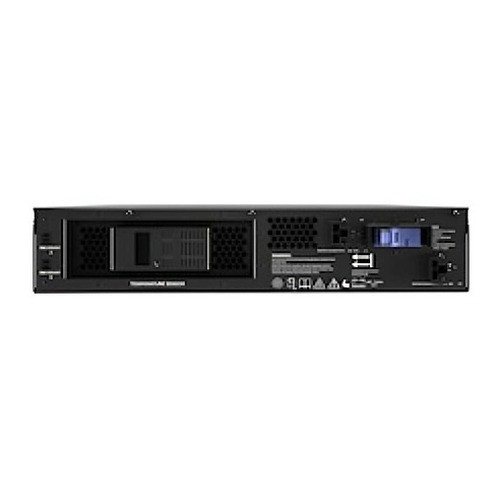
On connectivity, the GXT5-750LVRT2UXL lists USB, RS232, RS485, a dry-contact terminal block, and an optional IntelliSlot SNMP/web card (RDU120) for network management. The SMX750I's provided specs do not enumerate communication ports or network management options. The GXT5-750LVRT2UXL also carries ENERGY STAR 2.0, UL 1778 4th edition, CSA 22.2 No. 107.1, RoHS2, REACH, and WEEE certifications. The SMX750I's provided specs list no certifications. The Vertiv unit also includes a gravity-sensing color LCD; the SMX750I's provided specs do not describe a display.
Which should you choose: the SMX750I or the GXT5-750LVRT2UXL?
Our take: The GXT5-750LVRT2UXL is the stronger choice when power quality, real-power capacity, and battery serviceability are the primary decision criteria. Its True Online Double Conversion topology provides zero transfer time and full input-output isolation versus the SMX750I's line interactive design. It delivers 750 W of real power against the SMX750I's 600 W — a 25% advantage at the same VA rating. Hot-swappable batteries with external expansion capability contrast with the SMX750I's sealed, non-hot-swap battery as specified. The SMX750I's 10-outlet count exceeds the Vertiv's 6, and its lighter weight (48.5 lb vs 37 lb is inverted — the SMX750I is actually heavier) may matter in weight-restricted racks. Critically, these units target different voltage regions: the SMX750I is a 230 V international unit; the GXT5-750LVRT2UXL is a 120 V North American unit. Region compatibility must be confirmed before any cross-shop evaluation proceeds.
Side-by-Side Comparison
Spec-for-spec, from manufacturer data.
| Specification | APC by Schneider Electric SMX750I | Vertiv GXT5-750LVRT2UXL |
|---|---|---|
| UPS Topology | Line Interactive | True Online Double Conversion |
| Capacity (VA) | 750 VA | 750 VA |
| Capacity (Watts) | 600 W | 750 W |
| Output Power Factor | — | 0.9 – 1.0 |
| Output Voltage | 230 V AC | 110 / 115 / 120 / 125 VAC (configurable) |
| Input Voltage Region | 230 V (international) | 120 V nominal, 60–150 V range (North America) |
| Input Plug | — | NEMA 5-15P |
| Outlet Count | 10 | 6 (4 programmable, 2 non-programmable) |
| Outlet Type | — | NEMA 5-15R |
| Transfer Time | — | Zero (continuous online) |
| Waveform | Sine Wave | Pure Sine Wave |
| Efficiency | — | Up to 98% (Active ECO mode) |
| Battery Hot-Swap | — | Yes |
| External Battery Expansion | — | Yes |
| Battery Chemistry | Lead Acid (sealed, spill-proof) | — |
| Runtime at Full Load | 12 min | — |
| Runtime at Half Load | 34 min | — |
| Form Factor | 2U Rack/Tower Convertible | 2U Rack/Tower Convertible |
| Weight | 48.50 lb | 37 lb (16.8 kg) |
| Display | — | Gravity-sensing color LCD |
| Connectivity | — | USB, RS232, RS485, dry-contact, optional SNMP card |
| Certifications | — | ENERGY STAR 2.0, UL 1778, CSA 22.2 No. 107.1, RoHS2, REACH, WEEE |
Frequently Asked Questions
Which should you choose: the SMX750I or the GXT5-750LVRT2UXL?
The GXT5-750LVRT2UXL is the stronger choice when power quality, real-power capacity, and battery serviceability are the primary decision criteria. Its True Online Double Conversion topology provides zero transfer time and full input-output isolation versus the SMX750I's line interactive design. It delivers 750 W of real power against the SMX750I's 600 W — a 25% advantage at the same VA rating. Hot-swappable batteries with external expansion capability contrast with the SMX750I's sealed, non-hot-swap battery as specified. The SMX750I's 10-outlet count exceeds the Vertiv's 6, and its lighter weight (48.5 lb vs 37 lb is inverted — the SMX750I is actually heavier) may matter in weight-restricted racks. Critically, these units target different voltage regions: the SMX750I is a 230 V international unit; the GXT5-750LVRT2UXL is a 120 V North American unit. Region compatibility must be confirmed before any cross-shop evaluation proceeds.
Can I use either of these UPS units interchangeably in my data center regardless of location?
No. The SMX750I is designed for 230 V AC output and international markets, while the GXT5-750LVRT2UXL is designed for 120 V North American markets with a NEMA 5-15P input plug and 110–125 VAC configurable output. Using either unit in the wrong voltage region will not work without a separate step-up or step-down transformer, which is not a supported or recommended configuration. Confirm your facility's mains voltage before selecting either product.
Is the SMX750I or GXT5-750LVRT2UXL better for a deployment where I cannot afford any downtime for battery replacement?
The GXT5-750LVRT2UXL is the better fit for that requirement. Its specs explicitly state hot-swappable internal batteries, meaning batteries can be replaced while the unit continues to power connected loads. The SMX750I's provided specs describe sealed, maintenance-free lead acid batteries but do not indicate hot-swap capability. For zero-downtime battery maintenance in a North American 120 V environment, the GXT5-750LVRT2UXL is the specified choice.
Which unit supports SNMP network management for integration with monitoring platforms?
The GXT5-750LVRT2UXL supports optional SNMP and web-based management via the RDU120 IntelliSlot card, in addition to USB, RS232, RS485, and dry-contact interfaces listed in its specifications. The SMX750I's provided specifications do not enumerate communication interfaces or mention SNMP capability. Buyers requiring network-integrated UPS monitoring should verify the SMX750I's management options directly with APC/Schneider Electric, as that detail is absent from the supplied spec sheet.
More UPS Comparisons
- APC by Schneider Electric SMT750C vs CyberPower PR750RTXL2UC
- APC by Schneider Electric SMT750C vs Vertiv GXT5-750LVRT2UXL
- APC by Schneider Electric SMT750C vs CyberPower PR750LCDRT1U
- APC by Schneider Electric SMT750C vs CyberPower AVRG750U
- APC by Schneider Electric SMT750C vs APC by Schneider Electric SMT750CUS
- APC by Schneider Electric SMT750CUS vs CyberPower PR750RTXL2UC
UPS Buying Guides
Get a Second Opinion on Your Camera Choice
Share your site layout, coverage goals, and budget. Our team will validate the camera selection, flag anything we would change, and recommend products that match the use case.