
APC by Schneider Electric SMX750I vs APC by Schneider Electric SMT750C: Specification Comparison
Both the SMX750I and SMT750C are 750VA line-interactive sine-wave UPS units from APC's Smart-UPS portfolio, making them direct cross-shop candidates for buyers needing battery backup at this capacity tier. The comparison turns on three axes that matter most for UPS selection: power delivery and runtime, physical form factor and installation flexibility, and monitoring and management capabilities. The critical regional split — SMX750I is a 230V unit for international/European markets, while the SMT750C is a 120V unit for North American markets — should be the first filter for any buyer.
In This Guide
- Which unit delivers more usable power and how long will each keep equipment running?
- How does each unit mount, and what does that mean for rack versus desktop deployments?
- What monitoring, alerting, and communication capabilities does each unit offer?
- Which should you choose: the SMX750I or the SMT750C?
- Side-by-Side Specs
- FAQ
Which unit delivers more usable power and how long will each keep equipment running?
Both units are rated at 750VA, but their watt ratings diverge: the SMX750I is rated at 600W versus the SMT750C's 500W. This 100W difference means the SMX750I can sustain heavier real loads before hitting its power ceiling — relevant when powering equipment with high power factors such as modern servers or active networking gear.
For runtime, the SMX750I provides manufacturer-specified figures: 12 minutes at full load (600W) and 34 minutes at half load (300W). The SMT750C's specs do not include equivalent runtime-at-load figures; the battery is characterized as 24V / 7.0Ah with a 146 VAh runtime rating and a 49W battery charge power figure, but no minutes-at-load values are provided in the supplied specifications. Buyers requiring confirmed runtime numbers at a specific wattage should request SMT750C runtime curves from APC directly.
The SMT750C specifies a typical transfer time of 6ms (10ms maximum) and output frequency sync of 50/60Hz ±3Hz. The SMX750I's specs do not include transfer time or output frequency tolerance data as provided. The SMT750C also documents a 3-hour typical recharge time; no recharge time is listed for the SMX750I.
How does each unit mount, and what does that mean for rack versus desktop deployments?
The SMX750I is a 2U rack/tower convertible unit — it ships in a chassis designed to mount in a standard 19-inch equipment rack or stand upright as a tower, giving installers flexibility to place it in a data closet rack or on a shelf. Its weight is 48.50 lb and its rack dimension is listed as 3.50 inches (consistent with 2U). This dual-orientation design is a hallmark of the SMX product line and suits mixed rack/floor environments.
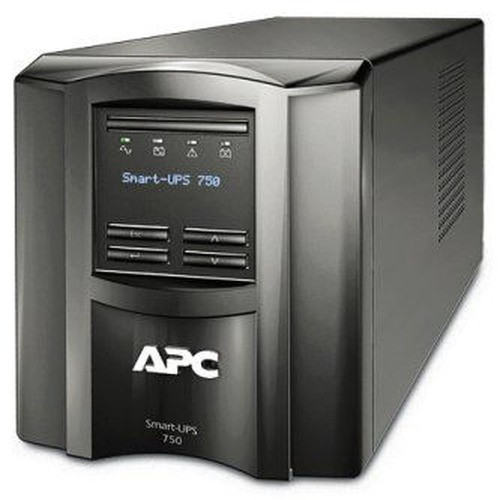
The SMT750C is explicitly not rack-mountable per its specifications: 'Mounting Mode: Not rack-mountable' and 'Two Post Mountable: 0.' It is a desktop/tower-only unit weighing 29.0 lb. Its smaller footprint and lower weight make it easier to place on or under a desk or on an equipment shelf, but it cannot be integrated into a rack cabinet without a third-party shelf.
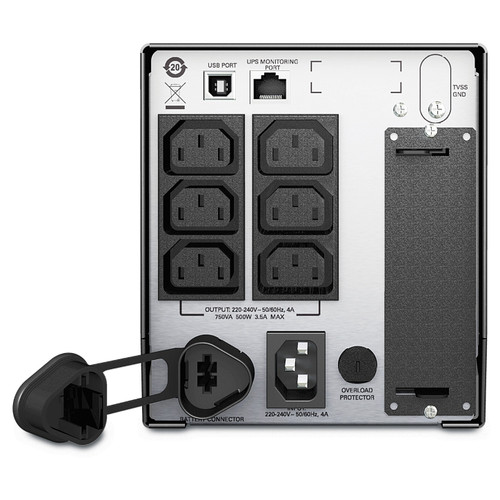
The SMX750I's output receptacles are 8× C13 (IEC) connectors, appropriate for 230V international equipment. The SMT750C provides 6× NEMA 5-15R outlets on a 6-foot NEMA 5-15P input cord, appropriate for standard North American 120V equipment. These outlet types are not interchangeable and reinforce that the two units target entirely different regional electrical infrastructures.
What monitoring, alerting, and communication capabilities does each unit offer?
The SMT750C includes a dedicated SmartConnect Ethernet port for cloud-based monitoring, with APC noting that feature availability varies by terms of use. This cloud connectivity is part of what APC markets as its 'Cloud-enabled monitoring' sub-family. The unit also has an LED status display showing on-line, on-battery, replace-battery, and overload indicators, plus configurable alarms for on-battery and low-battery states, and a documented harmonic distortion figure of less than 5%.
The SMX750I's provided specifications do not list any communication ports, network management card slots, cloud monitoring capability, or alarm/notification details. Buyers who require SNMP, network management, or remote monitoring on the SMX750I should verify available accessory slots or management card compatibility directly with APC, as that information is not present in the supplied spec sheet.
The SMT750C documents environmental operating parameters in detail: operating altitude 0–10,000 ft, storage altitude 0–50,000 ft, relative humidity 0–95%, ambient storage temperature 5–113°F (−15–45°C), acoustic noise 41 dBA, and heat dissipation 90 Btu/h. None of these environmental or acoustic figures appear in the SMX750I's supplied specifications.
Which should you choose: the SMX750I or the SMT750C?
Our take: The SMX750I is the stronger choice when the installation is in a 230V environment (Europe, Middle East, Asia, or international facilities) and requires rack mounting — its 2U convertible chassis and 600W capacity give it a clear edge over the SMT750C's 500W desktop-only design. The SMX750I delivers 20% more usable wattage (600W vs. 500W) and documented runtime of 12 minutes at full load versus no equivalent figure for the SMT750C. Conversely, the SMT750C is the appropriate selection for any North American 120V installation: its NEMA 5-15 connectivity is mandatory for that grid, and its built-in SmartConnect Ethernet port provides cloud monitoring that is absent from the SMX750I's provided specs. For IT buyers operating mixed domestic-and-international fleets, these two units are not interchangeable — voltage region must be the first filter before any other spec comparison.
Side-by-Side Comparison
Spec-for-spec, from manufacturer data.
| Specification | APC by Schneider Electric SMX750I | APC by Schneider Electric SMT750C |
|---|---|---|
| SKU | SMX750I | SMT750C |
| Product Series | SMX | SMT |
| UPS Topology | Line Interactive | Line Interactive |
| Waveform Type | Sine Wave | Sine Wave |
| Load Capacity (VA) | 750 VA | 750 VA |
| Load Capacity (Watts) | 600 W | 500 W |
| Input / Output Voltage | 230 V AC | 120 V AC (NEMA 5-15P in / NEMA 5-15R out) |
| Output Receptacles | 8× IEC C13 | 6× NEMA 5-15R |
| Form Factor | 2U Rack/Tower Convertible | Desktop/Tower only (not rack-mountable) |
| Weight | 48.50 lb | 29.0 lb (13.18 kg) |
| Battery Chemistry | Lead Acid (sealed, maintenance-free) | Lead Acid |
| Battery Voltage / Capacity | — | 24 V / 7.0 Ah |
| Typical Recharge Time | — | 3 h |
| Replacement Battery | — | RBC48 |
| Run Time at Full Load | 12 min | — |
| Run Time at Half Load | 34 min | — |
| Transfer Time | — | 6 ms typical / 10 ms maximum |
| Cloud / Network Monitoring | — | SmartConnect Ethernet port |
| Acoustic Noise | — | 41 dBA |
| Heat Dissipation | — | 90 Btu/h |
| Color | Black | Black |
Frequently Asked Questions
Which should you choose: the SMX750I or the SMT750C?
The SMX750I is the stronger choice when the installation is in a 230V environment (Europe, Middle East, Asia, or international facilities) and requires rack mounting — its 2U convertible chassis and 600W capacity give it a clear edge over the SMT750C's 500W desktop-only design. The SMX750I delivers 20% more usable wattage (600W vs. 500W) and documented runtime of 12 minutes at full load versus no equivalent figure for the SMT750C. Conversely, the SMT750C is the appropriate selection for any North American 120V installation: its NEMA 5-15 connectivity is mandatory for that grid, and its built-in SmartConnect Ethernet port provides cloud monitoring that is absent from the SMX750I's provided specs. For IT buyers operating mixed domestic-and-international fleets, these two units are not interchangeable — voltage region must be the first filter before any other spec comparison.
Can I use the SMX750I in a North American office with standard wall outlets?
No. The SMX750I is rated at 230V output and is designed for international electrical infrastructure. North American standard outlets are 120V (NEMA 5-15). Using a 230V UPS on a 120V circuit is not supported by the provided specifications, and the output receptacles (IEC C13) do not match standard North American plugs. The SMT750C is the appropriate model for 120V / NEMA environments.
Which unit is better if I need to mount the UPS in a server rack?
The SMX750I. Its specifications explicitly list a 2U rack/tower convertible form factor with rack-mount dimensions. The SMT750C's specifications state it is 'Not rack-mountable' and 'Two Post Mountable: 0,' meaning it cannot be natively installed in a rack cabinet.
Does either unit support remote or cloud-based monitoring out of the box?
Only the SMT750C specifies built-in cloud monitoring capability via its SmartConnect Ethernet port (availability subject to APC's terms of use). The SMX750I's provided specifications include no communication port or cloud monitoring details. Buyers requiring network management on the SMX750I should confirm available accessory options with APC before purchasing.
More UPS Comparisons
- APC by Schneider Electric SMT750C vs CyberPower PR750RTXL2UC
- APC by Schneider Electric SMT750C vs Vertiv GXT5-750LVRT2UXL
- APC by Schneider Electric SMT750C vs CyberPower PR750LCDRT1U
- APC by Schneider Electric SMT750C vs CyberPower AVRG750U
- APC by Schneider Electric SMT750C vs APC by Schneider Electric SMT750CUS
- APC by Schneider Electric SMT750CUS vs CyberPower PR750RTXL2UC
UPS Buying Guides
Get a Second Opinion on Your Camera Choice
Share your site layout, coverage goals, and budget. Our team will validate the camera selection, flag anything we would change, and recommend products that match the use case.