
APC by Schneider Electric SMX3000RMHV2U vs Vertiv GXT5-3KL630RT2UXL: Specification Comparison
The APC SMX3000RMHV2U and Vertiv GXT5-3KL630RT2UXL are both 3 kVA rack-mount UPS units targeting the same IT and light industrial power-protection tier. Where they diverge fundamentally is topology: APC delivers line-interactive protection with AVR, while Vertiv employs online double-conversion. Buyers in this segment weigh runtime behavior during power events, output power capacity, management depth, and certifications. Both units support 208 V environments and compete directly for server-room, networking-closet, and edge-deployment budgets.
In This Guide
- How does the protection topology and output power capacity differ between the two units?
- Which unit is more efficient, and how do their physical and environmental specs compare?
- What management interfaces, communications options, and compliance certifications does each unit provide?
- Which should you choose: the SMX3000RMHV2U or the GXT5-3KL630RT2UXL?
- Side-by-Side Specs
- FAQ
How does the protection topology and output power capacity differ between the two units?
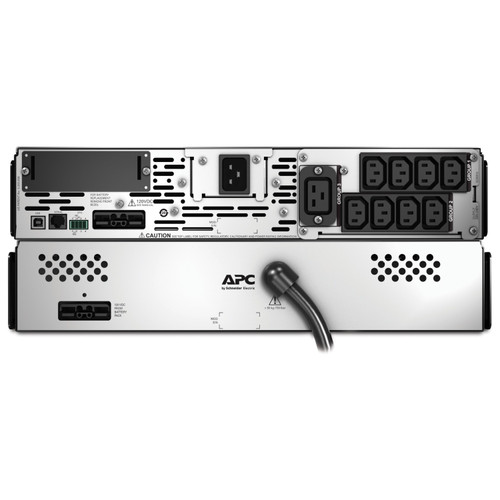
The SMX3000RMHV2U is a line-interactive UPS rated at 3,000 VA / 2,700 W (90% power factor). It provides Automatic Voltage Regulation (AVR) to correct sags and swells without switching to battery, and delivers a true sine-wave output at 50/60 Hz. Output voltage operates between 208 V and 240 V. Hold time on transfer ranges from 2 ms to 10 ms, and the unit carries a 645 J surge energy rating with dedicated surge protection.
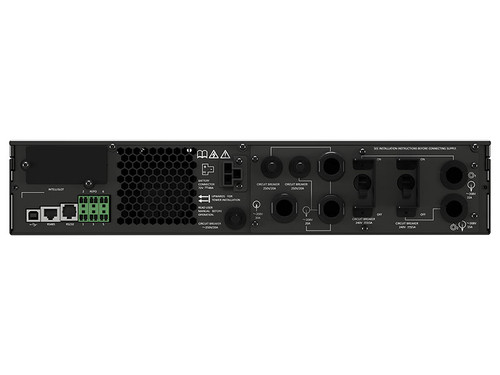
The GXT5-3KL630RT2UXL is an online double-conversion UPS rated at 3,000 VA / 3,000 W — a unity (100%) power factor versus the APC's 90%. Online double-conversion means the load runs continuously off the inverter; there is zero transfer time to battery during input disturbances. Output voltage is fixed at 208 VAC via L6-15R and L6-30R receptacles. Transfer time is not specified in the provided data. The Vertiv's unity power factor delivers 300 W more usable output at the same VA rating.
For loads sensitive to any transfer gap or that require constant voltage and frequency regulation (CVFR), the Vertiv's double-conversion topology is inherently superior. For loads tolerant of the 2–10 ms APC transfer window, the line-interactive approach is simpler and typically runs cooler.
Which unit is more efficient, and how do their physical and environmental specs compare?
The SMX3000RMHV2U is rated at 98.5% efficiency. No operating temperature range is provided in the supplied specs for this unit. Noise output is specified at 55 dB. Physical dimensions and weight are not provided in the supplied spec sheet for Product A.
The GXT5-3KL630RT2UXL lists two efficiency figures: up to 98% in Active ECO Mode and up to 95% in standard online mode. ECO mode reduces losses by occasionally bypassing the inverter — a compromise compared to full double-conversion. The unit is rated to operate from +32 to +122 °F (0 to 50 °C), weighs 65.1 lb, and measures 3.4 in H × 16.9 in W × 21.3 in D (2U rack). No noise level is specified for the Vertiv.
In full online mode the APC's 98.5% beats the Vertiv's 95% on-line figure. The Vertiv's 98% ECO mode approaches the APC's efficiency but only by reducing the protection level. Operating temperature and physical dimensions are only documented for the Vertiv in the provided specs; buyers cannot make a direct environmental or footprint comparison for the APC from the supplied data alone.
What management interfaces, communications options, and compliance certifications does each unit provide?
The SMX3000RMHV2U includes an audible alarm and an Emergency Power Off (EPO) circuit. No communications interfaces, network management options, or compliance certifications are listed in the provided spec data for this unit.
The GXT5-3KL630RT2UXL provides USB, RS485, RS232, and a terminal block as standard interfaces. An optional Vertiv RDU101 SNMP/Webcard enables SNMP and web-based management. A full-color graphic LCD with gravity-sensing orientation simplifies installation in both rack and tower orientations. Certifications documented include ENERGY STAR 2.0, UL1778, c-UL listing, RoHS2, and REACH.
The Vertiv has a substantially richer documented management and compliance profile based on the provided specs. The APC unit's interface and certification details are absent from the supplied data, so no head-to-head comparison can be made on those dimensions. Buyers requiring SNMP monitoring, energy-star compliance documentation, or multi-port output receptacle flexibility will find the Vertiv's spec sheet more informative; APC buyers should verify interface options directly with the manufacturer or distributor.
Which should you choose: the SMX3000RMHV2U or the GXT5-3KL630RT2UXL?
Our take: The GXT5-3KL630RT2UXL is the stronger choice when zero transfer time, unity power factor, and documented compliance certifications are mandatory — particularly for always-on servers, virtualization hosts, or regulated environments. Its online double-conversion topology eliminates the 2–10 ms transfer window present on the APC, and its 3,000 W output (100% power factor) delivers 300 W more usable capacity than the APC's 2,700 W. It also ships with ENERGY STAR 2.0, UL1778, RoHS2, and REACH certifications documented. The SMX3000RMHV2U holds an edge in rated efficiency (98.5% vs. 95% in online mode) and includes built-in EPO and surge protection (645 J) confirmed in specs — useful for environments with emergency-shutdown requirements. However, many management, physical, and environmental specs are absent from the APC's provided data, making a complete evaluation difficult. Buyers operating mixed-voltage or temperature-sensitive edge sites should consult full APC documentation before deciding.
Side-by-Side Comparison
Spec-for-spec, from manufacturer data.
| Specification | APC by Schneider Electric SMX3000RMHV2U | Vertiv GXT5-3KL630RT2UXL |
|---|---|---|
| Topology | Line-Interactive | Online Double-Conversion |
| Power Rating (VA) | 3,000 VA | 3,000 VA |
| Power Rating (W) | 2,700 W | 3,000 W |
| Power Factor | 0.9 | 1.0 |
| Output Voltage | 208 V – 240 V | 208 VAC |
| Input Voltage | — | 208 VAC nominal |
| Waveform | Sine | — |
| Transfer Time | 2 – 10 ms | 0 ms (online) |
| Efficiency | 98.5% | Up to 98% (ECO) / Up to 95% (online) |
| AVR | Yes | — |
| Surge Energy Rating | 645 J | — |
| EPO | Yes | — |
| Noise Level | 55 dB | — |
| Management Interfaces | — | USB, RS485, RS232, terminal block, optional SNMP/Webcard |
| Operating Temperature | — | +32 to +122 °F (0 to +50 °C) |
| Certifications | — | ENERGY STAR 2.0, UL1778, c-UL, RoHS2, REACH |
Frequently Asked Questions
Which should you choose: the SMX3000RMHV2U or the GXT5-3KL630RT2UXL?
The GXT5-3KL630RT2UXL is the stronger choice when zero transfer time, unity power factor, and documented compliance certifications are mandatory — particularly for always-on servers, virtualization hosts, or regulated environments. Its online double-conversion topology eliminates the 2–10 ms transfer window present on the APC, and its 3,000 W output (100% power factor) delivers 300 W more usable capacity than the APC's 2,700 W. It also ships with ENERGY STAR 2.0, UL1778, RoHS2, and REACH certifications documented. The SMX3000RMHV2U holds an edge in rated efficiency (98.5% vs. 95% in online mode) and includes built-in EPO and surge protection (645 J) confirmed in specs — useful for environments with emergency-shutdown requirements. However, many management, physical, and environmental specs are absent from the APC's provided data, making a complete evaluation difficult. Buyers operating mixed-voltage or temperature-sensitive edge sites should consult full APC documentation before deciding.
Is the SMX3000RMHV2U or GXT5-3KL630RT2UXL better for protecting servers with no tolerance for power interruption?
The GXT5-3KL630RT2UXL is better suited for that requirement. Its online double-conversion topology means the load runs off the inverter at all times, so there is no transfer delay when input power fails or fluctuates. The SMX3000RMHV2U is line-interactive and switches to battery in 2–10 ms, which most modern servers tolerate but is not zero.
Which unit delivers more usable wattage for high-density rack loads?
The Vertiv GXT5-3KL630RT2UXL delivers 3,000 W at a unity (1.0) power factor, versus 2,700 W for the APC SMX3000RMHV2U at a 0.9 power factor — a 300 W difference at the same 3,000 VA rating. For power-dense loads, the Vertiv provides more usable headroom.
Does either UPS support SNMP monitoring and remote management out of the box?
Based on the provided specifications, the Vertiv GXT5-3KL630RT2UXL supports SNMP and web management via an optional Vertiv RDU101 communications card, and includes USB, RS485, and RS232 interfaces as standard. No network management or interface specifications are listed in the provided APC SMX3000RMHV2U spec data; buyers should verify APC's management options directly with the manufacturer.
More UPS Comparisons
- APC by Schneider Electric SMT3000RMT2U vs Panduit U03S12L
- APC by Schneider Electric SMT3000RMT2U vs Vertiv GXT5-3KL620RT2UXL
- APC by Schneider Electric SMT3000RMT2U vs Vertiv GXT5-3KL630RT2UXL
- APC by Schneider Electric SMT3000RMT2U vs Panduit U03N11V
- APC by Schneider Electric SMT3000RMT2U vs APC by Schneider Electric SMTL3000RM2UCNC
- APC by Schneider Electric SMT3000RMT2U vs APC by Schneider Electric SMX3000HV
UPS Buying Guides
Get a Second Opinion on Your Camera Choice
Share your site layout, coverage goals, and budget. Our team will validate the camera selection, flag anything we would change, and recommend products that match the use case.