
APC by Schneider Electric SMX3000RMHV2U vs Vertiv GXT5-3KL620RT2UXL: Specification Comparison
Both the APC Smart-UPS X SMX3000RMHV2U and the Vertiv GXT5-3KL620RT2UXL are 2U rack-mount 3 kVA uninterruptible power supplies targeting IT infrastructure, network closets, and edge data center environments. The comparison centers on topology, power quality, efficiency, physical footprint, and management depth — the axes that determine fit for a given installation's availability and compatibility requirements.
In This Guide
- Which UPS topology delivers better power quality and what does that mean for connected equipment?
- How do efficiency, heat output, and operating environment compare for rack deployment?
- What are the differences in output receptacles, management interfaces, and physical footprint?
- Which should you choose: the SMX3000RMHV2U or the GXT5-3KL620RT2UXL?
- Side-by-Side Specs
- FAQ
Which UPS topology delivers better power quality and what does that mean for connected equipment?
The SMX3000RMHV2U uses Line-Interactive topology with a sine-wave output, Automatic Voltage Regulation (AVR), and a crest factor of 3:1. In line-interactive designs, the inverter corrects voltage sags and swells but only fully converts power to battery during an outage; the specified hold time is 2–10 ms, and a 645 J surge energy rating provides downstream protection. EPO (Emergency Power Off) is included.
The GXT5-3KL620RT2UXL uses On-line double-conversion topology, meaning all output power passes through the inverter continuously — the connected load is always isolated from raw utility power. This eliminates transfer-time concerns entirely (zero-millisecond transfer, inherent to the design) and provides the highest power conditioning. The GXT5 also achieves a true 3,000 W real-power rating vs. 2,700 W for the APC at the same 3,000 VA nameplate, yielding a 1.0 power factor versus 0.9 for the SMX3000RMHV2U.
For loads sensitive to voltage transients, frequency instability, or requiring zero transfer time — such as medical equipment, financial transaction servers, or dense virtualization hosts — double-conversion provides a higher protection tier. Line-interactive is adequate for most standard IT loads where the 2–10 ms transfer window is within server PSU hold-up tolerances.
How do efficiency, heat output, and operating environment compare for rack deployment?
The SMX3000RMHV2U is rated at 98.5% efficiency. The spec source does not qualify this figure with an operating mode caveat. Noise level is specified at 55 dB.
The GXT5-3KL620RT2UXL provides two efficiency figures: up to 98% in Active ECO Mode (a mode that partially bypasses the inverter to reduce losses, trading some protection for efficiency) and up to 95% in full on-line mode. ENERGY STAR 2.0 certification is listed, confirming third-party efficiency validation. Operating temperature for the GXT5 is specified at +32 to +122 °F (0 to +50 °C). No operating temperature range is provided in the supplied specs for the SMX3000RMHV2U, and no noise figure is provided for the GXT5.
Installers should note that the APC's 98.5% figure, if measured at full on-line load, would be exceptional for line-interactive; double-conversion units inherently carry higher conversion losses in their standard mode (GXT5 on-line: up to 95%). The GXT5's ECO mode can match APC efficiency figures but at reduced isolation from the utility.
What are the differences in output receptacles, management interfaces, and physical footprint?
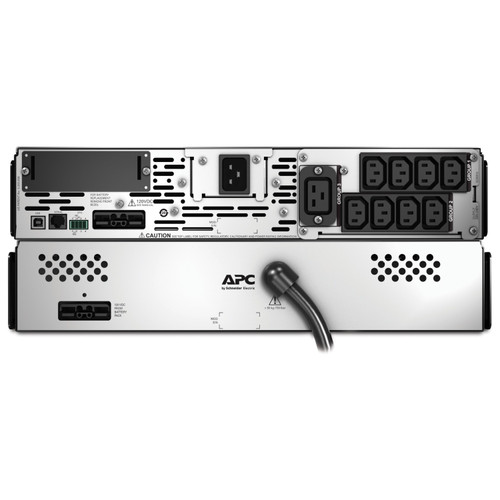
The SMX3000RMHV2U output voltage range spans 208–240 V with 50/60 Hz output frequency regulation. Output receptacle types, interface ports, and physical dimensions are not specified in the provided spec data. Audible alarms are confirmed present.
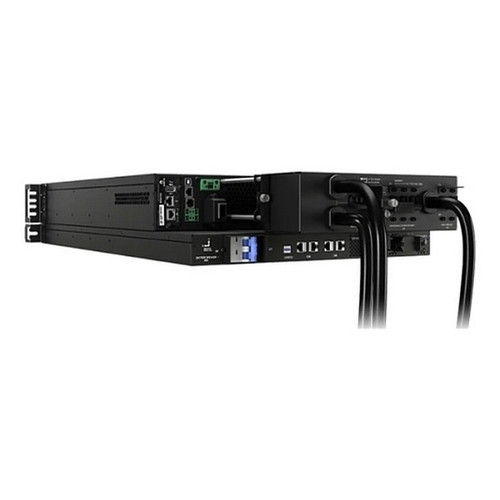
The GXT5-3KL620RT2UXL specifies its wiring explicitly: input via L6-20P; output via 2× L6-15R and 2× L6-20R receptacles. Output is fixed at 208 VAC. Input voltage is 208 VAC nominal. Physical dimensions are 3.4 in H × 16.9 in W × 21.3 in D, weight 65.1 lb. Management interfaces include USB, RS485, RS232, a terminal block, and an external battery connector; an optional Vertiv RDU101 SNMP/Webcard enables full SNMP and web management. The front panel features a full-color graphic LCD with gravity-sensing orientation. Certifications include UL1778, c-UL, RoHS2, REACH, and ENERGY STAR 2.0.
Buyers with existing 208 V L6-series PDU infrastructure will find the GXT5's receptacle set directly compatible. The SMX3000RMHV2U's 208–240 V output range offers slightly more flexibility for mixed-voltage environments, but without receptacle specs confirmed, cabling assumptions carry risk. Management depth strongly favors the GXT5 for monitored environments; the APC spec data does not enumerate network management options.
Which should you choose: the SMX3000RMHV2U or the GXT5-3KL620RT2UXL?
Our take: The GXT5-3KL620RT2UXL is the stronger choice when power quality, zero-transfer-time protection, and monitored management are the primary requirements. Its on-line double-conversion topology eliminates the 2–10 ms transfer window present in the SMX3000RMHV2U and delivers a true 3,000 W real-power output (1.0 power factor) versus the APC's 2,700 W (0.9 power factor) — a 300 W usable-capacity advantage at identical VA ratings. On-line mode efficiency is up to 95% versus the APC's stated 98.5%, though the GXT5's ECO mode approaches parity at up to 98%. The GXT5 also ships with explicitly specified L6-20P/L6-15R/L6-20R receptacles, SNMP-ready interface options, and ENERGY STAR 2.0 certification. The SMX3000RMHV2U is better suited for cost-sensitive deployments where line-interactive protection is sufficient, a 208–240 V flexible output range is needed, and the lower noise floor (55 dB specified) matters in open office or wiring-closet environments where the GXT5's noise level is not documented.
Side-by-Side Comparison
Spec-for-spec, from manufacturer data.
| Specification | APC by Schneider Electric SMX3000RMHV2U | Vertiv GXT5-3KL620RT2UXL |
|---|---|---|
| Topology | Line-Interactive | On-line Double-Conversion |
| Power Rating (VA) | 3,000 VA | 3,000 VA |
| Power Rating (W) | 2,700 W | 3,000 W |
| Power Factor | 0.90 | 1.00 |
| Output Voltage | 208–240 V | 208 VAC |
| Input Voltage | 50/60 Hz (voltage not specified) | 208 VAC nominal |
| Output Frequency | 50/60 Hz | — |
| Efficiency | 98.5% | Up to 98% (ECO) / Up to 95% (on-line) |
| Transfer Time | 2–10 ms | Zero (double-conversion, always on inverter) |
| Waveform | Sine | — |
| AVR | Yes | Inherent (double-conversion) |
| Surge Energy Rating | 645 J | — |
| EPO | Yes | — |
| Noise Level | 55 dB | — |
| Output Receptacles | — | 2× L6-15R, 2× L6-20R |
| Management Interfaces | — | USB, RS485, RS232, terminal block, optional SNMP card |
| Certifications | — | ENERGY STAR 2.0, UL1778, c-UL, RoHS2, REACH |
| Dimensions (H × W × D) | — | 3.4 in × 16.9 in × 21.3 in |
| Weight | — | 65.1 lb |
| Operating Temperature | — | +32 to +122 °F (0 to +50 °C) |
Frequently Asked Questions
Which should you choose: the SMX3000RMHV2U or the GXT5-3KL620RT2UXL?
The GXT5-3KL620RT2UXL is the stronger choice when power quality, zero-transfer-time protection, and monitored management are the primary requirements. Its on-line double-conversion topology eliminates the 2–10 ms transfer window present in the SMX3000RMHV2U and delivers a true 3,000 W real-power output (1.0 power factor) versus the APC's 2,700 W (0.9 power factor) — a 300 W usable-capacity advantage at identical VA ratings. On-line mode efficiency is up to 95% versus the APC's stated 98.5%, though the GXT5's ECO mode approaches parity at up to 98%. The GXT5 also ships with explicitly specified L6-20P/L6-15R/L6-20R receptacles, SNMP-ready interface options, and ENERGY STAR 2.0 certification. The SMX3000RMHV2U is better suited for cost-sensitive deployments where line-interactive protection is sufficient, a 208–240 V flexible output range is needed, and the lower noise floor (55 dB specified) matters in open office or wiring-closet environments where the GXT5's noise level is not documented.
Does the GXT5-3KL620RT2UXL or SMX3000RMHV2U offer better protection for sensitive servers?
The GXT5-3KL620RT2UXL provides higher protection through on-line double-conversion topology, which means the load is continuously powered through the inverter and completely isolated from utility power at all times — there is no transfer delay. The SMX3000RMHV2U is line-interactive with a 2–10 ms transfer time; while within the hold-up tolerance of most server PSUs, it does not provide the same level of power conditioning as double-conversion.
Can I connect my existing L6-20 devices directly to either UPS?
The GXT5-3KL620RT2UXL specifies 2× L6-20R output receptacles (plus 2× L6-15R), making it directly compatible with L6-20 plugged devices. The SMX3000RMHV2U's output receptacle types are not specified in the provided spec data, so compatibility with L6-20 devices cannot be confirmed from these specs alone and should be verified with the manufacturer.
Which UPS supports remote monitoring and SNMP management?
The GXT5-3KL620RT2UXL supports SNMP and web management via the optional Vertiv RDU101 communications card, plus USB, RS485, RS232, and a terminal block as standard interfaces. The SMX3000RMHV2U's management and communication interfaces are not enumerated in the provided specifications; buyers requiring confirmed SNMP capability should verify APC's accessory options independently.
More UPS Comparisons
- APC by Schneider Electric SMT3000RMT2U vs Panduit U03S12L
- APC by Schneider Electric SMT3000RMT2U vs Vertiv GXT5-3KL620RT2UXL
- APC by Schneider Electric SMT3000RMT2U vs Vertiv GXT5-3KL630RT2UXL
- APC by Schneider Electric SMT3000RMT2U vs Panduit U03N11V
- APC by Schneider Electric SMT3000RMT2U vs APC by Schneider Electric SMTL3000RM2UCNC
- APC by Schneider Electric SMT3000RMT2U vs APC by Schneider Electric SMX3000HV
UPS Buying Guides
Get a Second Opinion on Your Camera Choice
Share your site layout, coverage goals, and budget. Our team will validate the camera selection, flag anything we would change, and recommend products that match the use case.