
APC by Schneider Electric SMX3000LVUS vs APC by Schneider Electric SMTL3000RM2UCNC: Specification Comparison
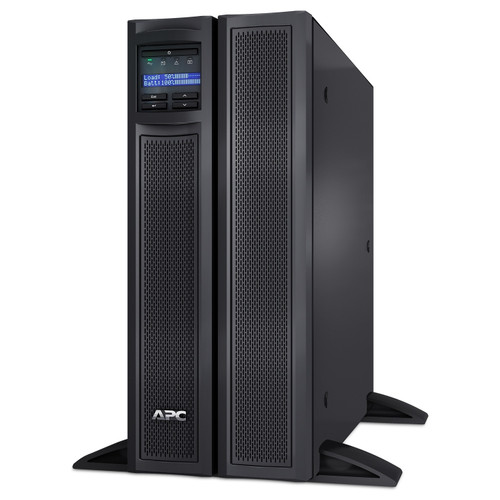
Both units are APC Smart-UPS Line-Interactive 3 kVA / 2700 W sine-wave UPS systems designed for North American 120 V environments — a class commonly deployed to protect network closets, security head-ends, NVR racks, and light server infrastructure. The SMX3000LVUS is a 4U rack/tower hybrid with a lead-acid battery architecture, while the SMTL3000RM2UCNC is a 2U rackmount unit built around a lithium-ion battery. This comparison evaluates how the two differ across input tolerance, outlet configuration, and efficiency.
In This Guide
- Which UPS handles wider input voltage swings and protects better against dirty power?
- Which unit offers more flexible outlet options and management interfaces?
- Which unit is more efficient and how does battery chemistry affect total cost of ownership?
- Which should you choose: the SMX3000LVUS or the SMTL3000RM2UCNC?
- Side-by-Side Specs
- FAQ
Which UPS handles wider input voltage swings and protects better against dirty power?
The SMTL3000RM2UCNC accepts input voltages from 82 V to 144 V — a 62 V window — allowing it to ride through substantial browndowns and overvoltages before switching to battery. The SMX3000LVUS operates over a much narrower 100 V to 127 V input range, a 27 V window, meaning it will transfer to battery sooner under voltage sag conditions common in older facilities or on long wire runs.
Both units accept 50/60 Hz input and deliver sine-wave output at 50/60 Hz, ensuring compatibility with active PFC power supplies in servers and NVRs. The SMTL3000RM2UCNC also specifies a 5% output voltage regulation figure; this spec is not provided for the SMX3000LVUS. Buyers in electrically noisy environments or facilities with known voltage instability will find the SMTL3000RM2UCNC's broader input window a meaningful operational advantage.
Which unit offers more flexible outlet options and management interfaces?
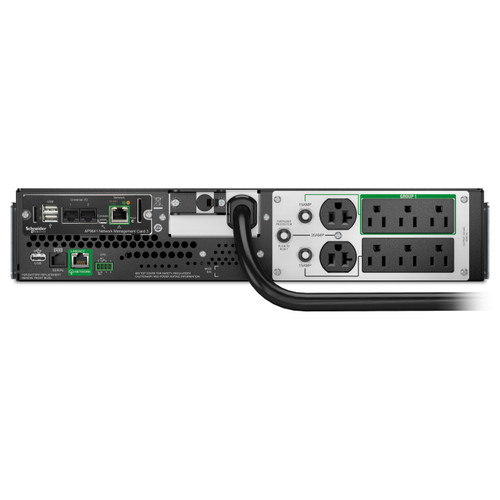
The SMX3000LVUS provides 10 AC outlets across three NEMA types — NEMA 5-15R, NEMA L5-20R, and NEMA L5-30R — and is powered by a NEMA L5-30P input plug. This locking-connector mix suits deployments that require twist-lock circuits for high-draw devices or that need to feed a variety of load types from a single UPS. The SMTL3000RM2UCNC offers 8 AC outlets in NEMA 5-15R and NEMA 5-20R configurations only — all straight-blade, no locking receptacles.
On management connectivity, the SMTL3000RM2UCNC specifies both a USB port and a serial interface, giving administrators two local management paths. Neither interface is listed in the SMX3000LVUS spec set provided; buyers requiring documented local or network management paths should verify SMX3000LVUS interface options against APC's full datasheet before purchasing. Both units list audible alarms (on-battery and low-battery) for the SMX3000LVUS; alarm configuration details are not specified for the SMTL3000RM2UCNC in the data provided.
Which unit is more efficient and how does battery chemistry affect total cost of ownership?
The SMX3000LVUS is rated at 98% efficiency versus 96% for the SMTL3000RM2UCNC. At a continuous 2700 W load, that 2-percentage-point difference translates to roughly 54 W of additional heat dissipation from the SMTL3000RM2UCNC — relevant in thermally constrained rack environments and in facilities where energy cost is tracked at the rack level.
The SMTL3000RM2UCNC uses a lithium-ion battery, which typically delivers a longer calendar life and lower per-cycle degradation than the valve-regulated lead-acid batteries conventional in the SMX3000LVUS class — though battery chemistry and warranty terms should be confirmed against APC's full product documentation, as those specs are not included in the data provided here. The SMTL3000RM2UCNC occupies 2U versus the SMX3000LVUS's 4U rack/tower footprint, a significant consideration in dense or space-constrained deployments. Surge energy rating favors the SMX3000LVUS at 540 J versus 459 J for the SMTL3000RM2UCNC.
Which should you choose: the SMX3000LVUS or the SMTL3000RM2UCNC?
Our take: The SMX3000LVUS is the stronger choice when outlet variety, locking-connector support, and peak efficiency are the primary concerns. It delivers 98% efficiency versus 96%, provides 10 outlets across three NEMA types including twist-lock L5-20R and L5-30R, and carries a higher surge energy rating of 540 J compared to 459 J. Conversely, the SMTL3000RM2UCNC is the better fit for space-constrained rack environments — it occupies only 2U versus 4U — and for sites with unstable utility power, where its 82–144 V input tolerance (versus 100–127 V) dramatically reduces unnecessary battery cycling. The SMTL3000RM2UCNC also documents USB and serial management interfaces and uses a lithium-ion battery that may reduce long-term maintenance overhead. Buyers protecting a mixed-load security or AV rack with locking circuits should lean toward the SMX3000LVUS; buyers prioritizing rack density, broad input tolerance, and lithium-ion battery longevity should prefer the SMTL3000RM2UCNC.
Side-by-Side Comparison
Spec-for-spec, from manufacturer data.
| Specification | APC by Schneider Electric SMX3000LVUS | APC by Schneider Electric SMTL3000RM2UCNC |
|---|---|---|
| UPS Topology | Line-Interactive | Line-Interactive |
| Output Power Capacity | 3 kVA | 3 kVA |
| Output Power | 2700 W | 2700 W |
| Waveform | Sine | Sine |
| Input Voltage Range | 100–127 V | 82–144 V |
| Output Voltage Range | 100–127 V | 120 V (fixed) |
| Output Voltage Regulation | — | 5% |
| Input / Output Frequency | 50/60 Hz | 50/60 Hz |
| Surge Energy Rating | 540 J | 459 J |
| Efficiency | 98% | 96% |
| Noise Level | 55 dB | 55 dB |
| AC Outlets | 10 | 8 |
| Outlet Types | NEMA 5-15R, L5-20R, L5-30R | NEMA 5-15R, 5-20R |
| Input Plug | NEMA L5-30P | — |
| USB Port | — | Yes |
| Serial Interface | — | Yes |
| Form Factor | 4U Rack/Tower | 2U Rackmount |
| Audible Alarms | Yes (on-battery, low battery) | — |
Frequently Asked Questions
Which should you choose: the SMX3000LVUS or the SMTL3000RM2UCNC?
The SMX3000LVUS is the stronger choice when outlet variety, locking-connector support, and peak efficiency are the primary concerns. It delivers 98% efficiency versus 96%, provides 10 outlets across three NEMA types including twist-lock L5-20R and L5-30R, and carries a higher surge energy rating of 540 J compared to 459 J. Conversely, the SMTL3000RM2UCNC is the better fit for space-constrained rack environments — it occupies only 2U versus 4U — and for sites with unstable utility power, where its 82–144 V input tolerance (versus 100–127 V) dramatically reduces unnecessary battery cycling. The SMTL3000RM2UCNC also documents USB and serial management interfaces and uses a lithium-ion battery that may reduce long-term maintenance overhead. Buyers protecting a mixed-load security or AV rack with locking circuits should lean toward the SMX3000LVUS; buyers prioritizing rack density, broad input tolerance, and lithium-ion battery longevity should prefer the SMTL3000RM2UCNC.
Which unit is better if my facility has frequent voltage sags or brownouts?
The SMTL3000RM2UCNC is the better choice for unstable utility power. Its input voltage window spans 82 V to 144 V, compared to the SMX3000LVUS's narrower 100 V to 127 V range. A wider input window means the UPS corrects voltage through its regulator rather than switching to battery, extending battery life and reducing wear in environments with chronic voltage instability.
Does the SMX3000LVUS or SMTL3000RM2UCNC take up less rack space?
The SMTL3000RM2UCNC occupies 2U of rack space. The SMX3000LVUS is rated at 4U in rack configuration. If rack space is at a premium — common in security head-end closets or colocation cages — the SMTL3000RM2UCNC offers the same 3 kVA / 2700 W capacity in half the vertical footprint.
Which UPS supports twist-lock outlets for high-draw or mission-critical devices?
The SMX3000LVUS supports NEMA L5-20R and NEMA L5-30R locking receptacles in addition to standard NEMA 5-15R outlets, and it connects via a NEMA L5-30P locking input plug. The SMTL3000RM2UCNC provides only straight-blade NEMA 5-15R and NEMA 5-20R outlets. If your load devices or downstream PDUs require locking connectors, the SMX3000LVUS is the appropriate choice.
More UPS Comparisons
- APC by Schneider Electric SMT3000RMT2U vs Panduit U03S12L
- APC by Schneider Electric SMT3000RMT2U vs Vertiv GXT5-3KL620RT2UXL
- APC by Schneider Electric SMT3000RMT2U vs Vertiv GXT5-3KL630RT2UXL
- APC by Schneider Electric SMT3000RMT2U vs Panduit U03N11V
- APC by Schneider Electric SMT3000RMT2U vs APC by Schneider Electric SMTL3000RM2UCNC
- APC by Schneider Electric SMT3000RMT2U vs APC by Schneider Electric SMX3000HV
UPS Buying Guides
Get a Second Opinion on Your Camera Choice
Share your site layout, coverage goals, and budget. Our team will validate the camera selection, flag anything we would change, and recommend products that match the use case.