
APC by Schneider Electric SMT2200I vs APC by Schneider Electric SRT2200RMXLA: Specification Comparison
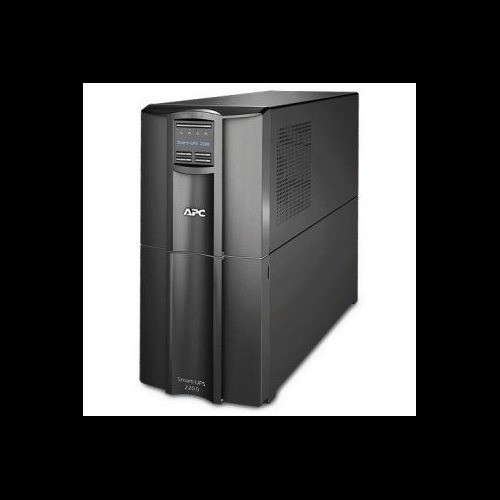
Both the SMT2200I and SRT2200RMXLA are 2200VA rack-mountable UPS units from APC's Smart-UPS line, making them plausible cross-shop candidates for data center and IT infrastructure buyers. However, they differ fundamentally in topology, input voltage, and power density. The SMT2200I targets 230V single-phase environments (EMEA/international) with Line Interactive topology, while the SRT2200RMXLA is a 120V North American Double Conversion Online unit. Buyers in the same region comparing these two should understand that the topology and voltage differences drive nearly every other spec delta.
In This Guide
- Which UPS topology and runtime architecture best protects your critical load?
- How do input voltage, efficiency losses, and physical environment requirements compare?
- What connectivity, output receptacles, and remote management options does each unit provide?
- Which should you choose: the SMT2200I or the SRT2200RMXLA?
- Side-by-Side Specs
- FAQ
Which UPS topology and runtime architecture best protects your critical load?
The SMT2200I uses Line Interactive topology with a 2ms typical transfer time to battery, meaning brief power anomalies trigger a switchover that, while fast, is not zero-transfer. Its rated output is 2200VA with no separate watt figure specified in the provided specs. The SRT2200RMXLA uses Double Conversion Online topology, where the load runs continuously from the inverter — transfer time to battery is effectively zero because the inverter never disconnects. Its rated output is 2200VA / 1800W (0.82 power factor), explicitly stated.
On runtime extensibility, the SRT2200RMXLA supports up to 8 external SRT72RMBP battery modules, scaling from 916 VAh to 6,426 VAh of additional capacity. The SMT2200I spec lists no external battery extension option — only a single internal RBC55 pack. For applications requiring extended runtime (network closets during prolonged outages, edge sites without generator backup), the SRT2200RMXLA's extensible architecture is a material advantage. For loads where a sub-3ms transfer is tolerable and runtime needs are met by internal batteries alone, the SMT2200I's Line Interactive design imposes lower idle heat and energy loss.
How do input voltage, efficiency losses, and physical environment requirements compare?
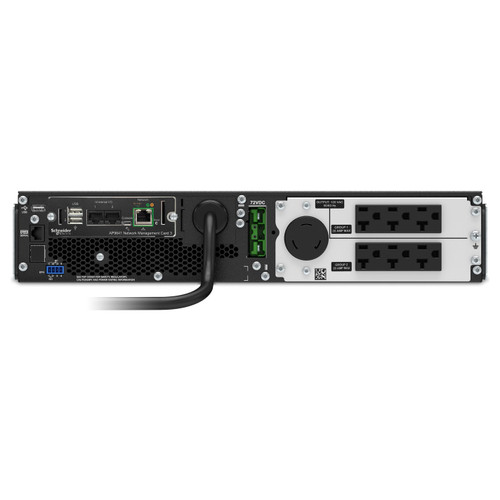
The SMT2200I is designed exclusively for 230V input (range 160–286V, adjustable 151–302V) with IEC-320 C20, Schuko, and British BS1363A input connectors — it is not usable on 120V North American circuits without a transformer. The SRT2200RMXLA accepts 120V input via NEMA 5-20P and delivers 120V output across six NEMA 5-20R and one NEMA L5-20R receptacles. These two units are therefore non-interchangeable from a voltage standpoint.
Thermal output reflects the topology difference: the SMT2200I dissipates 275 BTU/hr at full load, while the SRT2200RMXLA dissipates 535 BTU/hr — nearly double — consistent with Double Conversion's continuous AC-DC-AC conversion losses. Audible noise follows the same pattern: 45 dBA (SMT2200I) vs. 55 dBA (SRT2200RMXLA), a 10 dB difference that is perceptible in quiet environments. Operating altitude for the SMT2200I is specified to 3,000 meters; the SRT2200RMXLA to 10,000 ft (approximately 3,048 meters) — essentially equivalent. Both tolerate 0–95% relative humidity (non-condensing noted for SRT2200RMXLA; not explicitly stated for SMT2200I).
What connectivity, output receptacles, and remote management options does each unit provide?
The SMT2200I provides one IEC C19 (high-current) outlet, eight IEC C13 outlets, and two IEC jumper positions — a total of eleven load connection points suited for IEC-standard rack PDUs and server PSUs common in 230V environments. Its single SmartSlot expansion bay accepts optional network management or relay cards. No IP degree of protection rating is listed in the provided specs.
The SRT2200RMXLA provides seven NEMA outlets (six 5-20R plus one L5-20R) and includes one free expansion slot for an optional network management card (NMC 2 or 3 with environmental monitoring, per spec). It carries an IP20 ingress protection rating. The SRT2200RMXLA also explicitly lists an audible and visible alarm system prioritized by severity; the SMT2200I spec notes only a multi-function LCD control panel without specifying alarm output types. Both units support 2U rackmount form factor. Harmonic distortion is specified only for the SRT2200RMXLA (less than 2%); the SMT2200I provides output voltage distortion less than 5% — these are different measurements and not directly comparable.
Which should you choose: the SMT2200I or the SRT2200RMXLA?
Our take: The SRT2200RMXLA is the stronger choice when zero-transfer-time protection and runtime scalability are required in a 120V North American rack environment. Its Double Conversion Online topology eliminates the 2ms transfer window present in the SMT2200I, and its support for up to eight external battery modules versus the SMT2200I's single internal pack makes it the clear winner for extended-runtime deployments. However, this comes at a cost: heat dissipation is 535 BTU/hr versus 275 BTU/hr, and audible noise is 55 dBA versus 45 dBA — meaningful in space- or cooling-constrained installs. The SMT2200I is the correct choice for 230V EMEA or international deployments where Line Interactive topology is acceptable, cooling headroom is limited, and no runtime extension is needed. The two units are voltage-incompatible and not true substitutes within the same region.
Side-by-Side Comparison
Spec-for-spec, from manufacturer data.
| Specification | APC by Schneider Electric SMT2200I | APC by Schneider Electric SRT2200RMXLA |
|---|---|---|
| VA Rating | 2200VA | 2200VA |
| Watt Rating | — | 1800W |
| UPS Topology | Line Interactive | Double Conversion Online |
| Nominal Input Voltage | 230V | 120V |
| Input Connection | IEC-320 C20 / Schuko / BS1363A | NEMA 5-20P |
| Output Connections | 1x IEC C19, 8x IEC C13, 2x IEC Jumpers | 6x NEMA 5-20R, 1x NEMA L5-20R |
| Transfer Time | 2ms typical | 0ms (online) |
| Waveform | Sine wave | Sine wave |
| Battery Type | Sealed Lead-Acid | Lead-Acid |
| Replacement Battery | RBC55 | APCRBC141 / SRT72RMBPUS |
| External Battery Extension | — | Up to 8x SRT72RMBP modules |
| Typical Recharge Time | 3 hours | 3 hours |
| Heat Dissipation | 275 BTU/hr | 535 BTU/hr |
| Audible Noise | 45 dBA | 55 dBA |
| Form Factor | Tower / Rack (form not specified in spec) | 2U Rackmount |
| Management Expansion | 1x SmartSlot | 1x slot (optional NMC 2 or 3) |
Frequently Asked Questions
Which should you choose: the SMT2200I or the SRT2200RMXLA?
The SRT2200RMXLA is the stronger choice when zero-transfer-time protection and runtime scalability are required in a 120V North American rack environment. Its Double Conversion Online topology eliminates the 2ms transfer window present in the SMT2200I, and its support for up to eight external battery modules versus the SMT2200I's single internal pack makes it the clear winner for extended-runtime deployments. However, this comes at a cost: heat dissipation is 535 BTU/hr versus 275 BTU/hr, and audible noise is 55 dBA versus 45 dBA — meaningful in space- or cooling-constrained installs. The SMT2200I is the correct choice for 230V EMEA or international deployments where Line Interactive topology is acceptable, cooling headroom is limited, and no runtime extension is needed. The two units are voltage-incompatible and not true substitutes within the same region.
Can I use the SMT2200I or SRT2200RMXLA on a standard US wall outlet?
Only the SRT2200RMXLA is rated for 120V North American circuits (NEMA 5-20P input). The SMT2200I requires a 230V supply with IEC-320 C20, Schuko, or British BS1363A input — it cannot be plugged into a standard US 120V outlet without a step-up transformer, which is not specified or supported by APC for this unit.
Which unit is better if I need to run servers through a long power outage without a generator?
The SRT2200RMXLA is significantly better suited for extended outages. Its spec lists support for up to eight external SRT72RMBP battery modules, scaling runtime capacity up to 6,426 VAh. The SMT2200I spec lists no external battery extension capability — only a single internal RBC55 pack with no expansion option documented in the provided specifications.
Is the SRT2200RMXLA's Double Conversion topology worth the extra heat versus the SMT2200I's Line Interactive design?
It depends on load sensitivity and cooling capacity. Double Conversion (SRT2200RMXLA) provides continuous online power with no transfer gap, which is critical for equipment intolerant of even a 2ms interruption. The trade-off, per the provided specs, is 535 BTU/hr of heat dissipation and 55 dBA of noise versus 275 BTU/hr and 45 dBA for the Line Interactive SMT2200I. If your load tolerates the SMT2200I's 2ms typical transfer time and cooling is constrained, Line Interactive is the more efficient choice.
More UPS Comparisons
- CyberPower PR2200RTXL2UC vs APC by Schneider Electric SRT2200RMXLA
- CyberPower PR2200RTXL2UC vs APC by Schneider Electric SRT2200XLA
- CyberPower PR2200RTXL2UC vs APC by Schneider Electric SRT2200RMXLA-NC
- CyberPower PR2200RTXL2UC vs APC by Schneider Electric SMT2200I
- CyberPower PR2200RTXL2UC vs CyberPower OL2K2RTHD
- CyberPower PR2200RTXL2UC vs CyberPower OL2200RTXL2U
UPS Buying Guides
Get a Second Opinion on Your Camera Choice
Share your site layout, coverage goals, and budget. Our team will validate the camera selection, flag anything we would change, and recommend products that match the use case.