
APC by Schneider Electric E3SUPS20KFBS vs APC by Schneider Electric SUVTP20KH2B4S: Specification Comparison
Both the E3SUPS20KFBS and SUVTP20KH2B4S are three-phase, double-conversion online UPS systems rated at 20 kVA, positioning them in the same enterprise power-protection class. However, they differ in a critical architectural dimension: the E3SUPS20KFBS is designed for 208V input/output (North American three-phase), while the SUVTP20KH2B4S targets 400V three-phase input/output (international/European infrastructure). This comparison evaluates their power efficiency, runtime and battery characteristics, and environmental and physical specifications to help buyers choose the right unit for their voltage environment.
In This Guide
- How do the two units compare on real power output and input voltage compatibility?
- Which unit offers better runtime, battery management, and recharge characteristics?
- How do the units differ in environmental ratings, physical characteristics, and management interfaces?
- Which should you choose: the E3SUPS20KFBS or the SUVTP20KH2B4S?
- Side-by-Side Specs
- FAQ
How do the two units compare on real power output and input voltage compatibility?
Both units share a 20 kVA apparent power rating, but they diverge sharply on actual watt output and voltage architecture. The E3SUPS20KFBS delivers 20,000 W at unity power factor (1.0), meaning every kVA translates directly to usable kilowatts. The SUVTP20KH2B4S delivers only 16,000 W despite its identical 20 kVA rating, implying an 0.8 power factor — a meaningful derating that reduces actual load capacity by 20%.
On voltage, the two units serve entirely different infrastructure. The E3SUPS20KFBS accepts 208–220V three-phase input and delivers 208–220V output, suited to North American data center PDUs and switchgear. The SUVTP20KH2B4S is built for 400V three-phase input and output, the standard in Europe, the Middle East, and much of Asia-Pacific. A buyer cannot substitute one for the other without rewiring the facility. The E3SUPS20KFBS also specifies an unusually wide input frequency range of 40–70 Hz versus no stated frequency range for the SUVTP20KH2B4S.
Input current THD for the E3SUPS20KFBS is specified at 4%, indicating a very clean input draw that reduces stress on upstream generators and building wiring. No THD figure is provided for the SUVTP20KH2B4S. The SUVTP20KH2B4S does specify a maximum input current of 27 A, while no equivalent figure is listed for the E3SUPS20KFBS.
Which unit offers better runtime, battery management, and recharge characteristics?
Runtime data is only available for the SUVTP20KH2B4S: it provides 5.5 minutes of backup at full (20 kVA) load and 18.3 minutes at half load. No runtime figures are published for the E3SUPS20KFBS, which is described as a unit 'for internal batteries,' suggesting runtime depends entirely on the battery module configuration chosen — a common design pattern for modular three-phase UPS platforms where capacity is sized separately.
Battery recharge time is specified for the SUVTP20KH2B4S at 4 hours, a standard figure for lead-acid systems of this capacity. No recharge time is listed for the E3SUPS20KFBS. The E3SUPS20KFBS does specify a 96V battery bus voltage, which is useful for matching external battery cabinet configurations. The SUVTP20KH2B4S does not publish a battery voltage figure.
A critical differentiator is hot-swap battery support: the SUVTP20KH2B4S explicitly supports hot-swap batteries, allowing battery replacement without shutting down the connected load — a significant operational advantage in 24/7 environments. The E3SUPS20KFBS does not list this capability. The SUVTP20KH2B4S also specifies an Emergency Power Off (EPO) input, a required feature in many data center and raised-floor installations per electrical codes. The E3SUPS20KFBS does not list an EPO specification.
How do the units differ in environmental ratings, physical characteristics, and management interfaces?
Environmental operating range data is exclusively available for the SUVTP20KH2B4S: it is rated for 0–40°C operating temperature, 0–95% relative humidity (non-condensing assumed), and stores safely from -50 to 40°C with up to 95% storage humidity. None of these figures are published for the E3SUPS20KFBS. Installers specifying the E3SUPS20KFBS for environments with temperature or humidity constraints should obtain this data from APC directly before committing.
On physical characteristics, the SUVTP20KH2B4S weighs 415 kg — a substantial floor-loading consideration requiring structural assessment. No weight is listed for the E3SUPS20KFBS. Noise levels slightly favor the SUVTP20KH2B4S at 64 dB versus 68 dB for the E3SUPS20KFBS, a 4 dB difference that is perceptible but may not be decisive in a machine room environment. The E3SUPS20KFBS specifies an IP20 ingress protection rating (finger-safe, no moisture protection), which is standard for indoor IT equipment; the SUVTP20KH2B4S does not publish an IP rating.
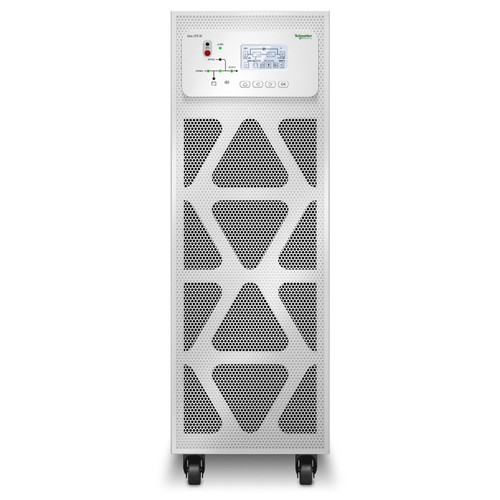
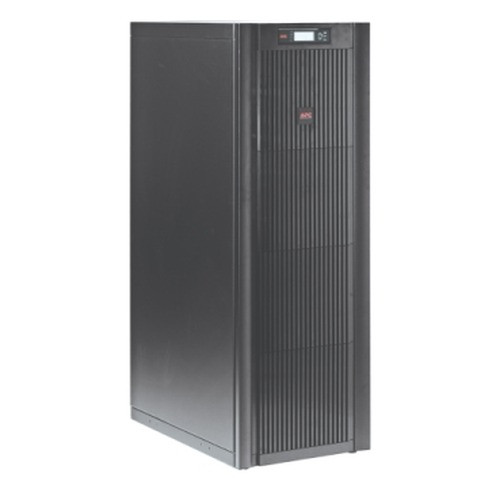
For local management and user interface, the E3SUPS20KFBS features a touch-controlled LCD display, offering a more modern interaction model. The SUVTP20KH2B4S uses LED indicators and an audible alarm system, providing status at a glance but without the granular data a full LCD affords. Both units carry the power-protection feature 'Overload' implicitly (standard for this class), but only the E3SUPS20KFBS explicitly lists it. The SUVTP20KH2B4S carries CE and ISO certifications; no certifications are listed for the E3SUPS20KFBS.
Which should you choose: the E3SUPS20KFBS or the SUVTP20KH2B4S?
Our take: The E3SUPS20KFBS is the stronger choice when the installation is on North American 208V three-phase infrastructure and maximum kilowatt output is the priority. It delivers 20,000 W versus the SUVTP20KH2B4S's 16,000 W — a 25% real-power advantage at the same kVA rating — and specifies a 4% input THD for cleaner upstream load. Conversely, the SUVTP20KH2B4S is the correct unit for 400V three-phase facilities (Europe, Asia-Pacific, and international deployments), adds hot-swap battery support and an EPO input that the E3SUPS20KFBS does not list, and provides published runtime figures (5.5 min full load, 18.3 min half load) for load-planning. The SUVTP20KH2B4S's 415 kg weight demands structural floor assessment. In most cases, the voltage architecture of the facility dictates the choice — these two units are not electrically interchangeable.
Side-by-Side Comparison
Spec-for-spec, from manufacturer data.
| Specification | APC by Schneider Electric E3SUPS20KFBS | APC by Schneider Electric SUVTP20KH2B4S |
|---|---|---|
| UPS Topology | Double-conversion (Online) | — |
| Apparent Power (kVA) | 20 kVA | 20 kVA |
| Real Power Output (W) | 20,000 W | 16,000 W |
| Input Voltage | 208–220 V (3-phase) | 400 V (3-phase) |
| Output Voltage | 208–220 V (3-phase) | 400 V (3-phase) |
| Input Frequency | 40–70 Hz | — |
| Output Frequency | 50/60 Hz | — |
| Max Input Current | — | 27 A |
| Input THD | 4% | — |
| Battery Voltage | 96 V | — |
| Hot-Swap Battery | — | Yes |
| Emergency Power Off (EPO) | — | Yes |
| Runtime at Full Load | — | 5.5 min |
| Runtime at Half Load | — | 18.3 min |
| Battery Recharge Time | — | 4 h |
| Noise Level | 68 dB | 64 dB |
| Operating Temperature | — | 0–40 °C |
| Operating Humidity | — | 0–95% |
| IP Rating | IP20 | — |
| Display / Interface | Touch LCD | LED indicators + audible alarm |
| Certifications | — | CE, ISO |
| Weight | — | 415 kg |
| Colour | White | Black |
Frequently Asked Questions
Which should you choose: the E3SUPS20KFBS or the SUVTP20KH2B4S?
The E3SUPS20KFBS is the stronger choice when the installation is on North American 208V three-phase infrastructure and maximum kilowatt output is the priority. It delivers 20,000 W versus the SUVTP20KH2B4S's 16,000 W — a 25% real-power advantage at the same kVA rating — and specifies a 4% input THD for cleaner upstream load. Conversely, the SUVTP20KH2B4S is the correct unit for 400V three-phase facilities (Europe, Asia-Pacific, and international deployments), adds hot-swap battery support and an EPO input that the E3SUPS20KFBS does not list, and provides published runtime figures (5.5 min full load, 18.3 min half load) for load-planning. The SUVTP20KH2B4S's 415 kg weight demands structural floor assessment. In most cases, the voltage architecture of the facility dictates the choice — these two units are not electrically interchangeable.
Can I use the E3SUPS20KFBS or the SUVTP20KH2B4S in a European 400V three-phase data center?
Only the SUVTP20KH2B4S is specified for 400V three-phase input and output, which is the standard in Europe and much of Asia-Pacific. The E3SUPS20KFBS is specified for 208–220V three-phase, matching North American infrastructure. Using the wrong unit would require facility rewiring and is not supported by the published specs.
Which UPS delivers more actual power to the load — the E3SUPS20KFBS or the SUVTP20KH2B4S?
The E3SUPS20KFBS delivers 20,000 W at its rated 20 kVA, equating to a unity (1.0) power factor. The SUVTP20KH2B4S delivers 16,000 W at the same 20 kVA rating, implying a 0.8 power factor. If your load is watt-constrained, the E3SUPS20KFBS provides 4,000 W more usable capacity — but only in a 208V environment.
Does either UPS support hot-swap batteries for maintenance without downtime?
Yes — the SUVTP20KH2B4S explicitly lists hot-swap battery support, allowing battery replacement while the UPS continues protecting the connected load. The E3SUPS20KFBS does not list hot-swap battery capability in the provided specifications; buyers requiring this feature for 208V installations should confirm with APC before purchasing.
More UPS Comparisons
- Panduit U20N32V vs APC by Schneider Electric SURT20KRMXLT-1TF10K
- Panduit U20N32V vs APC by Schneider Electric E3SUPS20KFBS
- Panduit U20N32V vs APC by Schneider Electric SUVTP20KH2B4S
- Panduit U20N32V vs Vertiv GXT5-20KMVRT11UXLN
- APC by Schneider Electric SURT20KRMXLT-1TF10K vs Vertiv GXT5-20KMVRT11UXLN
- APC by Schneider Electric SURT20KRMXLT-1TF10K vs APC by Schneider Electric E3SUPS20KFBS
UPS Buying Guides
Get a Second Opinion on Your Camera Choice
Share your site layout, coverage goals, and budget. Our team will validate the camera selection, flag anything we would change, and recommend products that match the use case.