
Altronix NETWAY5PQ vs Ubiquiti USW-FLEX-MINI: Specification Comparison
Both the Altronix NETWAY5PQ and the Ubiquiti USW-FLEX-MINI are 5-port managed switches targeted at networked infrastructure deployments, making them plausible cross-shop candidates for integrators needing a compact switching layer. However, their design philosophies diverge sharply: the NETWAY5PQ is a hardened PoE+ board built for security-system enclosures and outdoor-rated environments, while the USW-FLEX-MINI is a polycarbonate desktop unit powered by USB-C with no PoE output capability per its spec data. This comparison evaluates them across PoE and power architecture, environmental and physical build, and management and ecosystem fit.

In This Guide
- Which switch actually delivers PoE power to cameras and access-control devices — and how much?
- Which unit is built to survive the installation environment — enclosure, temperature range, and form factor?
- How are these switches managed, and how deeply do they integrate with security or IT platforms?
- Which should you choose: the NETWAY5PQ or the USW-FLEX-MINI?
- Side-by-Side Specs
- FAQ
Which switch actually delivers PoE power to cameras and access-control devices — and how much?
The NETWAY5PQ is specified as a PoE+ (802.3at) switch with 5 PoE+ output ports and intelligent per-port power management. 802.3at allows up to 30 W per port, making it capable of driving PTZ cameras, dual-band APs, and access-control panels that exceed the 15.4 W ceiling of 802.3af. The spec lists an overall 'intelligent per-port power management' capability but does not publish a total PoE budget watt figure in the provided data; buyers should confirm the aggregate budget from the datasheet before sizing a deployment.
The USW-FLEX-MINI presents a fundamentally different profile. Its total power consumption is listed at 2.5 W maximum, supplied via USB Type-C at 5 V. While the spec sheet tags it with 'PoE (802.3af)', its 2.5 W total draw makes delivering any meaningful PoE output physically impossible — 802.3af requires up to 15.4 W per port at the powered device. No PoE output budget is listed because none exists at that power level. The USW-FLEX-MINI should be treated as a non-PoE switch for practical planning purposes. Buyers who need to power endpoint devices must supply separate injectors or choose a different switch entirely.
For any deployment where cameras, readers, or intercoms draw power from the switch, the NETWAY5PQ is the only viable option of the two based on the provided specifications.
Which unit is built to survive the installation environment — enclosure, temperature range, and form factor?
The NETWAY5PQ is described as a 'compact hardened board design' with an extended operating temperature range rated for outdoor and harsh environments. It carries a pole-mount type designation and is explicitly positioned for hardened security deployments. No specific temperature floor or ceiling is published in the provided spec data; the datasheet (/content/product-datasheets/NETWAY5PQ.pdf) should be consulted for the precise range.
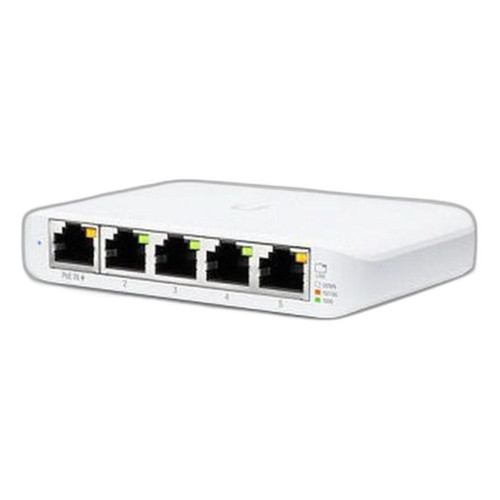
The USW-FLEX-MINI specifies an operating temperature of -5 to 45 °C (23 to 113 °F), a polycarbonate enclosure, and dimensions of 107 × 70 × 21 mm weighing 150 g. It is designed as a compact desktop unit. Polycarbonate construction and a -5 °C lower bound indicate an indoor or climate-controlled environment; the unit is not described as hardened, weatherized, or enclosure-rated.
For outdoor, pole-mounted, or enclosure-integrated installations, the NETWAY5PQ's hardened board form factor and extended temperature rating give it a structural advantage. For clean indoor IT closets or desktop deployments in conditioned spaces, the USW-FLEX-MINI's compact polycarbonate form is appropriate. The specific low-temperature floor of the NETWAY5PQ is not stated in the provided specs, which is a gap buyers should resolve before cold-climate outdoor installs.
How are these switches managed, and how deeply do they integrate with security or IT platforms?
The NETWAY5PQ is a managed switch with device discovery and integrates with Altronix's LINQ networked security device management ecosystem. LINQ is purpose-built for physical security infrastructure — power management, device health, and remote diagnostics within Altronix's product family. The management interface type (web UI, SNMP, proprietary app) is not explicitly specified in the provided data beyond 'managed switch with device discovery.'
The USW-FLEX-MINI lists 'Ethernet' as its management interface and supports up to 1,000 VLANs with a switching capacity of 10 Gbps and a forwarding rate of 7 Mpps. Ubiquiti's UniFi ecosystem — which this switch is part of — provides centralized cloud or on-premises controller management via UniFi Network Application. VLAN segmentation at 1,000 VLANs is a concrete, published figure relevant to network architects who need to isolate camera VLANs, guest networks, and management planes.
The NETWAY5PQ is optimized for physical security integrators already in the Altronix/LINQ ecosystem. The USW-FLEX-MINI fits IT-centric deployments managed through UniFi controllers where VLAN granularity and throughput specs are primary concerns. Neither unit's management credentials are interoperable with the other's platform based on the provided specifications.
Which should you choose: the NETWAY5PQ or the USW-FLEX-MINI?
Our take: The NETWAY5PQ is the stronger choice when the installation requires actual PoE power delivery to endpoint devices, hardened outdoor or enclosure-rated construction, and integration with Altronix's LINQ security management ecosystem. Three concrete spec deltas define the gap: (1) the NETWAY5PQ delivers PoE+ (802.3at, up to 30 W per port) across all 5 ports, while the USW-FLEX-MINI's 2.5 W total USB-C power draw makes PoE output to endpoints physically infeasible; (2) the NETWAY5PQ carries an extended outdoor-rated temperature specification versus the USW-FLEX-MINI's -5 to 45 °C indoor-grade polycarbonate range; (3) the NETWAY5PQ ships with a lifetime warranty versus the USW-FLEX-MINI's unspecified manufacturer warranty duration. The USW-FLEX-MINI is better suited to IT-managed indoor environments where 1,000 VLAN support, 10 Gbps switching capacity, and UniFi ecosystem integration matter more than PoE output or environmental hardening — and where endpoints are powered independently.
Side-by-Side Comparison
Spec-for-spec, from manufacturer data.
| Specification | Altronix NETWAY5PQ | Ubiquiti USW-FLEX-MINI |
|---|---|---|
| Product Type | Managed PoE+ Switch (board) | Managed Gigabit Switch (desktop) |
| Total Ports | 5 | 5 |
| PoE Output Standard | PoE+ (802.3at) | None (2.5 W total draw; 802.3af tag not deliverable) |
| PoE Budget (published) | Not specified in provided data | — |
| Switching Capacity | Not specified in provided data | 10 Gbps |
| Non-Blocking Throughput | Not specified in provided data | 5 Gbps |
| Forwarding Rate | Not specified in provided data | 7 Mpps |
| VLAN Support | Not specified in provided data | Up to 1,000 |
| Power Input | Not specified in provided data | USB Type-C, 5 V, 2.5 W max |
| Power Consumption | Not specified in provided data | 2.5 W |
| Operating Temperature | Extended range, outdoor-rated (exact range not provided) | -5 to 45 °C (23 to 113 °F) |
| Enclosure / Form Factor | Hardened board (pole-mount) | Polycarbonate compact desktop |
| Dimensions | Not specified in provided data | 107 x 70 x 21 mm |
| Weight | Not specified in provided data | 150 g (5.3 oz) |
| Ecosystem / Management | Altronix LINQ; managed with device discovery | Ubiquiti UniFi; Ethernet management |
| Warranty | Lifetime | Manufacturer Warranty (duration not specified) |
Frequently Asked Questions
Which should you choose: the NETWAY5PQ or the USW-FLEX-MINI?
The NETWAY5PQ is the stronger choice when the installation requires actual PoE power delivery to endpoint devices, hardened outdoor or enclosure-rated construction, and integration with Altronix's LINQ security management ecosystem. Three concrete spec deltas define the gap: (1) the NETWAY5PQ delivers PoE+ (802.3at, up to 30 W per port) across all 5 ports, while the USW-FLEX-MINI's 2.5 W total USB-C power draw makes PoE output to endpoints physically infeasible; (2) the NETWAY5PQ carries an extended outdoor-rated temperature specification versus the USW-FLEX-MINI's -5 to 45 °C indoor-grade polycarbonate range; (3) the NETWAY5PQ ships with a lifetime warranty versus the USW-FLEX-MINI's unspecified manufacturer warranty duration. The USW-FLEX-MINI is better suited to IT-managed indoor environments where 1,000 VLAN support, 10 Gbps switching capacity, and UniFi ecosystem integration matter more than PoE output or environmental hardening — and where endpoints are powered independently.
Can the USW-FLEX-MINI power my IP cameras directly like the NETWAY5PQ does?
No. The USW-FLEX-MINI's total power consumption is listed at 2.5 W via USB-C, which is far below the minimum required to supply PoE (802.3af requires up to 15.4 W at the powered device). It cannot deliver PoE power to cameras or other endpoints based on its provided specifications. The NETWAY5PQ is specified as a PoE+ (802.3at) switch with per-port power management across all 5 ports and is the appropriate choice for powering IP cameras, readers, or intercoms from the switch.
Is the NETWAY5PQ or the USW-FLEX-MINI better for a UniFi-managed network?
The USW-FLEX-MINI is the correct choice for a UniFi-managed network. It is a Ubiquiti product designed to operate within the UniFi ecosystem, managed via the UniFi Network Application. The NETWAY5PQ integrates with Altronix's LINQ ecosystem and is not specified as compatible with UniFi controllers. If your site standardizes on UniFi management, the USW-FLEX-MINI fits; if you are running Altronix LINQ infrastructure, the NETWAY5PQ is the native fit.
Which switch is better for outdoor or harsh-environment cabinet installs?
The NETWAY5PQ is specified with an extended operating temperature range rated for outdoor and harsh environments and is described as a hardened board design with pole-mount capability — purpose-built for security enclosure and outdoor use. The USW-FLEX-MINI is rated -5 to 45 °C in a polycarbonate desktop enclosure with no weatherization or hardening specification. For outdoor cabinets, pole mounts, or environments outside the -5 to 45 °C band, the NETWAY5PQ is the appropriate option based on the provided specs. Note: the NETWAY5PQ's exact temperature floor is not published in the provided spec data; confirm from the datasheet for extreme cold-climate installs.
More Network Switch Comparisons
- TP-Link ES205GP vs Ubiquiti USW-FLEX
- TP-Link ES205GP vs Ubiquiti USW-FLEX-MINI
- TP-Link ES205GP vs Ubiquiti USW-FLEX-3
- TP-Link ES205GP vs Ubiquiti USW-FLEX-MINI-3
- TP-Link ES205GP vs TP-Link SG105PP-M2
- TP-Link SG105PP-M2 vs Ubiquiti USW-FLEX
Network Switch Buying Guides
Get a Second Opinion on Your Camera Choice
Share your site layout, coverage goals, and budget. Our team will validate the camera selection, flag anything we would change, and recommend products that match the use case.