
Allied Telesis IE340-20GP-980 vs TP-Link SL1218MP: Specification Comparison
Both the Allied Telesis AT-IE340-20GP-980 and the TP-Link TL-SL1218MP are 16-port PoE switches serving IP surveillance and networked device deployments. The comparison covers switching performance, power delivery, and physical installation suitability. The AT-IE340-20GP-980 is an industrial-grade, DIN rail-mounted unit targeting harsh or cabinet-less environments, while the TL-SL1218MP is a rack-mount, unmanaged consumer-commercial switch. Despite sharing a 16-port PoE form factor, they differ substantially in data-plane speed, PoE standard support, power source, and environmental ratings.
In This Guide
- Which switch delivers more bandwidth and higher per-port data speeds?
- How do PoE budget, standard support, and power input compare between the two switches?
- Which switch is better suited to demanding physical environments, and what management features are available?
- Which should you choose: the IE340-20GP-980 or the SL1218MP?
- Side-by-Side Specs
- FAQ
Which switch delivers more bandwidth and higher per-port data speeds?
The AT-IE340-20GP-980 provides 16 copper ports running at 10/100/1000T (Gigabit) and 4 SFP uplink slots rated at 100/1000X, yielding a switching fabric of 40 Gbps and a forwarding rate of 29.7 Mpps. All 20 ports contribute to a true Gigabit backplane.
The TL-SL1218MP offers 16 ports limited to 10/100 Mbps (Fast Ethernet), with only 2 Gigabit uplink ports (combo SFP/RJ-45). Its switching capacity is 7.2 Gbps with no forwarding rate stated in the provided specs. Access ports are therefore capped at 100 Mbps, which constrains cameras or devices needing Gigabit connectivity.
For high-resolution camera streams, multi-megapixel encoders, or any device requiring Gigabit access, the AT-IE340-20GP-980's all-Gigabit copper plane and 40 Gbps fabric represent a decisive bandwidth advantage. The TL-SL1218MP's 7.2 Gbps capacity and 100 Mbps access ports suit lower-bitrate, cost-sensitive installations.
How do PoE budget, standard support, and power input compare between the two switches?
The AT-IE340-20GP-980 supports PoE++ (802.3bt implied by the 'PoE++' designation) across all 16 ports, with a maximum PoE budget of 240 W. The spec sheet distinguishes PoE at 15 W across all 16 ports and PoE+ at 30 W on 8 of those ports, reflecting power-sharing across the budget. Total maximum power consumption is 271 W. Input is 18–57 V DC wide-range, requiring an external DC power supply rather than a standard AC outlet.
The TL-SL1218MP supports 802.3af/at (PoE/PoE+) on all 16 ports, with a maximum per-port output of 30 W and a total PoE budget of 192 W. It draws from a standard 100–240 V AC, 50/60 Hz supply — the same outlet found in any commercial building — eliminating the need for a separate DC source.
The AT-IE340-20GP-980 carries a 48 W higher PoE budget (240 W vs 192 W) and supports higher PoE++ per-port ceilings, benefiting high-draw PTZ cameras, access controllers, or multi-radio APs. However, its DC-only input requires a compatible power source or UPS in the installation design. The TL-SL1218MP's AC input is simpler to deploy in standard IT closets.
Which switch is better suited to demanding physical environments, and what management features are available?
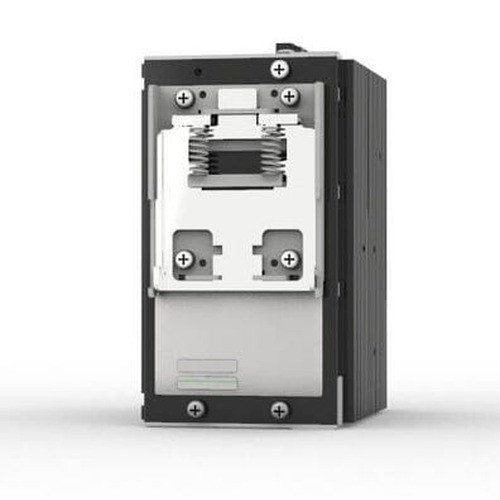
The AT-IE340-20GP-980 uses a fanless aluminum and sheet-metal enclosure rated IP30, mounts on a DIN rail, and operates across an industrial temperature range (specific range not listed in the provided specs). Its fanless design eliminates moving parts, reducing failure risk in dusty or vibration-prone environments. Weight is 2.34 kg (DIN rail configuration) in a compact 91 × 139 × 153 mm footprint. Enclosure color is white. No noise rating is provided.
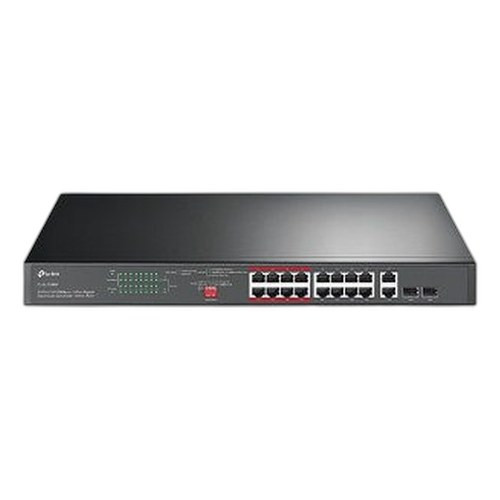
The TL-SL1218MP is a rack-mount unit (1U, 440 × 180 × 44 mm) with 2 fans for active cooling. Its operating temperature range is 0 °C–40 °C (32 °F–104 °F) — a standard commercial indoor envelope. Storage temperature extends to −40 °C–70 °C. No IP ingress protection rating is stated. Its Extend Mode provides PoE reach up to 250 m on ports 1–8.
The AT-IE340-20GP-980 is engineered for industrial, outdoor-cabinet, or non-air-conditioned spaces where fanless operation and IP30 rating matter. The TL-SL1218MP suits climate-controlled server rooms or wiring closets. On management: the TL-SL1218MP is explicitly unmanaged (plug-and-play only). No management classification is stated in the provided AT-IE340-20GP-980 specs, so a direct comparison on that axis cannot be made from available data.
Which should you choose: the IE340-20GP-980 or the SL1218MP?
Our take: The AT-IE340-20GP-980 is the stronger choice when all-Gigabit access ports, higher PoE budget, and industrial environmental resilience are required. Its 40 Gbps fabric versus 7.2 Gbps, 240 W PoE budget versus 192 W, and fanless IP30-rated enclosure make it the appropriate selection for high-density IP surveillance, outdoor cabinets, or edge deployments without climate control. The TL-SL1218MP's 16 ports are capped at 100 Mbps, immediately disqualifying it for Gigabit camera streams. Where the TL-SL1218MP has an advantage is AC-power simplicity (100–240 V vs. 18–57 V DC) and rack-mount form factor suited to standard IT rooms. Its 250 m Extend Mode also benefits long cable runs. Buyers deploying Gigabit cameras, high-draw PTZ heads, or industrial edge environments should select the AT-IE340-20GP-980; those running legacy 100 Mbps cameras in a standard wiring closet on a tighter budget may find the unmanaged TL-SL1218MP sufficient.
Side-by-Side Comparison
Spec-for-spec, from manufacturer data.
| Specification | Allied Telesis IE340-20GP-980 | TP-Link SL1218MP |
|---|---|---|
| Product Type | Industrial PoE++ Switch | Unmanaged PoE+ Switch |
| Managed | — | No (Unmanaged) |
| Copper Access Ports | 16× 10/100/1000T (Gigabit) | 16× 10/100 Mbps (Fast Ethernet) |
| Uplink Ports | 4× 100/1000X SFP | 2× Gigabit combo (SFP/RJ-45) |
| Total Ports | 20 | 18 |
| Switching Fabric | 40 Gbps | 7.2 Gbps |
| Forwarding Rate | 29.7 Mpps | — |
| PoE Standard | PoE++ (16 ports) | 802.3af/at — PoE/PoE+ (16 ports) |
| PoE Budget | 240 W | 192 W |
| Max per-Port PoE | 30 W (PoE+) on 8 ports | 30 W (PoE+) |
| Max Power Consumption | 271 W | — |
| Power Input | 18–57 V DC | 100–240 V AC, 50/60 Hz |
| Cooling | Fanless | 2 Fans |
| Enclosure / IP Rating | Aluminum/Sheet Metal, IP30 | — (no IP rating stated) |
| Mount Type | DIN Rail | Rack Mount |
| Dimensions (mm) | 91 × 139 × 153 | 440 × 180 × 44 |
| Operating Temp | — | 0 °C–40 °C (32 °F–104 °F) |
| Extend Mode (long-reach PoE) | — | 250 m (ports 1–8) |
Frequently Asked Questions
Which should you choose: the IE340-20GP-980 or the SL1218MP?
The AT-IE340-20GP-980 is the stronger choice when all-Gigabit access ports, higher PoE budget, and industrial environmental resilience are required. Its 40 Gbps fabric versus 7.2 Gbps, 240 W PoE budget versus 192 W, and fanless IP30-rated enclosure make it the appropriate selection for high-density IP surveillance, outdoor cabinets, or edge deployments without climate control. The TL-SL1218MP's 16 ports are capped at 100 Mbps, immediately disqualifying it for Gigabit camera streams. Where the TL-SL1218MP has an advantage is AC-power simplicity (100–240 V vs. 18–57 V DC) and rack-mount form factor suited to standard IT rooms. Its 250 m Extend Mode also benefits long cable runs. Buyers deploying Gigabit cameras, high-draw PTZ heads, or industrial edge environments should select the AT-IE340-20GP-980; those running legacy 100 Mbps cameras in a standard wiring closet on a tighter budget may find the unmanaged TL-SL1218MP sufficient.
Can the AT-IE340-20GP-980 or TL-SL1218MP power high-draw PTZ cameras or multi-radio APs?
The AT-IE340-20GP-980 supports PoE++ up to a 240 W total budget and can deliver 30 W per port on up to 8 ports simultaneously, making it compatible with high-draw PTZ cameras and dual-radio APs that exceed standard PoE+ limits. The TL-SL1218MP supports 802.3at (PoE+) at up to 30 W per port within a 192 W total budget — capable of standard PoE+ PTZ cameras but not devices requiring PoE++ power levels beyond 30 W per port.
Which switch works in an outdoor cabinet or industrial environment without air conditioning?
The AT-IE340-20GP-980 is the appropriate choice. Its fanless aluminum enclosure carries an IP30 rating and mounts on a DIN rail, making it suited for industrial cabinets, curbside enclosures, or locations with dust and vibration. The TL-SL1218MP uses active fan cooling, has no stated IP rating, and is rated for a commercial 0 °C–40 °C indoor operating range only.
Do I need a special power supply to install the AT-IE340-20GP-980 versus the TL-SL1218MP?
Yes. The AT-IE340-20GP-980 requires an 18–57 V DC input — a standard AC outlet is not sufficient; you must provision a compatible DC power supply, DIN rail PSU, or DC-output UPS in the enclosure. The TL-SL1218MP accepts 100–240 V AC, 50/60 Hz directly from a standard outlet or PDU, with no additional power conversion equipment needed.
More Network Switch Comparisons
- Vivotek GEL-205A-260 vs TP-Link SL1218MP
- Vivotek GEL-205A-260 vs Allied Telesis AT-x530L-18GHXm-10
- Vivotek GEL-205A-260 vs Ubiquiti USW-LITE-16-POE
- Vivotek GEL-205A-260 vs Ubiquiti USW-16-POE
- TP-Link SL1218MP vs Allied Telesis AT-x530L-18GHXm-10
- TP-Link SL1218MP vs Ubiquiti USW-LITE-16-POE
Network Switch Buying Guides
Get a Second Opinion on Your Camera Choice
Share your site layout, coverage goals, and budget. Our team will validate the camera selection, flag anything we would change, and recommend products that match the use case.