
Allied Telesis GS970M/18PS-R-10 vs Ubiquiti USW-LITE-16-POE: Specification Comparison
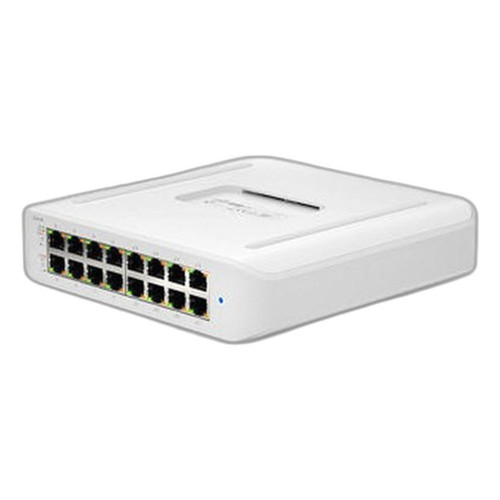
Both the Allied Telesis AT-GS970M/18PS-R-10 and the Ubiquiti USW-LITE-16-POE are 16-port Gigabit PoE+ managed switches targeting small-to-mid commercial deployments—surveillance, wireless access points, and VoIP. Each delivers 802.3at PoE+ across all 16 copper ports and fits into space-constrained installations. They diverge sharply on PoE power budget, uplink flexibility, physical form factor, and total system weight, making this a genuine cross-shop decision for installers evaluating edge-closet or desktop switch placements.
In This Guide
- Which switch delivers enough PoE power and port density for the planned device load?
- Does each switch provide sufficient throughput and uplink flexibility for the network tier it serves?
- Which switch fits the physical and environmental constraints of the installation site?
- Which should you choose: the GS970M/18PS-R-10 or the USW-LITE-16-POE?
- Side-by-Side Specs
- FAQ
Which switch delivers enough PoE power and port density for the planned device load?
The AT-GS970M/18PS-R-10 provides a 247W total PoE+ budget across its 16 copper ports. At 15W per port, all 16 ports can be powered simultaneously; at the full 30W 802.3at ceiling, 8 ports can run concurrently. This budget is suited to installations mixing PTZ cameras, outdoor APs, and IP intercoms that individually draw 15–30W.
The USW-LITE-16-POE offers a 45W total PoE+ budget across all 16 ports, with a 60W internal power supply (15W consumed by the switch itself). In practice, 45W shared across 16 ports yields an average of just 2.8W per active PoE device if all ports are loaded—adequate only for a small cluster of low-draw sensors or a few 802.3af cameras, not for simultaneous full-load PoE+ devices. The per-port ceiling is 30W (802.3at), but the aggregate budget severely limits how many ports can draw at that rate concurrently.
Does each switch provide sufficient throughput and uplink flexibility for the network tier it serves?
The AT-GS970M/18PS-R-10 has a 36 Gbps switching fabric and a 26.8 Mpps forwarding rate. It adds two dedicated 100/1000X SFP fiber uplink ports, bringing the total port count to 18. The SFP slots enable fiber runs to an upstream aggregation switch or MDF over distances impractical for copper, and provide link redundancy independent of the 16 access ports.
The USW-LITE-16-POE has a 32 Gbps switching capacity and a 24 Mpps forwarding rate. No SFP or dedicated uplink ports are specified in the provided data; all 16 ports are copper RJ-45. VLAN support is documented at 1,000 VLANs. Uplink to upstream infrastructure must use one of the 16 copper ports, consuming a PoE-capable access port and reducing available endpoint ports to 15 or fewer.
Which switch fits the physical and environmental constraints of the installation site?
The AT-GS970M/18PS-R-10 measures 341 × 231 × 44 mm and weighs 4.35 kg. Maximum power consumption is 330W (switch plus full PoE load). Acoustic noise is rated at 34 dBA. The housing is described as white. No operating temperature range is provided in the supplied specifications. The unit is rack-mount capable based on its dimensions.
The USW-LITE-16-POE measures 192 × 185 × 44 mm and weighs 1.2 kg—roughly half the footprint and less than one-third the weight of the Allied Telesis unit. It is wall-mountable and desktop-capable with a polycarbonate enclosure. Power consumption excluding PoE output is 15W; the internal 60W supply covers both the switch and PoE load. Operating temperature is specified at −15 to 40 °C. The unit carries NDAA compliance plus CE, FCC, IC, and Anatel certifications. No acoustic noise rating is provided in the supplied specifications.
Which should you choose: the GS970M/18PS-R-10 or the USW-LITE-16-POE?
Our take: The AT-GS970M/18PS-R-10 is the stronger choice when the installation requires powering a full rack of PoE+ devices simultaneously or demands fiber uplink flexibility. Its 247W PoE budget is 5.5× the USW-LITE-16-POE's 45W, meaning it can sustain all 16 ports at 15W concurrently versus the Ubiquiti's roughly 2–3 active devices at that draw before budget exhaustion. Its two dedicated SFP fiber uplink ports preserve all 16 copper access ports for endpoints, while the Ubiquiti must sacrifice a copper port for upstream connectivity. The USW-LITE-16-POE is the appropriate choice when aggregate PoE demand is genuinely low—a handful of lightweight sensors or a small AP cluster—and when the compact 192 × 185 mm wall-mount form factor, 1.2 kg weight, NDAA compliance, and documented −15 to 40 °C operating range are decision factors. Platform alignment also matters: the USW-LITE-16-POE is designed for UniFi-managed environments.
Side-by-Side Comparison
Spec-for-spec, from manufacturer data.
| Specification | Allied Telesis GS970M/18PS-R-10 | Ubiquiti USW-LITE-16-POE |
|---|---|---|
| Copper PoE Ports | 16 × 10/100/1000T RJ-45 | 16 × 1G RJ-45 |
| Fiber / SFP Uplink Ports | 2 × 100/1000X SFP | — |
| Total Ports | 18 | 16 |
| PoE Standard | PoE+ (802.3at) | PoE+ (802.3at) |
| Total PoE Power Budget | 247W | 45W |
| Max PoE Per Port | 30W | 30W |
| Simultaneous 15W Ports | 16 | 3 (45W ÷ 15W) |
| Switching Fabric | 36 Gbps | 32 Gbps |
| Forwarding Rate | 26.8 Mpps | 24 Mpps |
| Max Power Consumption (total) | 330W | 60W (internal PSU) |
| Switch Power (excl. PoE) | — | 15W |
| VLAN Support | — | 1,000 VLANs |
| Dimensions (W × D × H mm) | 341 × 231 × 44 | 192 × 185 × 44 |
| Weight | 4.35 kg (9.6 lb) | 1.2 kg (2.6 lb) |
| Form Factor | Rack-mount | Desktop / Wall-mount |
| Operating Temperature | — | −15 to 40 °C |
| Acoustic Noise | 34 dBA | — |
| NDAA Compliant | — | Yes |
| Certifications | — | CE, FCC, IC, Anatel |
Frequently Asked Questions
Which should you choose: the GS970M/18PS-R-10 or the USW-LITE-16-POE?
The AT-GS970M/18PS-R-10 is the stronger choice when the installation requires powering a full rack of PoE+ devices simultaneously or demands fiber uplink flexibility. Its 247W PoE budget is 5.5× the USW-LITE-16-POE's 45W, meaning it can sustain all 16 ports at 15W concurrently versus the Ubiquiti's roughly 2–3 active devices at that draw before budget exhaustion. Its two dedicated SFP fiber uplink ports preserve all 16 copper access ports for endpoints, while the Ubiquiti must sacrifice a copper port for upstream connectivity. The USW-LITE-16-POE is the appropriate choice when aggregate PoE demand is genuinely low—a handful of lightweight sensors or a small AP cluster—and when the compact 192 × 185 mm wall-mount form factor, 1.2 kg weight, NDAA compliance, and documented −15 to 40 °C operating range are decision factors. Platform alignment also matters: the USW-LITE-16-POE is designed for UniFi-managed environments.
Can the USW-LITE-16-POE power 16 cameras at once?
Only if the cameras draw a combined total of 45W or less—approximately 2.8W per port averaged across all 16. At a typical IP camera draw of 5–15W per device, the 45W budget supports roughly 3 to 9 cameras simultaneously before the budget is exhausted. The AT-GS970M/18PS-R-10's 247W budget supports all 16 ports at 15W concurrently, or 8 ports at the full 30W 802.3at ceiling.
Is the AT-GS970M/18PS-R-10 or the USW-LITE-16-POE better for larger deployments with fiber backbone runs?
The AT-GS970M/18PS-R-10 is better suited: it includes two dedicated SFP fiber uplink ports that connect to an upstream aggregation switch over fiber without consuming any of the 16 PoE access ports. The USW-LITE-16-POE has no SFP ports specified in the provided data; fiber connectivity would require a separate media converter and would still consume one of the 16 copper ports.
Which switch is NDAA compliant?
The USW-LITE-16-POE is documented as NDAA compliant in the provided specifications. No NDAA compliance status is stated in the provided specifications for the AT-GS970M/18PS-R-10.
More Network Switch Comparisons
- Vivotek GEL-205A-260 vs TP-Link SL1218MP
- Vivotek GEL-205A-260 vs Allied Telesis AT-x530L-18GHXm-10
- Vivotek GEL-205A-260 vs Ubiquiti USW-LITE-16-POE
- Vivotek GEL-205A-260 vs Ubiquiti USW-16-POE
- TP-Link SL1218MP vs Allied Telesis AT-x530L-18GHXm-10
- TP-Link SL1218MP vs Ubiquiti USW-LITE-16-POE
Network Switch Buying Guides
Get a Second Opinion on Your Camera Choice
Share your site layout, coverage goals, and budget. Our team will validate the camera selection, flag anything we would change, and recommend products that match the use case.