
Allied Telesis GS970M/18PS-R-10 vs TP-Link SL1218MP: Specification Comparison
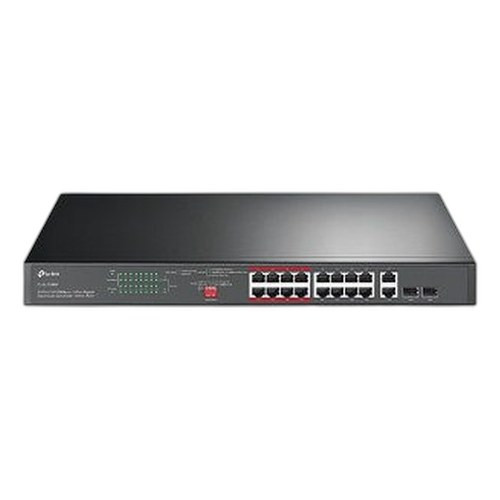
Both the Allied Telesis GS970M/18PS-R-10 and the TP-Link TL-SL1218MP are 18-port rack-mount PoE+ switches targeting mid-scale surveillance and wireless deployments, each offering 16 PoE-capable access ports plus 2 uplink ports. The Allied Telesis unit delivers Gigabit copper on all 16 access ports with full management capability, while the TP-Link unit provides 10/100 Mbps on its 16 access ports and operates unmanaged. This comparison evaluates PoE power budget and port throughput, build and power characteristics, and management capability.
In This Guide
- Which switch delivers more PoE power and network throughput to connected devices?
- How do the two switches compare on physical footprint, power consumption, and operating environment?
- What management features and integration options does each switch offer?
- Which should you choose: the GS970M/18PS-R-10 or the SL1218MP?
- Side-by-Side Specs
- FAQ
Which switch delivers more PoE power and network throughput to connected devices?
The GS970M/18PS-R-10 provides a 247W total PoE+ budget across its 16 ports, each capable of 802.3at (30W), supporting up to 8 ports simultaneously at full 30W or all 16 at 15W. Its 16 access ports run at full 10/100/1000T (Gigabit) speeds, backed by a 36 Gbps switching fabric and a 26.8 Mpps forwarding rate.
The TL-SL1218MP offers a 192W total PoE+ budget across its 16 ports, also rated 802.3af/at (30W per port per spec). Its 16 access ports are limited to 10/100 Mbps; only the 2 uplink ports reach Gigabit speeds. Switching capacity is 7.2 Gbps with no forwarding rate figure stated in the provided specs. An Extend Mode is noted that pushes reach to 250m at reduced speed on ports 1–8.
The PoE budget difference is 55W (247W vs. 192W), meaningful when powering high-wattage PTZ cameras or dual-radio APs. The throughput gap is more significant: Gigabit access ports on the Allied Telesis unit versus Fast Ethernet (100 Mbps ceiling) on the TP-Link unit, a 10× per-port bandwidth difference that matters for high-resolution multi-stream camera feeds.
How do the two switches compare on physical footprint, power consumption, and operating environment?
The GS970M/18PS-R-10 measures 341 × 231 × 44 mm and weighs 4.35 kg (9.6 lb). Maximum power consumption is 330W and maximum heat dissipation is rated at 169 BTU/hr. Acoustic noise is specified at 34 dBA. Housing color is white. No operating temperature range is provided in the supplied specs.
The TL-SL1218MP measures 440 × 180 × 44 mm. No weight figure is provided in the supplied specs. Power supply input is 100–240V AC, 50/60Hz; a maximum power consumption figure in watts is not stated in the supplied specs beyond the AC input range. Operating temperature is specified as 0°C–40°C (32°F–104°F); storage temperature is –40°C to 70°C. Two cooling fans are noted.
Both units occupy 1U of rack space. The Allied Telesis unit is shallower (231 mm depth vs. 180 mm on the TP-Link), but the TP-Link is wider at 440 mm versus 341 mm. The Allied Telesis datasheet provides a concrete noise figure (34 dBA) and heat dissipation (169 BTU/hr); comparable figures are absent from the TP-Link specs provided. The TP-Link supplies an operating temperature range; the Allied Telesis spec provided does not.
What management features and integration options does each switch offer?
The GS970M/18PS-R-10 is a managed switch. No further detail on specific management protocols, web GUI, CLI, or SNMP support is enumerated in the provided specs, but the managed designation means traffic control, VLAN segmentation, QoS prioritization, and monitoring are available. The two SFP uplink ports support fiber connectivity for long-distance trunk runs.
The TL-SL1218MP is explicitly unmanaged—plug-and-play with no configuration interface. It offers two operating modes selectable at the hardware level: Priority Mode (ports 1–8 given precedence) and Extend Mode (250m reach on ports 1–8). The two Gigabit combo SFP slots are noted as supporting single-mode fiber. No VLAN, QoS, or SNMP capability is available given its unmanaged nature.
For any deployment requiring VLAN isolation between camera segments and office traffic, per-port PoE scheduling, SNMP monitoring, or integration with a network management system, the GS970M/18PS-R-10 is the only option between these two. The TL-SL1218MP's unmanaged design suits simple, flat-network installations where configuration overhead must be zero.
Which should you choose: the GS970M/18PS-R-10 or the SL1218MP?
Our take: The GS970M/18PS-R-10 is the stronger choice when port-level throughput, PoE headroom, and network management are required. It delivers Gigabit on all 16 access ports versus 100 Mbps on the TL-SL1218MP—a 10× per-port bandwidth advantage critical for multi-stream high-resolution cameras. Its 247W PoE budget exceeds the TL-SL1218MP's 192W by 55W, allowing more high-wattage devices simultaneously. As a managed switch it supports VLAN, QoS, and monitoring absent from the unmanaged TL-SL1218MP. The TL-SL1218MP is a fit for budget-constrained, flat-network deployments running legacy 10/100 cameras where plug-and-play simplicity is the priority and 192W of PoE+ suffices. Installers standardizing on a managed, Gigabit-to-the-edge infrastructure—particularly in surveillance or wireless AP deployments—should specify the GS970M/18PS-R-10.
Side-by-Side Comparison
Spec-for-spec, from manufacturer data.
| Specification | Allied Telesis GS970M/18PS-R-10 | TP-Link SL1218MP |
|---|---|---|
| Access Port Count | 16 × 10/100/1000T (Gigabit) | 16 × 10/100 Mbps (Fast Ethernet) |
| Uplink Ports | 2 × SFP (100/1000X) | 2 × Gigabit combo SFP |
| Total Ports | 18 | 18 |
| PoE Standard | 802.3at (PoE+) | 802.3af/at (PoE+) |
| PoE-Enabled Ports | 16 | 16 |
| Total PoE Budget | 247W | 192W |
| Max Concurrent 30W Ports (per spec) | 8 ports at 30W | — |
| Switching Fabric / Capacity | 36 Gbps | 7.2 Gbps |
| Forwarding Rate | 26.8 Mpps | — |
| Managed / Unmanaged | Managed | Unmanaged |
| Max Power Consumption | 330W | — |
| Heat Dissipation | 169 BTU/hr | — |
| Noise Level | 34 dBA | — |
| Dimensions (W × D × H) | 341 × 231 × 44 mm | 440 × 180 × 44 mm |
| Weight | 4.35 kg (9.6 lb) | — |
| Operating Temperature | — | 0°C–40°C (32°F–104°F) |
Frequently Asked Questions
Which should you choose: the GS970M/18PS-R-10 or the SL1218MP?
The GS970M/18PS-R-10 is the stronger choice when port-level throughput, PoE headroom, and network management are required. It delivers Gigabit on all 16 access ports versus 100 Mbps on the TL-SL1218MP—a 10× per-port bandwidth advantage critical for multi-stream high-resolution cameras. Its 247W PoE budget exceeds the TL-SL1218MP's 192W by 55W, allowing more high-wattage devices simultaneously. As a managed switch it supports VLAN, QoS, and monitoring absent from the unmanaged TL-SL1218MP. The TL-SL1218MP is a fit for budget-constrained, flat-network deployments running legacy 10/100 cameras where plug-and-play simplicity is the priority and 192W of PoE+ suffices. Installers standardizing on a managed, Gigabit-to-the-edge infrastructure—particularly in surveillance or wireless AP deployments—should specify the GS970M/18PS-R-10.
Is the GS970M/18PS-R-10 or TL-SL1218MP better for a 16-camera IP surveillance installation?
The GS970M/18PS-R-10 is better suited for most IP camera installations. It provides Gigabit throughput on all 16 access ports—important for high-resolution or multi-stream cameras—and a 247W PoE budget versus 192W on the TL-SL1218MP. Its managed capability also allows VLAN isolation and QoS prioritization for camera traffic, neither of which is available on the unmanaged TL-SL1218MP.
Can the TL-SL1218MP power PTZ cameras or dual-radio access points that draw close to 30W?
The TL-SL1218MP is rated for 802.3at (30W per port) with a 192W total budget. If all 16 ports drew 30W simultaneously the aggregate would exceed that budget, so simultaneous full-load across all ports is not supported. The spec does not detail per-port power allocation logic in the provided data. The GS970M/18PS-R-10 explicitly states support for 8 ports at full 30W concurrently within its 247W budget.
Does either switch support fiber uplinks for connecting to a core switch in another building?
Both switches include 2 SFP uplink slots. The GS970M/18PS-R-10 specifies 100/1000X SFP ports. The TL-SL1218MP spec notes Gigabit combo SFP slots described as supporting single-mode fiber. Specific transceiver compatibility lists are not included in the provided specs for either unit and should be confirmed against each manufacturer's transceiver compatibility matrix before purchasing.
More Network Switch Comparisons
- Vivotek GEL-205A-260 vs TP-Link SL1218MP
- Vivotek GEL-205A-260 vs Allied Telesis AT-x530L-18GHXm-10
- Vivotek GEL-205A-260 vs Ubiquiti USW-LITE-16-POE
- Vivotek GEL-205A-260 vs Ubiquiti USW-16-POE
- TP-Link SL1218MP vs Allied Telesis AT-x530L-18GHXm-10
- TP-Link SL1218MP vs Ubiquiti USW-LITE-16-POE
Network Switch Buying Guides
Get a Second Opinion on Your Camera Choice
Share your site layout, coverage goals, and budget. Our team will validate the camera selection, flag anything we would change, and recommend products that match the use case.