
Allied Telesis AT-x530L-18GHXm-10 vs Ubiquiti USW-LITE-16-POE: Specification Comparison
Both the Allied Telesis AT-x530L-18GHXm-10 and the Ubiquiti USW-LITE-16-POE are 16-port managed PoE switches targeting network infrastructure deployments, making them a legitimate cross-shop in the Layer 2/3 switching category. However, they occupy meaningfully different performance tiers: the AT-x530L-18GHXm-10 is a multi-gigabit, rack-mount PoE++ platform aimed at high-density power and uplink demands, while the USW-LITE-16-POE is a compact gigabit PoE+ desktop switch optimized for lightweight, space-constrained installations. Buyers evaluating both are typically weighing power budget, port speed, and deployment context.
In This Guide
- How do the PoE power budgets and per-port delivery compare?
- What switching performance and port speeds does each unit deliver?
- How do physical form factor, environmental ratings, and management capabilities compare?
- Which should you choose: the AT-x530L-18GHXm-10 or the USW-LITE-16-POE?
- Side-by-Side Specs
- FAQ
How do the PoE power budgets and per-port delivery compare?
The AT-x530L-18GHXm-10 provides a 720W total PoE budget across its 16 multi-gigabit ports, supporting IEEE 802.3bt PoE++ at up to 90W per port (8 ports), 60W per port (12 ports), 30W per port (all 16 ports), and backward compatibility down to 7.5W and 15.4W. This makes it well-suited for powering high-draw devices such as pan-tilt-zoom cameras, access points with multiple radios, or thin clients.
The USW-LITE-16-POE delivers a 45W total PoE budget across all 16 ports, conforming to IEEE 802.3at (PoE+) with a maximum of 30W per port. Its 60W internal power supply supports up to 15W system power plus 45W PoE output. For deployments running standard IP cameras, VoIP phones, or low-power access points, this budget may suffice, but it cannot support PoE++ devices or high-density simultaneous full-power loads. The AT-x530L-18GHXm-10 budget is 16× larger than the USW-LITE-16-POE's 45W.
What switching performance and port speeds does each unit deliver?
The AT-x530L-18GHXm-10 features 16 multi-rate copper ports supporting 100M/1G/2.5G/5G speeds, plus two 10G SFP+ uplink ports and two stacking ports. Its switching fabric runs at 200 Gbps with a forwarding rate of 148.8 Mpps. Latency is specified at 2.56µs at 10 Gbps, 5.23µs at 5 Gbps, 7.72µs at 2.5 Gbps, 7.96µs at 1 Gbps, and 8.35µs at 100 Mbps. The stacking ports allow daisy-chain clustering for unified management across multiple units.
The USW-LITE-16-POE provides 16 ports at 1 Gbps maximum speed with a 32 Gbps switching capacity and a forwarding rate of 24 Mpps. No SFP+ uplinks, stacking ports, or multi-gigabit copper speeds are specified for this model. Latency figures are not provided in the supplied specifications. For environments where 1 Gbps per-port throughput is sufficient and uplink aggregation is not required, the USW-LITE-16-POE's fabric is adequate; where multi-gigabit edge speeds or 10G uplinks are needed, it does not qualify.
How do physical form factor, environmental ratings, and management capabilities compare?
The AT-x530L-18GHXm-10 is a 1U rack-mount unit measuring 441 × 256 × 44 mm and weighing 4.3 kg unpackaged. It generates a maximum of 970W power consumption (including PoE load) and 3,317 BTU/h heat dissipation, with an audible noise level of 42 dBA. No operating temperature range or NDAA compliance status is specified in the provided data. Housing is described as white. Management is not detailed in the supplied specifications beyond the presence of stacking ports.
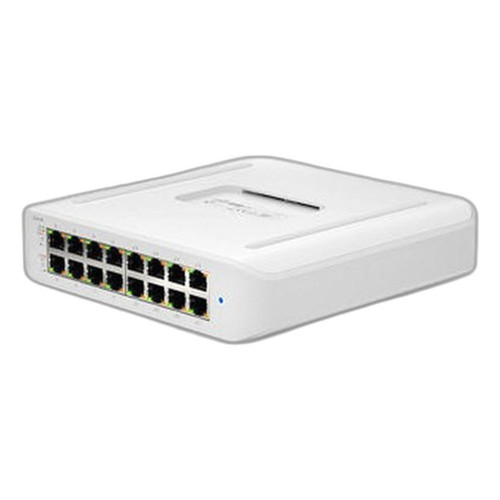
The USW-LITE-16-POE is a compact desktop/wall-mount unit measuring 192 × 185 × 44 mm and weighing 1.2 kg, constructed from polycarbonate. It consumes 15W excluding PoE output and operates between -15°C and +40°C. It is confirmed NDAA compliant and carries CE, FCC, IC, and Anatel certifications. VLAN support is specified at 1,000 VLANs, and management is listed as Ethernet-based (consistent with Ubiquiti's UniFi controller ecosystem, though controller software specifics are not enumerated in the provided specs). No noise or heat dissipation figures are provided for this model.
Which should you choose: the AT-x530L-18GHXm-10 or the USW-LITE-16-POE?
Our take: The AT-x530L-18GHXm-10 is the stronger choice when deployments require high-power PoE++ delivery, multi-gigabit edge speeds, or 10G uplink capacity. Its 720W PoE budget dwarfs the USW-LITE-16-POE's 45W, its per-port ceiling reaches 90W versus 30W, and its switching fabric of 200 Gbps with 148.8 Mpps forwarding rate substantially outpaces the USW-LITE-16-POE's 32 Gbps / 24 Mpps. The USW-LITE-16-POE, however, is the practical choice for compact, power-light installations: its 192 × 185 × 44 mm footprint and 1.2 kg weight suit closet or wall-mount deployments where the AT-x530L-18GHXm-10's 1U rack chassis is impractical. NDAA compliance is confirmed only for the USW-LITE-16-POE, which matters for federally regulated projects. Buyers running standard gigabit PoE+ devices on a tight budget or in a space-constrained site should evaluate the USW-LITE-16-POE; those powering high-draw cameras, multi-radio APs, or requiring multi-gigabit edge connectivity need the AT-x530L-18GHXm-10.
Side-by-Side Comparison
Spec-for-spec, from manufacturer data.
| Specification | Allied Telesis AT-x530L-18GHXm-10 | Ubiquiti USW-LITE-16-POE |
|---|---|---|
| PoE Standard | 802.3bt (PoE++) | 802.3at (PoE+) |
| Total PoE Budget | 720W | 45W |
| Max PoE Per Port | 90W (8 ports) / 60W (12 ports) / 30W (16 ports) | 30W |
| PoE-Enabled Ports | 16 | 16 |
| Copper Port Speed | 100M / 1G / 2.5G / 5G (multi-gigabit) | 1G |
| Total Copper Ports | 16 | 16 |
| Uplink Ports | 2 × 10G SFP+ | — |
| Stacking Ports | 2 | — |
| Switching Fabric | 200 Gbps | 32 Gbps |
| Forwarding Rate | 148.8 Mpps | 24 Mpps |
| Form Factor | 1U rack-mount | Compact desktop / wall-mount |
| Dimensions (mm) | 441 × 256 × 44 | 192 × 185 × 44 |
| Weight (unpackaged) | 4.3 kg (9.48 lb) | 1.2 kg (2.6 lb) |
| Max Power Consumption | 970W | 60W (internal PSU; 15W system + 45W PoE) |
| Noise | 42 dBA | — |
| NDAA Compliant | — | Yes |
| Operating Temperature | — | -15 to 40°C (5 to 104°F) |
| VLAN Support | — | 1,000 VLANs |
| Enclosure Material | — | Polycarbonate |
| Certifications | — | CE, FCC, IC, Anatel |
Frequently Asked Questions
Which should you choose: the AT-x530L-18GHXm-10 or the USW-LITE-16-POE?
The AT-x530L-18GHXm-10 is the stronger choice when deployments require high-power PoE++ delivery, multi-gigabit edge speeds, or 10G uplink capacity. Its 720W PoE budget dwarfs the USW-LITE-16-POE's 45W, its per-port ceiling reaches 90W versus 30W, and its switching fabric of 200 Gbps with 148.8 Mpps forwarding rate substantially outpaces the USW-LITE-16-POE's 32 Gbps / 24 Mpps. The USW-LITE-16-POE, however, is the practical choice for compact, power-light installations: its 192 × 185 × 44 mm footprint and 1.2 kg weight suit closet or wall-mount deployments where the AT-x530L-18GHXm-10's 1U rack chassis is impractical. NDAA compliance is confirmed only for the USW-LITE-16-POE, which matters for federally regulated projects. Buyers running standard gigabit PoE+ devices on a tight budget or in a space-constrained site should evaluate the USW-LITE-16-POE; those powering high-draw cameras, multi-radio APs, or requiring multi-gigabit edge connectivity need the AT-x530L-18GHXm-10.
Is the AT-x530L-18GHXm-10 or USW-LITE-16-POE better for powering high-wattage devices like PTZ cameras or multi-radio access points?
The AT-x530L-18GHXm-10 is purpose-built for this use case. It supports PoE++ (802.3bt) at up to 90W per port on 8 ports and up to 60W per port on 12 ports, with a 720W total budget. The USW-LITE-16-POE is limited to PoE+ (802.3at) at 30W per port maximum and a 45W total budget, which cannot sustain multiple high-draw devices simultaneously. If your devices require more than 30W each or your aggregate load exceeds 45W, the USW-LITE-16-POE is not sufficient.
Can either switch be used in a wall-mount or desktop deployment outside a server rack?
The USW-LITE-16-POE is explicitly designed for compact desktop and wall-mount installation, measuring 192 × 185 × 44 mm and weighing 1.2 kg. The AT-x530L-18GHXm-10 is a 1U rack-mount unit measuring 441 × 256 × 44 mm and weighing 4.3 kg; no desktop or wall-mount capability is specified for it in the provided data. If rack space is unavailable, the USW-LITE-16-POE is the specified fit.
Which switch is NDAA compliant for government or federally funded projects?
NDAA compliance is confirmed in the provided specifications for the USW-LITE-16-POE only. The AT-x530L-18GHXm-10's specifications do not include an NDAA compliance statement in the data provided. Buyers with federal procurement requirements should verify AT-x530L-18GHXm-10 compliance directly with Allied Telesis before specifying it.
More Network Switch Comparisons
- Vivotek GEL-205A-260 vs TP-Link SL1218MP
- Vivotek GEL-205A-260 vs Allied Telesis AT-x530L-18GHXm-10
- Vivotek GEL-205A-260 vs Ubiquiti USW-LITE-16-POE
- Vivotek GEL-205A-260 vs Ubiquiti USW-16-POE
- TP-Link SL1218MP vs Allied Telesis AT-x530L-18GHXm-10
- TP-Link SL1218MP vs Ubiquiti USW-LITE-16-POE
Network Switch Buying Guides
Get a Second Opinion on Your Camera Choice
Share your site layout, coverage goals, and budget. Our team will validate the camera selection, flag anything we would change, and recommend products that match the use case.