
Aiphone IX-EA vs Aiphone IX-DVF-6: Specification Comparison
Both the Aiphone IX-EA and IX-DVF-6 are IP video door stations in the Aiphone IX series, designed for SIP-based access control deployments. The IX-EA is a single-call surface-mount unit suited to single-entry or residential-style applications, while the IX-DVF-6 accommodates up to six individually-directory-mapped call buttons in a flush-mount form factor. This comparison evaluates call capacity and physical integration, environmental and power specifications, and protocol/platform compatibility to help installers and IT buyers determine which unit fits their deployment.
In This Guide
- How do call capacity and physical installation requirements differ between the IX-EA and IX-DVF-6?
- Which unit is rated for harsher environments, and how do their power requirements compare?
- How do the IX-EA and IX-DVF-6 compare on network protocol support and VMS/access-control platform integration?
- Which should you choose: the IX-EA or the IX-DVF-6?
- Side-by-Side Specs
- FAQ
How do call capacity and physical installation requirements differ between the IX-EA and IX-DVF-6?
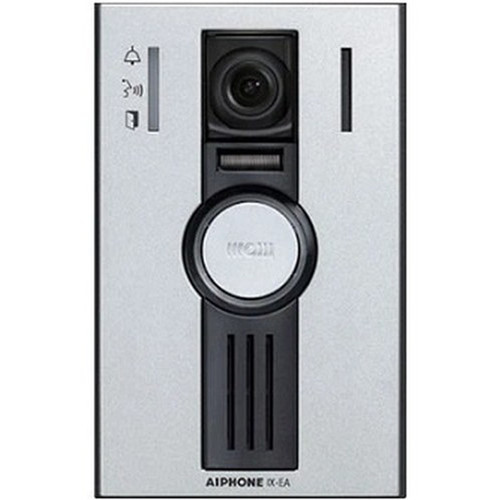
The IX-EA is a single-call station with no stated call-button count in its spec sheet, implying one call destination. It ships in a surface-mount form factor measuring 6-5/16" H × 3-15/16" W × 1-3/4" D, requiring no in-wall cutout and suiting retrofit or single-tenant scenarios where a flush finish is not required.
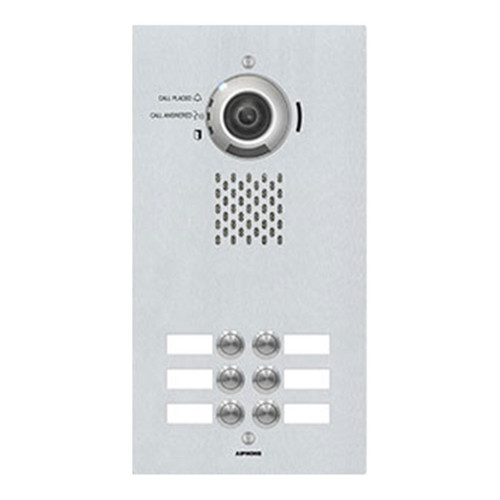
The IX-DVF-6 provides six discrete call buttons, each mappable to an individual directory entry, making it purpose-built for multi-tenant vestibules, apartment lobbies, or office suites where multiple parties share one entry point. Its flush-mount design at 13-11/16" H × 7-3/16" W demands a prepared wall opening and box rough-in. Depth is not listed in the provided specs. The larger panel and six-button layout represent a fundamentally different installation scope and pre-construction coordination requirement compared to the IX-EA.
Which unit is rated for harsher environments, and how do their power requirements compare?
The IX-DVF-6 carries an IP65 ingress protection rating and an IK08 impact resistance rating, with a specified operating temperature range of -40°F to 140°F (-40°C to 60°C). These ratings make it suitable for exposed exterior installations in climates with severe winters or locations subject to physical abuse (IK08 equates to resistance against 5-joule impacts).
The IX-EA is rated for outdoor use but its spec sheet does not list an IP or IK rating. Its operating temperature range is 14°F to 140°F (-10°C to 60°C), a narrower cold-side window than the IX-DVF-6 by 54°F. Both units are PoE-powered via IEEE 802.3af Class 0. The IX-DVF-6 additionally accepts 24V DC as an alternate power source, providing a fallback where PoE infrastructure is unavailable. Maximum power draw is 5.28W for the IX-DVF-6 versus 5.18W for the IX-EA — a negligible 0.1W difference on the same PoE class budget.
How do the IX-EA and IX-DVF-6 compare on network protocol support and VMS/access-control platform integration?
Both units support ONVIF Profile S and RTSP, ensuring compatibility with a broad range of SIP-capable VMS and IP intercom management platforms. Both implement IEEE 802.1X port security for network authentication in managed-switch environments.
The IX-DVF-6 spec sheet enumerates a broader explicit protocol list: IPv4, IPv6, TCP, UDP, SIP, HTTP, HTTPS, RTSP, RTP, RTCP, IGMP, MLD, SMTP, SFTP, DHCP, NTP, and DNS. Notably, it lists IPv6 and multicast protocol support (IGMP, MLD), which matter in enterprise networks running dual-stack or multicast-routed VLANs. It also includes local microSD card storage for on-device event recording. The IX-EA's spec sheet does not enumerate individual protocols beyond ONVIF Profile S and RTSP, and no local storage is specified. The IX-DVF-6 also lists two contact outputs, enabling direct integration with electric strikes or magnetic locks; the IX-EA spec sheet does not list contact outputs.
Which should you choose: the IX-EA or the IX-DVF-6?
Our take: The IX-DVF-6 is the stronger choice when the installation requires multi-tenant call routing, harsher environmental performance, or direct door-hardware integration via dry contacts. Key spec deltas: the IX-DVF-6 supports six individually-mapped call buttons versus the IX-EA's single call destination; its cold-side operating temperature extends to -40°F versus the IX-EA's 14°F — a 54°F advantage for northern or exposed sites; and it provides two contact outputs for direct strike/lock wiring not listed on the IX-EA. The IX-EA is the appropriate selection for single-tenant surface-mount retrofits where no wall rough-in is feasible, an IP/IK ingress rating is not contractually required, and the simpler protocol footprint is sufficient. Both units share the same 1.23MP sensor, H.264/MJPEG codecs, PoE 802.3af Class 0 power, and ONVIF Profile S compliance, so either integrates cleanly into existing Aiphone IX or SIP-compatible platforms.
Side-by-Side Comparison
Spec-for-spec, from manufacturer data.
| Specification | Aiphone IX-EA | Aiphone IX-DVF-6 |
|---|---|---|
| Product Type | IP Video Door Station | IP Video Door Station |
| Call Buttons | — | 6 |
| Camera Resolution | 1.23 MP | 1.23 MP |
| Sensor Size | 1/3" CMOS | — |
| Min. Illumination | 5 lux | 5 lux |
| Low-Light Aid | — | White LED |
| Video Codec | H.264/AVC, Motion JPEG | H.264/AVC, Motion JPEG |
| Audio Codec | — | G.711, G.722 |
| Audio Mode | Two-way | — |
| Power Source | PoE (IEEE 802.3af Class 0) | PoE (IEEE 802.3af Class 0) or 24V DC |
| Max Power Draw | 5.18W | 5.28W |
| Mounting Type | Surface-mount | Flush-mount |
| Dimensions | 6-5/16" H x 3-15/16" W x 1-3/4" D | 13-11/16" H x 7-3/16" W |
| Operating Temp | 14°F to 140°F (-10°C to 60°C) | -40°F to 140°F (-40°C to 60°C) |
| Ingress / Impact Rating | — | IP65, IK08 |
| Contact Outputs | — | 2 |
| Local Storage | — | microSD card |
| Port Security | IEEE 802.1X | IEEE 802.1X |
| VMS / Protocol | ONVIF Profile S, RTSP | ONVIF Profile S, SIP, IPv4/IPv6, RTSP + more |
| Warranty | 2-Year | — |
Frequently Asked Questions
Which should you choose: the IX-EA or the IX-DVF-6?
The IX-DVF-6 is the stronger choice when the installation requires multi-tenant call routing, harsher environmental performance, or direct door-hardware integration via dry contacts. Key spec deltas: the IX-DVF-6 supports six individually-mapped call buttons versus the IX-EA's single call destination; its cold-side operating temperature extends to -40°F versus the IX-EA's 14°F — a 54°F advantage for northern or exposed sites; and it provides two contact outputs for direct strike/lock wiring not listed on the IX-EA. The IX-EA is the appropriate selection for single-tenant surface-mount retrofits where no wall rough-in is feasible, an IP/IK ingress rating is not contractually required, and the simpler protocol footprint is sufficient. Both units share the same 1.23MP sensor, H.264/MJPEG codecs, PoE 802.3af Class 0 power, and ONVIF Profile S compliance, so either integrates cleanly into existing Aiphone IX or SIP-compatible platforms.
Is the IX-EA or IX-DVF-6 better for a multi-tenant apartment lobby?
The IX-DVF-6 is purpose-built for that scenario. It provides six individually-mapped call buttons with separate directory entries, a flush-mount panel suited to finished lobby walls, and two contact outputs for door-strike integration. The IX-EA has a single call destination and no listed contact outputs, making it unsuitable for multi-tenant call routing without additional hardware.
Can either unit be installed in a climate with sub-zero winter temperatures?
The IX-DVF-6 is rated down to -40°F and carries an IP65 ingress protection rating, making it appropriate for exposed cold-climate installations. The IX-EA's specified operating minimum is 14°F (-10°C), and no IP ingress rating is listed in its spec sheet. For sub-zero deployments, the IX-DVF-6 is the documented choice.
Do both units work with the same VMS and SIP platforms?
Both carry ONVIF Profile S compliance and RTSP support, and both implement IEEE 802.1X port security, so they share a compatible baseline for SIP-based intercom platforms and ONVIF-compliant VMS. The IX-DVF-6 additionally lists IPv6, IGMP, MLD, SMTP, SFTP, and microSD local storage in its spec sheet — capabilities not listed for the IX-EA — which may matter for enterprise dual-stack networks or deployments requiring on-device event logging.
More Intercom Comparisons
- Hanwha TID-600R vs Aiphone IX-EA
- Hanwha TID-600R vs Axis A8207-VE
- Hanwha TID-600R vs Aiphone IX-DVF-6
- Hanwha TID-600R vs Aiphone JOS-1FW
- Aiphone IX-EA vs Axis A8207-VE
- Aiphone IX-EA vs 2N 01273-001
Intercom Buying Guides
Get a Second Opinion on Your Camera Choice
Share your site layout, coverage goals, and budget. Our team will validate the camera selection, flag anything we would change, and recommend products that match the use case.