
Aiphone IX-DVF-4A vs Aiphone IX-DVF-6: Specification Comparison
Both the Aiphone IX-DVF-4A and IX-DVF-6 are IP-based video door stations in the IX Series, designed for multi-tenant or multi-directory SIP/ONVIF deployments. The two units share the same enclosure dimensions, camera hardware, power architecture, environmental ratings, and network protocol stack. The primary differentiator is call-button capacity — four labeled buttons on the IX-DVF-4A versus six on the IX-DVF-6 — along with one camera-type spec the IX-DVF-6 does not explicitly state and one storage feature the IX-DVF-4A does not list.

In This Guide
- How many individual call directories and tenants can each door station support?
- What are the imaging capabilities and low-light performance of each unit?
- How do the two units compare on power, environmental hardening, local storage, and system integration?
- Which should you choose: the IX-DVF-4A or the IX-DVF-6?
- Side-by-Side Specs
- FAQ
How many individual call directories and tenants can each door station support?
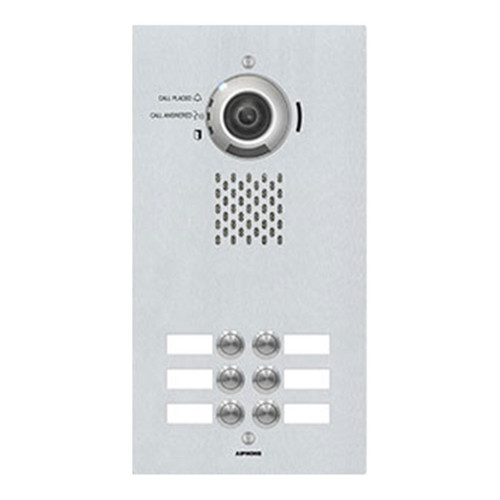
The IX-DVF-4A provides four labeled call buttons, each mapped to its own individual directory, making it suited for entry points serving up to four distinct tenants, suites, or departments from a single panel.
The IX-DVF-6 provides six labeled call buttons with individual directories, extending addressable capacity by two additional parties from the same footprint. For buildings with five or six separate tenants sharing a single entrance, the IX-DVF-6 eliminates the need for a second panel or an expansion module.
No additional call-expansion or sub-page capability is specified for either model in the provided data. Buyers needing more than six directories should consult Aiphone's IX Series capacity documentation for master-station directory trees, as that is outside the scope of these two units.
What are the imaging capabilities and low-light performance of each unit?
Both stations share a 1.23-megapixel camera with identical lens-tilt adjustability (–8°, 0°, +15°) and a 5 lux minimum illumination threshold. Video encoding is H.264/AVC and Motion JPEG on both, and ONVIF Profile S compliance is confirmed for both.
The IX-DVF-4A specifies a 1/3-inch CMOS sensor type. The IX-DVF-6 spec sheet does not explicitly state the sensor type; it instead notes a white LED illuminator in the low-light field while still citing 5 lux as the minimum illumination value. The IX-DVF-6 spec does not confirm whether the LED is always active or IR-supplemental.
Audio codec support is identical on both: G.711 and G.722, covering narrowband and wideband voice quality respectively.
How do the two units compare on power, environmental hardening, local storage, and system integration?
Power draw is identical at 5.28 W, and both accept PoE (IEEE 802.3af Class 0) or 24 V DC. Operating temperature range is -40 °F to 140 °F on both, and both carry IP65 ingress protection and IK08 impact resistance — making either suitable for exposed exterior mounting in harsh climates.
Physical dimensions are the same (13-11/16" H × 7-3/16" W), and both connect via Cat-5e/6. Both carry IEEE 802.1x port security, and both are compliant with SIP and ONVIF Profile S, supporting integration with third-party SIP call servers and VMS platforms.
The IX-DVF-6 specifies a microSD card local storage slot, which the IX-DVF-4A spec does not mention. This could be relevant for sites that need edge-buffered video capture at the door station without relying solely on a network recorder. The IX-DVF-4A spec includes trigger inputs (two) explicitly; the IX-DVF-6 spec does not list trigger inputs, though both list two contact outputs.
Which should you choose: the IX-DVF-4A or the IX-DVF-6?
Our take: The IX-DVF-6 is the stronger choice when the entry point must serve five or six distinct tenants from a single panel, or when local microSD edge storage at the door station is a site requirement. The IX-DVF-4A covers four directories versus six on the IX-DVF-6 — a direct two-tenant capacity shortfall in the same physical footprint. The IX-DVF-6 also specifies a microSD storage slot not listed for the IX-DVF-4A. Conversely, the IX-DVF-4A explicitly documents a 1/3-inch CMOS sensor type and two trigger inputs, neither of which appear in the IX-DVF-6 spec sheet; installers who need confirmed trigger-input wiring for gate or door-release circuits should verify the IX-DVF-6 against Aiphone's full datasheet before committing. Where directory count is four or fewer and trigger inputs are required, the IX-DVF-4A is the better-documented choice.
Side-by-Side Comparison
Spec-for-spec, from manufacturer data.
| Specification | Aiphone IX-DVF-4A | Aiphone IX-DVF-6 |
|---|---|---|
| Call Buttons | 4 (labeled) | 6 (labeled) |
| Individual Directories | Yes | Yes |
| Camera Resolution | 1.23 megapixel | 1.23 megapixel |
| Camera Sensor Type | 1/3" CMOS | — |
| Camera Tilt Adjustment | +15°, 0°, −8° | +15°, 0°, −8° |
| Minimum Illumination | 5 lux | 5 lux |
| White LED Illuminator | — | Specified |
| Audio Codecs | G.711, G.722 | G.711, G.722 |
| Video Codecs | H.264/AVC, Motion JPEG | H.264/AVC, Motion JPEG |
| Power Source | PoE 802.3af Class 0 or 24V DC | PoE 802.3af Class 0 or 24V DC |
| Power Draw | 5.28 W | 5.28 W |
| Operating Temperature | −40°F to 140°F | −40°F to 140°F |
| Ingress / Impact Rating | IP65, IK08 | IP65, IK08 |
| Dimensions (H × W) | 13-11/16" × 7-3/16" | 13-11/16" × 7-3/16" |
| Contact Outputs | 2 | 2 |
| Trigger Inputs | 2 | — |
| Local Storage | — | microSD card |
| Port Security | IEEE 802.1x | IEEE 802.1x |
| Compliance | SIP, ONVIF Profile S | SIP, ONVIF Profile S |
| Network Connection | Cat-5e/6 | Cat-5e/6 |
Frequently Asked Questions
Which should you choose: the IX-DVF-4A or the IX-DVF-6?
The IX-DVF-6 is the stronger choice when the entry point must serve five or six distinct tenants from a single panel, or when local microSD edge storage at the door station is a site requirement. The IX-DVF-4A covers four directories versus six on the IX-DVF-6 — a direct two-tenant capacity shortfall in the same physical footprint. The IX-DVF-6 also specifies a microSD storage slot not listed for the IX-DVF-4A. Conversely, the IX-DVF-4A explicitly documents a 1/3-inch CMOS sensor type and two trigger inputs, neither of which appear in the IX-DVF-6 spec sheet; installers who need confirmed trigger-input wiring for gate or door-release circuits should verify the IX-DVF-6 against Aiphone's full datasheet before committing. Where directory count is four or fewer and trigger inputs are required, the IX-DVF-4A is the better-documented choice.
Is the IX-DVF-4A or IX-DVF-6 better for a six-unit apartment building with one shared entrance?
The IX-DVF-6 is the appropriate choice for that scenario. It provides six individually labeled call buttons and directories — one per unit — from a single panel. The IX-DVF-4A supports only four call buttons, which would fall two short for a six-unit building.
Do both door stations work with third-party SIP phone systems and VMS platforms?
Yes. Both the IX-DVF-4A and IX-DVF-6 are specified as SIP-compliant and ONVIF Profile S-compliant, and both share the same protocol stack (IPv4/IPv6, TCP, UDP, SIP, HTTP, HTTPS, RTSP, RTP, RTCP, and others). Either unit can integrate with SIP call servers and ONVIF-compatible VMS platforms.
Can either door station record video locally without a separate NVR?
The IX-DVF-6 spec lists a microSD card slot, which supports local edge storage at the door station. The IX-DVF-4A spec does not mention a microSD slot or any local storage capability. If on-device recording without a dedicated NVR is a requirement, the IX-DVF-6 is the only one of the two that specifies this feature.
More Intercom Comparisons
- Hanwha TID-600R vs Aiphone IX-EA
- Hanwha TID-600R vs Axis A8207-VE
- Hanwha TID-600R vs Aiphone IX-DVF-6
- Hanwha TID-600R vs Aiphone JOS-1FW
- Aiphone IX-EA vs Axis A8207-VE
- Aiphone IX-EA vs 2N 01273-001
Intercom Buying Guides
Get a Second Opinion on Your Camera Choice
Share your site layout, coverage goals, and budget. Our team will validate the camera selection, flag anything we would change, and recommend products that match the use case.