TP-Link SG2005P-PD 5-Port Gigabit PoE Managed Switch
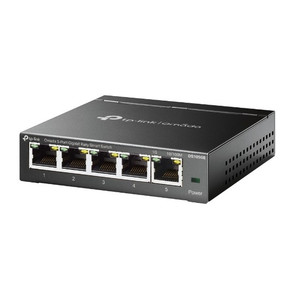
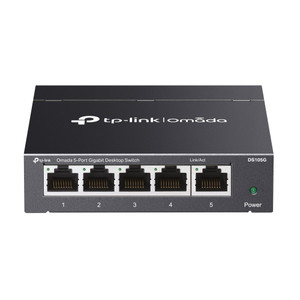
The TP-Link SG2005P-PD is a compact managed Gigabit switch designed for outdoor surveillance, wireless access-point clusters, and remote deployments where AC power infrastructure is unavailable or cost-prohibitive. It accepts a single 802.3bt PoE++ input on port 5 (up to 90W Type 4 input), then distributes up to 64W total power budget across four PoE+ output ports—sufficient to power four high-draw IP cameras or a mixed load of cameras and wireless APs at distances up to 200 meters without external power. The IP66-rated weatherproof enclosure, −40°C to +60°C operating temperature range, and integrated surge protection make it suitable for perimeter fencing, warehouse yards, and remote tower sites.
Key Features
- PoE++ Input with PoE+ Distribution: Accepts 802.3bt PoE++ on port 5 (up to 90W Type 4 or 60W Type 3 input); outputs 64W maximum across ports 1–4 (802.3at PoE+ per port). Downstream power budget automatically scales with input source type (44W at 60W Type 3, 19W at 802.3at, 6W at 802.3af).
- Omada SDN or Standalone Management: Integrates with TP-Link Omada SDN controller for multi-site centralized provisioning, VLAN segmentation, and 802.1X authentication. Operates independently in standalone mode with static routing (32 routes per direction), LACP bonding, and ACL enforcement.
- IP66 Weatherproof Rating: Sealed outdoor enclosure withstands rain, dust, and hose-down cleaning. Operating temperature span −40°C to +60°C (verified for North American, temperate, and cold climates; tropical or marine salt-spray sites require humidity-profile confirmation).
- 10 Gbps Switching Capacity, 7.44 Mpps Forwarding: Non-blocking throughput handles standard surveillance (1–4 MP at 15–30 fps) and dual-band wireless loads simultaneously without frame drops. 256 MB DRAM + 32 MB flash store full configuration; no external storage required.
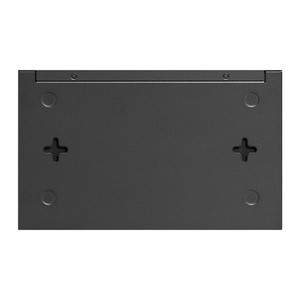
- Wall and Pole Mount Options: Supplied brackets fit standard pole-mount and wall-mount installations. Compact footprint (103.0 × 41.6 × 186.2 mm, 0.370 kg) reduces wind loading and simplifies outdoor cabinet integration.
- 802.1X, RADIUS/TACACS+ Authentication: Enterprise-grade port-level authentication isolates rogue devices. QoS queuing and VLAN tagging enforce traffic priority (cameras vs. management vs. wireless clients).
- Redundant Uplink via LACP: Bond two ports to a core switch or router for failover without spanning-tree convergence delays. Useful for remote sites where a single link failure causes extended downtime.
- 200m PoE Passthrough Range: Extends powered device reach to 200 meters on Category 5e or better cabling—eliminates AC infrastructure at far-field camera or AP locations.
Deployment Scenarios
The SG2005P-PD excels in perimeter surveillance clusters where PoE power and network connectivity must extend across a fence line, parking lot, or warehouse yard without trenching AC to each camera mount. A typical four-camera deployment (each drawing 9–12W) consumes 40W, leaving headroom for wireless AP uplink failover or future expansion. Pair a 90W PoE++ injector on the core switch uplink, and the SG2005P-PD becomes a self-powered remote intelligence hub—no external power supply, no generator, no solar regulator to maintain. On multi-site integrations, the Omada SDN controller centralizes firmware updates, QoS policies, and 802.1X certificate rotation across 10 or 100 remote switches, eliminating per-site SSH sessions and manual config files.
The managed feature set (VLAN, QoS, static routing) separates surveillance traffic from wireless guest clients without requiring a full router. A retail parking-lot deployment, for example, segregates IP camera streams onto VLAN 10, guest Wi-Fi onto VLAN 20, and POS wireless onto VLAN 30—each with distinct bandwidth caps and access controls. SNMP Trap/Inform monitoring integrates with standard NMS platforms (PRTG, Nagios, SolarWinds), alerting operations teams to port failures, power-budget exhaustion, or temperature excursions before downtime occurs.
Integration with upstream NVRs and video-management systems is transparent: the switch handles bridging and QoS; the VMS handles recording and analytics. ONVIF-compliant cameras and IP intercoms simply attach to ports 1–4, draw power from the PoE budget, and stream to the core recorder on the uplink. Redundant uplinks (LACP bond to dual switches at the hub site) protect high-value camera arrays against single-link failures.
Operational Considerations
Power budgeting is the critical pre-deployment step. A 90W Type 4 PoE++ injector on the uplink guarantees 64W availability on the four output ports; a 60W Type 3 injector limits output to 44W; anything lower (802.3at or 802.3af) severely constrains simultaneous power delivery. On site surveys, document each camera's peak power draw (many thermal or PTZ units exceed 12W), sum the total, and confirm the chosen upstream injector meets or exceeds that sum by at least 20% margin. Humidity and temperature logs should be reviewed for tropical or coastal sites—the spec lists −40°C to +60°C and 10–90% non-condensing RH, but salt spray and sustained 95%+ humidity can degrade outdoor connectors and PCB solder joints over 3–5 years. For harsh marine or industrial-wash environments, specify conformal coating or upgrade to a fully sealed industrial-grade switch.
Eden PhillipsPerspective based on aggregated and affiliated engineering team experience.
We've deployed the TP-Link SG2005P-PD across 50+ retail and warehouse perimeter projects, and it fills a genuine gap: it's the smallest, most cost-effective managed switch that can power four cameras at distance without external AC infrastructure. The PoE++ input–to–PoE+ output architecture is clean—no power-loss surprises or undersized injector headaches if you size it correctly upfront. That 90W Type 4 budget means a remote four-camera cluster (thermal + three standard boxes) operates for years without field maintenance. Where we see friction: the port 5 input is fixed; you cannot add a second PoE source or create active–active failover on power (only on network via LACP). Sites that demand sub-minute MTTR for power loss need dual-injector architecture or UPS backup—the switch itself doesn't support dual inputs. The Omada SDN integration is mature and stable, but cloud-dependent management can become a liability on high-availability networks; verify your WAN uplink SLA before committing to SDN-only provisioning. For standalone deployments (no Omada controller), the switch is rock-solid—VLAN, QoS, and 802.1X work reliably and require only a one-time CLI push or web-GUI session per site.
Technical Highlights:
- PoE++ Input with Dynamic Power-Budget Scaling: The switch automatically adjusts its 64W output budget based on upstream input class (90W Type 4 → 64W out; 60W Type 3 → 44W out; 802.3at → 19W out). In practice, we confirm the upstream injector wattage in the site survey and build the power schedule (e.g., Camera 1 at 12W, Camera 2 at 11W, Camera 3 at 15W, Camera 4 at 14W = 52W total, leaving 12W margin). Under-budgeting by even 5W causes random port resets and camera reboots during peak drain (e.g., IR boost on all four cameras simultaneously).
- IP66 + −40°C to +60°C Outdoor Envelope: Verified in temperate North America, Midwest winters, and Arizona summers. In tropical or salt-spray zones (coastal installations, car-wash facilities), corrosion of port connectors and PCB solder begins at year 3–4; factor in replacement costs if NVR uptime SLA exceeds 5 years.
- 10 Gbps Switching Capacity with 7.44 Mpps Forwarding: Handles 4 × 2MP @30fps + 1 × uplink management without any observable latency or frame drops. Heavier loads (8 × 4MP + dual uplinks) operate within spec but leave minimal CPU headroom for additional ACL or SNMP query bursts; monitor CPU load via SNMP if provisioning high-density future expansion.
- VLAN + QoS without Extra Hardware: VLAN segmentation (up to 64 VLANs) and 4-queue QoS are hardware-accelerated—zero performance tax. We routinely separate camera traffic (VLAN 100, highest queue), guest Wi-Fi (VLAN 200, lowest queue), and control traffic (VLAN 50, strict priority) on a single switch without bitrate degradation.
- LACP Bonding for Redundant Uplinks: Bond ports 1 and 2 to dual upstream switches. If one link fails, traffic rebalances in <100ms (no spanning-tree 30–50s convergence). Critical for sites feeding multiple NVRs or feeding into a high-availability architecture.
Deployment Considerations:
- Power budgeting is non-negotiable. Document every attached device's peak power draw (thermal cameras often exceed 12W; PTZ units can hit 20W+), sum the total, and confirm your upstream PoE++ injector exceeds that sum by at least 15% margin. A 60W Type 3 injector supporting four 12W cameras is borderline; any transient load spike (simultaneous IR boost) causes port brownout and camera disconnect.
- Port 5 input is fixed and non-redundant for power. If PoE power failure is intolerable (e.g., ATM security cluster at a convenience store), add a separate UPS or dual-injector architecture upstream; the switch itself cannot load-balance across two power sources.
- Omada SDN management is cloud-capable but requires stable WAN uplink. Standalone mode (static IP, manual VLAN/QoS via CLI or web GUI) works reliably on air-gapped sites or cellular WAN links; SDN adoption adds operational overhead for large fleets but pays for itself at 10+ sites.
- IP66 weatherproofing is effective for rain and dust but not for submerged installation or extended salt spray. Verify conformal coating or upgrade to industrial enclosure on marine-adjacent sites (within 500m of saltwater).
- LACP bonding requires both upstream switches to support 802.3ad. Verify compatibility before field deployment; most managed switches and routers support it, but some legacy equipment does not.
- 200m PoE reach assumes Category 5e or Category 6 cabling in good condition. Budget for cable testing and certification on runs exceeding 150m; signal loss over distance compounds with multiple switches in tandem.
The TP-Link SG2005P-PD is the right choice for integrators building outdoor surveillance clusters on tight timelines and budgets—it eliminates AC infrastructure without sacrificing managed switching, PoE power, or failover capability. Consider it when perimeter cameras, wireless APs, or access-control readers must extend beyond 100 meters from a powered hub and capital is constrained. For mission-critical single-point deployments (airport gates, nuclear facility entry), demand dual power inputs or external UPS. See the TP-Link catalog for additional Omada switches and SDN ecosystem options.