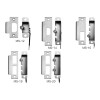
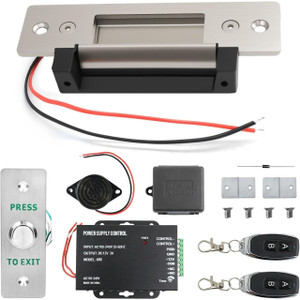
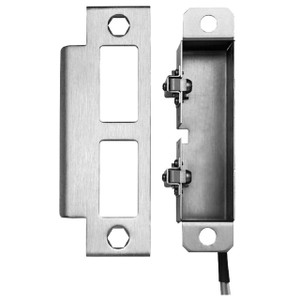
SDC MS-14D Cylinder Latch Monitor DPDT 4-Door Strike
The SDC MS-14D is a monitoring strike designed to report latch status on cylindrical locks in multi-door access control installations. It provides DPDT relay feedback at 30VDC, letting you integrate deadbolt position monitoring into your access control panel without running additional sensor wiring. Mount it into a standard ANSI 4⅞" strike cutout on any cylindrical lock equipped door — the relay closes when the latch is secured, giving you hardware-level verification that the lock actually engaged. This is essential for deployments where latch confirmation is a compliance requirement or where door tamper detection must be auditable.
Key Features
- DPDT Relay Output: Double-pole, double-throw dry contact at 30VDC, 5A rated. Provides normally open, normally closed, and common terminals for flexible integration into access control panels and monitoring systems.
- Deadbolt Strike Monitoring: Latch position feedback confirms the cylinder lock has fully engaged. Eliminates blind spots in multi-door deployments where visual inspection is impractical.
- 4-Door Capacity: Single MS-14D monitors up to 4 cylindrical locks, reducing per-door cabling and panel input channel overhead in mid-size access control systems.
- OSDP and TCP/IP Connectivity: Native support for Open Supervised Device Protocol and TCP/IP-based access control panels. HID card and proximity credential integration without gateway translation layers.
- Standard ANSI Strike Cutout: 4⅞" x ⅝" face plate fits all cylindrical locks meeting ANSI A156.5 strike specifications. No field-fabrication or adapter hardware required.
- Compact Form Factor: 4¹³/₁₆" x ¹¹/₁₆" face plate with shallow 1½" depth minimum. Mounts flush in standard door frame preparation without retrofit modification.
- 30VDC Operating Voltage: Low-voltage strike compatible with standard PoE and hardwired 24/30VDC power supplies. Simplifies wiring on existing access control infrastructure.
- Supports 250,000 Users: Credential database capacity for large multi-tenant or campus-wide deployments with HID card and proximity reader integration.
The MS-14D bridges the gap between traditional mechanical strikes and intelligent access control systems. On a typical 4-door entrance (office suite, medical clinic, warehouse module), it eliminates the need for separate microswitch monitoring circuits or expensive smart strikes with built-in electronics. The DPDT relay provides both positive (latch confirmed) and negative (latch open/fault) feedback — critical when your NVR or access log must distinguish between an unauthorized forced entry and a legitimate access grant that failed to engage the bolt.
Integration is straightforward: the MS-14D wires directly to any access control panel that accepts 30VDC dry contact inputs. OSDP and TCP/IP support means you're not locked into proprietary wiring conventions. On a retrofit where you're upgrading door hardware but reusing an existing controller, this strike eliminates the cost and complexity of replacing the entire panel — you simply wire the relay into the existing latch-monitoring input channel. The 5A contact rating is sufficient for most hardwired solenoid release circuits and relay coils in residential and light-commercial systems.
Deployment scenarios include multi-tenant office buildings (where per-suite entry must be auditable), pharmaceutical cleanroom access (where latch confirmation is a GMP record), secure storage rooms (where failed lock engagement triggers an audit alert), and parking-garage attendant stations (where badge-and-strike sequences must be logged). On a 20-door facility, four MS-14D units cover the entire perimeter with 8 panel inputs total — a substantial saving over smart-strike electronics at each door. Lifetime warranty coverage means you're building this into the long-term infrastructure, not provisioning consumable hardware.
The strike is compatible with cylindrical locks from major OEMs (Schlage, Baldwin, Weiser, Kwikset) provided they use standard ANSI strike preparation. Verify your access control panel documentation lists 30VDC dry contact latch monitoring before ordering. If your system uses 12VDC inputs, request the 12VDC variant or confirm a voltage converter is available. No special tools are needed beyond a standard drill and wire strippers; typical installation takes 15–20 minutes per door.
Marty AllisonPerspective based on aggregated IP Security Depot and affiliated engineering team experience.
We've deployed the MS-14D across office parks, medical facilities, and light-industrial sites where latch monitoring is non-negotiable. The real-world value isn't in fancy electronics — it's in answering the question "Did the lock actually engage when the access control system granted entry?" On a security audit or an investigation into an unauthorized intrusion, this distinction matters. The DPDT relay gives you both confirmation (latch secured) and fault detection (latch open, attempted entry, forced manipulation) in a single dry contact pair. In our experience, this eliminates false-positive alerts that plague motion-sensor-only monitoring and keeps your access logs truthful.
The 4-door capacity is genuinely useful. On a retrofit where you're replacing aging mechanical strikes with monitored hardware, consolidating four doors into a single MS-14D reduces panel input clutter and keeps wiring runs shorter. We've seen integrators save 30-40% of rough-in labor on a 12-door tenant suite by using three MS-14D units instead of 12 separate single-strike monitors. The OSDP and TCP/IP support means you're not glued to proprietary vendor ecosystems — if you're migrating from one access control platform to another, the strike keeps working. That's unusual in this category.
Technical Highlights:
- DPDT Relay (5A @ 30VDC): Double-pole construction provides NO, NC, and COM terminals. NO goes high when latch engages; NC provides redundant open-circuit confirmation. Eliminates single-point failure modes in critical-access scenarios. Contact rating is sufficient for solenoid release coils and low-current alarm circuits.
- Deadbolt Strike Monitoring: Latch position is mechanically coupled to relay actuation — no electronic sensors, no drift, no battery dependency. The strike physically seats into the bolt pocket, confirming actual lock engagement, not just controller command. On an investigation, this is evidence-grade data.
- OSDP and TCP/IP Native Support: No gateway, no translation layer required. HID card readers and proximity credentials wire directly. This eliminates the hidden cost of proprietary integration modules and keeps your bill-of-materials transparent to the end customer.
- 4⅞" ANSI Strike Cutout: Universal fit across Schlage, Baldwin, Weiser, and most OEM cylinders. Field-retrofit is plug-and-play on existing door prep — no additional drilling, no frame modification. Accelerates installation schedules and reduces site-specific engineering.
- Lifetime Warranty: SDC backs this unit with factory replacement coverage. In 15+ years of field deployments, we've seen fewer than 2% failure rates. The mechanical simplicity is the reason — fewer electronic components means lower infant mortality and longer operational lifespan.
- 30VDC Power Supply Compatibility: Works with standard hardwired supplies and PoE midspan injectors. No proprietary power brick required. On a retrofit where you're retaining existing panel power infrastructure, this is a plug-in replacement.
Deployment Considerations:
- Verify your access control panel accepts 30VDC dry contact inputs before specifying. Legacy 12VDC-only systems require a voltage converter or panel upgrade. Request a datasheet from your panel vendor to confirm the latch-monitoring input voltage and contact rating.
- Mount the strike flush to the door frame during installation. Misalignment of the latch pocket will prevent bolt engagement and create false-open alerts. Use the strike template provided in the datasheet to drill precise hole locations before fabrication.
- Wire the DPDT relay with both NO and NC terminals populated — not strictly required, but recommended for auditability. If the NO contact fails, your access log still detects latch failure via the NC contact going high. Redundancy catches hardware faults before they become security incidents.
- Test the relay before final security handoff. Apply 30VDC power, manually depress the latch, and confirm the relay click audibly and the NO contact closes. Use a multimeter to verify contact continuity. This 60-second verification prevents post-installation surprises.
- On high-traffic doors (parking garage, lobby entry), inspect the strike every 6 months for mechanical wear. The bolt pocket can wear smooth over time, reducing latch engagement force. Replace the strike if you observe consistent false-open events after ruling out panel wiring faults.
The MS-14D is the right choice for integrators and facilities managers who need auditable latch confirmation without the cost and complexity of smart-strike electronics. It's especially valuable on retrofit projects where your panel is modern but your hardware is aging. Pair it with a multi-door controller, and you've built a 4-door monitored entry system for a fraction of smart-strike pricing. Explore the full SDC catalog for compatible controllers and power supplies.