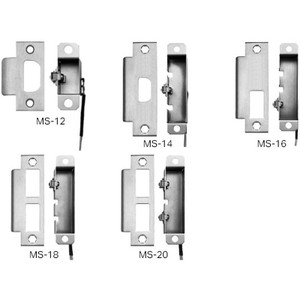
SDC MS-20D Mortise Lock Latch & Bolt Monitor
The SDC MS-20D is a mortise-mount latch and deadbolt position monitor designed for multi-door access control systems that require real-time mechanical lock status feedback. It connects to HID credential platforms and networked access control panels via wired OSDP and TCP/IP protocols, monitoring up to four mortise deadbolts simultaneously and reporting latch position status to your security system's audit logs and alarm logic. Ideal for high-security corridors, executive areas, and facilities where door lock confirmation must be independent of credential verification.
Key Features
- Dual-Door Monitoring Capacity: Monitors latch and bolt position across up to 4 doors simultaneously. Eliminates manual verification and centralizes lock status in your access control system.
- OSDP and TCP/IP Connectivity: Wired communication protocols integrate directly with HID credential systems and third-party networked access control panels without custom middleware.
- DPDT Contact Output: Double-pole double-throw contact rated 5 amps at 30VDC resistive load. Switches reliably whenever deadbolt position changes, feeding door status to panel inputs and alarm logic.
- 30VDC Operating Voltage: Standard access control panel supply voltage — no separate power supply required. Efficient integration into existing infrastructure.
- Field-Reversible Installation: Single SKU covers both left and right hand door mounting. Handed orientation can be flipped on-site if door swing direction is opposite from expected, eliminating return stock and installation rework.
- Mortise-Mount Form Factor: Compact 4 13/16" × 11/16" profile mounts directly on mortise lock body. Requires minimum 1½ inch depth behind lock housing — confirm clearance before installation.
- HID Credential System Integration: Native compatibility with HID access control platforms. Supports up to 250,000 user accounts across networked multi-door deployments.
- Lifetime Warranty: Factory-backed coverage for the product lifecycle, reducing lifecycle cost and providing long-term operational confidence.
The MS-20D bridges the gap between credential-based access decisions and mechanical lock confirmation. In high-security environments, a cardholder may be granted access, but the physical deadbolt must also be verified as engaged. The DPDT contact closure triggers immediately when the bolt moves, sending that status to your access control panel's event log or directly to alarm inputs. This eliminates the scenario where a door is electronically unlocked but the mechanical lock fails to retract — a critical distinction in audit-driven facilities and emergency egress scenarios.
Installation is straightforward: mount the monitor on the mortise lock, run the DPDT leads (common and throw) to your access control panel's discrete input, and configure the panel to interpret contact closure as lock-engaged and open circuit as lock-disengaged. Because the MS-20D is field-reversible, installers can test the door swing on-site and flip the internal mechanism if needed — no stock planning for left/right variants. The 5 amp contact rating is sufficient for signaling relays, panel inputs, and low-power alarm circuits; do not attempt to switch heavy loads directly through the contact, as sustained over-current will degrade contact life.
Deployment across 2, 3, or 4 doors is common in secure office wings and data-center access corridors. Each door's lock status appears independently in your access control system's audit trail and real-time dashboard. Multi-door setups benefit from centralized visibility — security staff can review lock status for all monitored doors without manual inspection or secondary systems. Integrators appreciate the lack of protocol translation: OSDP and TCP/IP are standard VMS and access control panel interfaces, so configuration is plug-and-play on platforms like HID, Genetec, and Milestone.
The MS-20D's wired infrastructure and dry-contact output make it suitable for retrofit into existing mortise lock installations without requiring new electrical infrastructure. The 30VDC supply is standard on nearly all modern access control systems, and the DPDT contact can be wired to both active alarm circuits and passive monitoring inputs simultaneously — one physical output, multiple system destinations.
Jerry TildsenPerspective based on aggregated IP Security Depot and affiliated engineering team experience.
We've installed the MS-20D across secure office suites, executive corridors, and multi-tenant facilities where lock position feedback is non-negotiable. The key value is operational simplicity: you get true electromechanical confirmation that a mortise deadbolt is actually engaged, independent of whether the access control credential was accepted. In our experience, that distinction saves time during audit reviews and eliminates false-positive alarms on adjacent systems. The OSDP and TCP/IP dual-connectivity is particularly useful in mixed environments — some clients prefer wired OSDP to their HID panels, others want TCP/IP logging to their Genetec or Milestone VMS. The MS-20D doesn't force you into one path. We've seen deployments where the same monitor feeds lock status to both an access control panel input AND a separate siren/strobe relay for alarm escalation. The field-reversible design is underrated — it means zero rework if the installer flips the door orientation on-site, which happens more often than you'd think in retrofits. The main trade-off is wired connectivity; this is not a wireless or battery-powered device. On new construction or major renovation, that's not a concern. On retrofit jobs where you can't run new cable, you'll need to explore wireless monitoring alternatives.
Technical Highlights:
- DPDT Contact Rating (5A @ 30VDC): Sufficient for signaling standard panel inputs, relay coils, and alarm triggers. Do not use this contact to directly switch high-current devices (solenoids, buzzers) — route through an external relay or solid-state switch if you need to control power-hungry outputs. Respecting the contact rating keeps the device reliable for 10+ years of daily operation.
- Dual-Protocol Wiring (OSDP + TCP/IP): The same physical device can be configured for either protocol depending on your access control backbone. OSDP is lower-latency and more secure; TCP/IP offers easier integration with IP-based VMS platforms. You don't need to choose at purchase time — field configuration handles it.
- Four-Door Monitoring in One Unit: Reduces panel clutter and wiring runs compared to four separate single-door monitors. Multi-door facilities appreciate the centralized status reporting — one dashboard view of all protected doors instead of four separate inputs.
- Field Reversibility: The internal mechanism can be flipped on-site without returning to the factory. This eliminates the cost and delay of ordering the opposite-handed variant, which is a real win in retrofit scenarios where the lock orientation was misread in planning.
- Lifetime Warranty: Long-term cost confidence in a mechanical device that sees daily lock cycling. Reduces TCO on multi-door deployments where replacement labor is significant.
Deployment Considerations:
- Wired infrastructure only — requires cable run from monitor to access control panel. If running new cable is not feasible (concrete walls, existing conduit congestion), explore wireless alternatives or plan for surface-mounted raceway. Budget the cable labor into your retrofit estimate.
- Contact rating is 5 amps at 30VDC resistive. Do not attempt to switch inductive loads (solenoids, relays) directly without an intermediate relay. Confirm your alarm escalation circuit doesn't exceed this rating, or interpose a relay coil and use the relay's higher-rated contacts downstream.
- Mortise lock compatibility is critical — the monitor mounts on mortise locks fitted with deadbolts only. Confirm the target lock is a mortise deadbolt (not a cylindrical lock or rim-mounted hardware) before ordering. Measure the space behind the lock housing; 1½ inch depth minimum is required.
- The field-reversible design means you can test the door swing and flip the mechanism if needed. However, do not over-cycle the internal flip; it's a one-time or occasional adjustment, not a daily toggle. Document which orientation was selected after installation.
- Multi-door monitoring requires sufficient panel inputs or a networked access control system that can aggregate four lock status channels. Confirm your panel has the input capacity before specifying the MS-20D for a four-door corridor.
The MS-20D is the right choice for integrators and end-user teams that need straightforward, wired lock position monitoring tied to HID credential systems or networked access control platforms. If you're managing secure office suites, data-center access, or executive corridors where audit trails must reflect actual lock engagement, this device bridges the credential and mechanical layers cleanly. For more options and related mortise lock solutions, visit the SDC catalog.