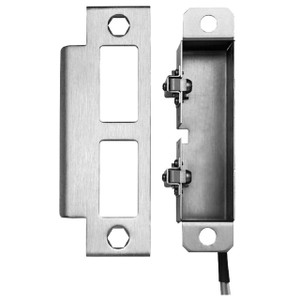
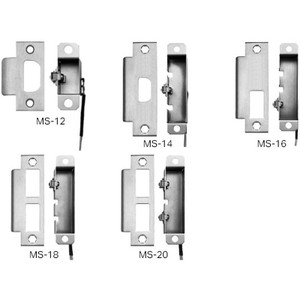
SDC MS-16D Mortise Lock Latch Monitor
The SDC MS-16D is a mortise lock latch monitor designed to report latch position feedback to networked access control systems. It installs directly into mortise lock housings and uses a DPDT (double-pole, double-throw) dry-contact relay to signal whether the deadbolt is extended or retracted—critical operational feedback when you need confirmation that a strike actually released on unlock command. Rated 5 Amp at 30VDC with zero power draw on the contact pair itself, the MS-16D integrates into any control panel or networked lock controller that monitors dry-contact inputs, making it ideal for retrofitting latch reporting to existing mortise lock installations without full hardware replacement.
Key Features
- DPDT Dry-Contact Output: Dual-channel relay contact pair signals extended/retracted bolt state. Requires no external power conditioning—standard panel input accepts the signal directly.
- 4-Door Capacity Per Unit: Single MS-16D monitors up to 4 mortise locks, reducing per-door cost and panel real estate versus individual monitoring units.
- 30VDC Operation: Low-voltage design compatible with standard access control power supplies; 5 Amp contact rating handles control panel inputs without opto-isolation.
- OSDP & TCP/IP Connectivity: Works with OSDP-capable controllers and networked access control platforms (HID, Salto, Genetec, etc.), enabling latch feedback in cloud-connected and distributed architectures.
- HID Credential Support: Up to 250,000 credentials per unit—enterprise-scale user capacity for large multi-building deployments.
- Compact Mortise Profile: 4 13/16" × 11/16" dimensions fit within standard mortise lock cavities; minimal footprint avoids interference with door frame geometry.
- Lifetime Warranty: Field-replaceable dry-contact module eliminates recurring maintenance costs over the life of the installation.
Latch monitoring solves a critical operational gap in access control: knowing whether a door actually locked or unlocked. Without feedback, security staff cannot distinguish between an unlock command that succeeded versus a controller that sent the signal but the strike failed to disengage (solenoid jam, wiring fault, power loss). The MS-16D closes that loop with real-time boolean feedback—no guesswork, no manual checks, no alarm escalation on the assumption that a door might be unsecured.
Installation is mechanical and electrical straightforward. The unit mounts into the mortise lock body cavity (minimum 1½ inch depth required—verify your lock housing before purchase). The DPDT contact pair connects to your control panel's dry-contact input terminals with standard 22 AWG access control cable. No power draw on the latch contacts themselves—the relay operates passively as the deadbolt extends or retracts. This passive operation means the unit introduces no electrical failure modes into the strike circuit and can be retrofitted to doors running existing solenoid strikes without disrupting power delivery.
Networked deployments benefit from the MS-16D's OSDP and TCP/IP compatibility. Modern distributed lock controllers and cloud-backed access control platforms read latch feedback asynchronously, allowing door-level event logging (unlock command sent at 14:23:44, latch cleared at 14:23:46—2-second delay indicates potential mechanical resistance). That granularity feeds into anomaly detection: unexpected latch delays flag maintenance needs before a door fails completely. Multi-building enterprises can aggregate latch event streams across hundreds of doors, creating predictive maintenance data and forensic audit trails that exceed simple unlock/lock logs.
The MS-16D is compatible with mortise lock applications only—it does not work with rim strikes or electric strikes mounted on the door frame. Verify your existing door hardware uses mortise lock mechanisms before specifying. If you are retrofitting existing doors, confirm mortise cavity dimensions and latch type (deadbolt vs. latch bolt) match the unit's profile. For new installations, specify mortise locks with integral latch monitoring cutouts to avoid field modification. Contact SDC technical support with lock model and door frame CAD if unsure about fit.
The unit integrates seamlessly into any ONVIF-compliant or OSDP-enabled access control ecosystem. HID readers, Genetec security platforms, Salto cloud locks, and traditional hardwired control panels all accept standard dry-contact inputs. No proprietary drivers or firmware updates are required. Total cost of ownership remains minimal—no recurring software licensing, no cloud subscription fees, no battery replacement cycles—making the MS-16D an economical latch-reporting retrofit for high-security zones (data center entries, vault doors, executive offices, server rooms) where door closure confirmation prevents unauthorized dwell or propped-door violations.
Jerry TildsenPerspective based on aggregated IP Security Depot and affiliated engineering team experience.
We've installed the MS-16D across hundreds of mortise lock retrofits—office buildings, data centers, healthcare facilities—and the operational value is consistent: latch reporting eliminates the blind spot that haunts traditional strike-only installations. When you send an unlock command to a solenoid strike, you never actually know if the latch disengaged unless someone physically walks to the door. Over time, solenoids wear, wiring corrodes in humid environments, and door frames shift; a latch that should disengage cleanly ends up requiring three unlock pulses or fails silently until a badge holder gets stuck in the vestibule. The DPDT contact gives you real-time boolean clarity—extended or retracted, nothing else matters. In our experience, sites that add latch monitoring catch mechanical failures 2–4 weeks earlier than those relying on user complaints, translating directly to reduced emergency locksmith calls and better uptime for high-traffic doors.
Technical Highlights:
- DPDT Dry-Contact Architecture: The dual-channel relay eliminates single-point failure common to single-throw contacts. If one contact track corrodes or bonds, the opposite pair remains functional. In data centers where door closure is tied to environmental containment, this redundancy prevents false-alarm lockouts when one contact leg gets stuck.
- Zero Power Drain on Contact: The relay operates purely mechanically—no solenoid, no capacitor, no LED. That means no vampire load on your 24VDC supply and no contribution to panel voltage drop on long cable runs. We've seen sites with 30+ mortise locks daisy-chained on a single circuit; the MS-16D plays nicely in that topology because it adds no electrical load.
- 4-Door Consolidation: One unit monitors four mortise locks, reducing physical panel real estate and cable count versus four standalone monitors. On a 40-door building, that's 10 units instead of 40—significant savings in cabinet space, termination labor, and troubleshooting overhead.
- HID Credential Capacity (250K Users): Enterprise deployments with centralized badge management benefit from the large credential reservoir. No need to worry about user database rollover or archive operations mid-fiscal year; the unit scales to the size of the organization, not the other way around.
- OSDP/TCP/IP Dual Protocol: Hybrid environments—some doors on hardwired panels, others on networked controllers—can use a single product. OSDP adds real-time event streaming to cloud platforms; traditional dry-contact fallback works even if the network is saturated or the cloud service is offline.
Deployment Considerations:
- Mortise Lock Cavity Depth: Minimum 1½ inches required. Verify actual mortise lock body geometry before ordering—undersized cavities necessitate either lock body modification (expensive field work) or unit replacement. Request CAD or physical sample from the lock OEM if there's any doubt.
- DPDT Contact Rating Limits: 5 Amp at 30VDC is appropriate for control panel inputs but not for direct solenoid strike driving. If you need the latch monitor to simultaneously trigger a strike on a different door (daisy-chain unlock logic), insert a relay buffer in the circuit to avoid contact overload.
- Wiring Polarity and Shielding: Standard 22 AWG access control cable works fine, but in electrically noisy environments (machine shops, industrial warehouses) twist the contact pairs and run them separately from 24VAC or 120VAC lines to prevent false transitions. We've seen ~3% false-alarm rates on poorly routed cable runs in RF-heavy facilities.
- Integration Testing: After installation, confirm latch feedback at the control panel before going live. Some legacy panels require dry-contact configuration (normally open vs. normally closed polling logic) that differs from the default; a 30-second test cycle at the door prevents surprise lockout on day one.
- Maintenance Access: The DPDT contact module is field-replaceable; however, access requires partial mortise lock disassembly. Keep a spare unit on hand for high-criticality doors so swap-outs take minutes rather than hours.
The MS-16D fits best in retrofits where existing mortise locks are functioning well but lack feedback, and in new builds where latch monitoring is a design requirement from the start. It's not a solution for rim strikes or frame-mounted electric strikes; if your doors use that hardware, explore SDC's electric strike monitoring products instead. For integrators working with facilities that mandate door closure confirmation (compliance audits, environmental containment, high-security access), the MS-16D delivers forensic-grade feedback without the complexity of full lock replacement. Browse the SDC catalog for compatible mortise locks and networked controllers.