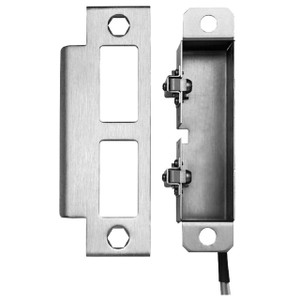
SDC MS-14 Cylindrical Latch Monitor
The SDC MS-14 is a latch status monitor designed for cylindrical lock assemblies paired with standard 4⅞" ANSI strikes. It provides real-time electrical feedback on door latch position — engaged or disengaged — via an SPDT (Single Pole Double Throw) dry contact rated at 5 Amp @ 30VDC. Deploy this where your access control system requires hardware-level verification that a door latch has actually engaged after an unlock command, rather than relying on solenoid feedback or time-based assumptions. Common applications include high-security facilities, pharmaceutical storage, server rooms, and any environment where audit trails must prove physical latch status at the moment of access.
Key Features
- SPDT Dry Contact Output: 5 Amp @ 30VDC rated — connects directly to any access control panel or door controller input without intermediate relays. Provides positive confirmation of latch state (open/closed) in real time.
- 30VDC Power Requirement: Low-voltage operation integrates with standard access control power supplies and hardwired strike circuits. No additional transformer or isolated supply needed on most installations.
- Cylindrical Latch / ANSI 4⅞" Strike Compatibility: Mounts into the standard strike pocket on cylindrical locks with ANSI cutout specification. Retrofits into existing door hardware without replacement.
- Real-Time Latch Feedback: Eliminates guesswork on whether a door actually latched. Triggers alerts if a door fails to engage after unlock, supporting compliance audits and tamper detection.
- Compact Face Dimensions: 4 13/16" × 11/16" mounting footprint fits standard strike installation cavities. Minimum 1¼" strike depth required — verify existing hardware clearance before installation.
- Lifetime Warranty: Factory-backed coverage on all mechanical and electrical components — reflects SDC's confidence in deadbolt strike reliability for long-term access control integration.
Integration & Deployment
The MS-14 bridges the gap between access control software and physical door hardware. Most access control panels include supervised door position inputs designed to accept dry contacts; the latch monitor's SPDT output wires directly into these terminals. In HID-based systems, the contact maps to a latch-status field in the access event log — when a cardholder swipes to exit a secure area, the system confirms the door actually latched before clearing the transaction. This prevents the common scenario where a door appears closed in video but the latch never engaged, defeating the physical security intent.
For facilities operating under HIPAA, FDA 21 CFR Part 11, or SOC 2 compliance frameworks, latch confirmation becomes a documented control. The MS-14 provides the hardware evidence; your access control software records the timestamp and user associated with the latch state change. In pharmacy clean rooms, laboratory cold storage, or regulated document vaults, this audit trail is often mandatory.
Installation is straightforward: power the monitor from your 30VDC strike supply, run the SPDT contact pair back to the access control panel input, and configure the panel to log latch-open alerts. No special wiring, no relay logic — the contact is unswitched until the latch mechanically trips the internal sensor. On a typical retrofit, installation takes 15–20 minutes per door, including testing and label verification.
Hardware Considerations & Cost of Ownership
Cylindrical latch monitors operate independently of the lock cylinder itself — they don't require rekeying, and they don't interfere with manual operation. If a user manually locks the door from the inside, the monitor still reports engaged state. This passive monitoring approach keeps total cost of ownership low: no recurring maintenance, no battery replacement, no software licensing. The lifetime warranty means end-user facilities can budget for the hardware cost as a one-time capex item per door. Compare this to wireless latch sensors, which introduce battery lifecycle planning and RF coverage survey overhead — the hardwired MS-14 avoids those operational complexities entirely.
Marty AllisonPerspective based on aggregated IP Security Depot and affiliated engineering team experience.
We've deployed the SDC MS-14 across pharmaceutical facilities, financial institutions, and multi-tenant office environments where access control audit trails carry regulatory weight. The real value isn't the monitor itself — it's the elimination of ambiguity around whether a door actually locked after an access event. We've seen scenarios where a solenoid strike energizes, the controller logs "door unlocked," but the mechanical latch never fully resets due to humidity, wear, or installation tolerance. A few months in, the door is effectively propped open, and no one notices until an audit. The MS-14 catches this on day one: if the latch doesn't engage, the SPDT contact remains in the "open" state, and the access control system flags it. On a 50-door facility, that early warning capability prevents costly rework and compliance violations. The tradeoff is straightforward wiring — you're committing to hardwired daisy-chain or individual runs back to the control panel. For new construction or full-access-control retrofits, that's negligible; for retrofit onto a single door in an older building, you may need to run conduit, which adds labor cost. But the operational payoff — guaranteed latch confirmation — typically justifies the installation effort.
Technical Highlights:
- 5 Amp SPDT Dry Contact: Rated for panel-level switching without intermediate relays. In practice, access control panels draw micro-amps on supervised inputs — the 5 Amp rating provides headroom for industrial environments with electrical noise and allows the same contact to drive visual or audible alerts at the door if needed.
- 30VDC Power, Integrated with Strike Supply: The MS-14 uses the same 30VDC rail as your solenoid strike. One power supply powers both the strike solenoid and the monitor — no parallel infrastructure. On large deployments (50+ doors), this simplifies power distribution and reduces overall panel footprint.
- Passive Monitoring, No Interference: The monitor does not energize, unlock, or actuate the latch. It simply senses position. This means it doesn't degrade lock performance or add failure modes — it's a pure sensor. Manual operation (key-from-inside, handle-throw) still works identically whether the monitor is powered or not.
- ANSI 4⅞" Strike Fit: Standard commercial cylindrical locks use ANSI strike cutouts. The MS-14 is spec'd to fit this cavity without modification to the frame or strike plate. Retrofit compatibility is high across Schlage, Yale, Falcon, and other mainstream cylindrical locks.
- Lifetime Warranty on Mechanical Components: Latch sensing is a simple mechanical switch — no complex electronics to fail. The warranty reflects the simplicity and durability. End-user facilities view this as a permanent hardware install with no planned replacement cycle.
Deployment Considerations:
- Verify strike pocket depth: minimum 1¼" clearance required. On older doors or non-standard frames, strike cavity may be shallower — measure before ordering. If clearance is marginal, you may need to countersink or relocate the strike plate.
- Power supply capacity: Confirm your 30VDC supply has sufficient amperage for all solenoid strikes + monitors combined. A typical solenoid strike draws 0.5–1.0 Amp during energize; add 10–15 mA per monitor. On a 20-door system, budget 15–20 Amps total at the power supply.
- SPDT wiring to panel: Identify the panel's supervised door input pinout. Some panels expect NC (normally-closed) contact logic; others expect NO (normally-open). The MS-14 provides both poles of the SPDT — wire according to your panel's input specification. Test with a meter before closing the circuit.
- Conduit and cable runs: Hardwired latch monitoring requires individual 2-pair or 3-pair runs (power + SPDT feedback) from each door back to the control panel. In retrofit scenarios, this can be the largest labor expense. Plan conduit routing during the access control design phase.
- Latch wear and calibration: Over time (years of use), the latch cam may settle slightly. If the monitor begins reporting false-opens (latch disengages when the door is closed), the monitor sensing arm may need minor adjustment. SDC datasheet provides calibration guidance — a simple screwdriver adjustment, not a factory repair.
The SDC MS-14 is ideal for integrators and facility managers building compliance-critical access control systems where latch confirmation is a documented security control. It's not a solution for facilities that can tolerate solenoid feedback alone; it's purpose-built for environments where regulatory or operational policy requires hardware-level latch status in the audit trail. Browse the full SDC catalog for complementary strike hardware and controllers.