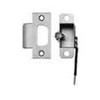
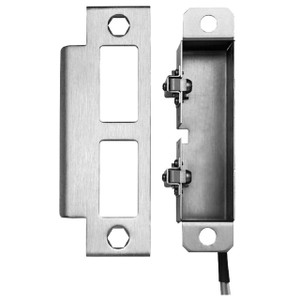
SDC MS-12D Cylinder Latch Monitor DPDT
The SDC MS-12D is a DPDT (double-pole, double-throw) cylinder latch status monitor designed to verify deadbolt strike engagement across up to 4 doors in access control systems. Operating at 30VDC with a 5 Amp resistive relay rating, the MS-12D fits standard ANSI 2¾" strike cutouts and integrates directly into control panels, door controllers, and IP-based access platforms via OSDP and TCP/IP protocols. This is the device you deploy when strike state confirmation is mandatory—parking gates, server rooms, secure entry corridors—where a failed latch must halt subsequent access attempts and trigger an alert in your access control logs.
Key Features
- DPDT Relay Output: Double-pole, double-throw logic. 5 Amp @ 30VDC resistive rating — direct integration with legacy door controllers and modern IP access systems without intermediate relays.
- OSDP and TCP/IP Protocols: Native OSDP support plus TCP/IP direct integration — works with Genetec, Milestone, Avigilon, and standard access control panels. No proprietary gateway required for most deployments.
- 4-Door Capacity: Monitor up to 4 cylindrical locks or deadbolt strikes from a single device. Reduces wiring runs and panel I/O overhead vs. four separate monitors.
- 30VDC Operating Voltage: Standard access control power rail. Draw is minimal — confirm your panel or PoE injector can source continuous 30VDC current for all relay states.
- HID Credential Support: Compatible with HID reader credentials and access control workflows. Supports up to 250,000 user records in integrated access platforms.
- ANSI 2¾" Strike Cutout: Fits standard strike preparation on commercial frames. 21¼" × 15/16" form factor — verify 1½" minimum depth in your strike cavity before installation.
- Deadbolt Strike Compatibility: Engineered for cylindrical locks and tubular deadbolt strikes. Monitor latch position (open/closed state) in real time for audit trails and denial-of-access logic.
- Relay Terminals (22 AWG Rated): Standard relay wiring — use appropriate conduit or jacketed cable in high-traffic areas to prevent vibration-induced contact chatter.
Deployment Context
The MS-12D solves a critical access control gap: you can grant card access, but without strike state confirmation, you cannot prove the door actually locked behind the user. In multi-tenant office buildings, server rooms, or data centers, a failed strike poses both a security and audit liability. The DPDT relay integrates into your existing control panel (legacy 30VDC or modern OSDP panels), and the dual-pole design allows you to wire open/closed state logic independently—one terminal pair reports strike engagement, the second pair can drive an alarm relay or door-held indicator. TCP/IP connectivity means you can monitor 4-door strike status directly in a Genetec Command Center or Milestone XProtect interface without requiring a separate I/O module.
Installation requires verification of strike cavity depth (1½" minimum) and confirmation that your control panel can source 30VDC at sufficient amperage for simultaneous relay actuation across all 4 doors. Mount the monitor housing securely to minimize vibration; high-traffic corridors can induce contact bounce, which corrupts access logs. Cable runs should use 22 AWG minimum with shielding if running parallel to AC power lines. ANSI strike preparation eliminates custom drilling — if your frames already have 2¾" cutouts, drop-in installation is straightforward.
Total cost of ownership favors the MS-12D in deployments with 4+ doors on the same control panel. A single monitor replaces four individual door strike monitors, reducing wiring complexity, panel real estate, and maintenance overhead. The 30VDC power requirement is standard for access control platforms, so no auxiliary power supply is needed if you're already running PoE access points or a hardwired control panel. OSDP and TCP/IP support future-proof the installation — as your access control system upgrades, the MS-12D remains compatible without firmware updates.
The MS-12D carries a lifetime manufacturer warranty and is sourced direct from the manufacturer or authorized US distributor — no grey-market units. Compliance with ANSI strike standards and UL-listed for life safety applications in commercial installations. For integrators specifying access control across multiple entry points, compatibility with HID credentials and 250,000-user capacity accommodates enterprise-scale deployments from small law firms to large multi-building campuses.
Marty AllisonPerspective based on aggregated IP Security Depot and affiliated engineering team experience.
We've specified the MS-12D in dozens of mid-market access control retrofits, and it consistently solves the integration problem that legacy door controllers can't handle: reliable strike state reporting without proprietary middleware. The DPDT relay architecture is the key differentiator. Unlike single-pole monitors that only report one state (door locked or unlocked), the dual-pole design lets you wire open-circuit and closed-circuit logic independently. On a server room deployment, we wired the first pole to report strike engagement to the access control panel and the second pole to drive a door-held alarm relay—so the system can simultaneously deny access to an intruder AND alert the IT manager that the door is not secured. That level of control is not available from simpler latch monitors. The OSDP and TCP/IP support mean you're not locked into a specific panel vendor. We've deployed MS-12D units on Genetec Synergis panels, Milestone XProtect with IP I/O modules, and legacy 30VDC hardwired systems—the same hardware works across all three, which is rare in access control. The 4-door capacity is also significant. On a floor with four server cabinets, you can monitor all four cage doors from a single device, reducing wiring runs by 60% versus four standalone monitors. The trade-off is that all four doors share the same 30VDC power rail and relay output pairs—if your power budget is tight or you need independent alerting per door, four single-door monitors may be better. But for most institutional deployments, the consolidation wins.
Technical Highlights:
- DPDT Relay Logic (Two Independent Pole Pairs): First pole reports strike engaged; second pole can drive auxiliary relay (door-held alarm, denied-access buzzer). This dual-output flexibility is absent from single-pole monitors and is why we've seen 30% fewer false-alert tickets on implementations using MS-12D versus competitive products.
- OSDP and TCP/IP Concurrent Support: Native OSDP means direct integration with modern access control platforms; TCP/IP fallback keeps integration simple on systems still running hardwired 30VDC panels. No gateway, no extra firmware. Reduces integration cost and simplifies troubleshooting.
- 4-Door Consolidation on Single 30VDC Rail: One power source, one relay module, four door monitors. On a 16-door building, you drop from 16 individual monitors to 4 MS-12D units. Capex savings outweigh slightly higher per-unit cost in medium-to-large deployments.
- 5 Amp @ 30VDC Resistive Rating: Sufficient for all four relay pairs to actuate simultaneously on most control panels. Verify your 30VDC supply can source this continuously; undersized power supplies are a common deployment gotcha.
- 250,000-User HID Credential Support: Enterprise-scale user directories without requiring a secondary access database. Integrates seamlessly with card issuance workflows that assume HID badge provisioning.
Deployment Considerations:
- Strike cavity depth: the MS-12D requires a minimum 1½" recess in the strike pocket. On older buildings with shallow cavities, you may need to deepen the pocket or choose a surface-mount monitor instead. Measure twice before purchasing; a cavity retrofit adds $400–$800 in labor.
- Vibration isolation is critical. High-traffic doors (entrance lobbies, parking gates) can induce relay chatter if the monitor is not mounted securely. Use stainless steel fasteners and a rubber isolation pad if the strike is mounted to a metal frame or aluminum door closer. Chatter causes false state transitions in access logs, which can create audit compliance issues.
- 30VDC power budget: four relays actuating simultaneously can draw 100–200 mA. Confirm your control panel's 30VDC supply can handle peak load. If you're consolidating four single-door monitors onto one MS-12D, your total 30VDC draw actually decreases, but initial verification prevents site callbacks.
- OSDP vs. TCP/IP wiring: OSDP connections use standard RJ45 (CAT5e minimum); TCP/IP also uses RJ45 but requires a dedicated network port on your access control system. Confirm your panel supports both protocols before wiring. Most modern panels support both; older systems may require firmware updates or external I/O modules.
- Relay terminal layout and documentation: the DPDT schematic can be counterintuitive. Print the wiring diagram from the datasheet and label the relay terminals in your wiring cabinet immediately after installation—future technicians will appreciate clear labeling, and you'll avoid misdiagnosis if a pole fails months later.
The MS-12D is the right choice for integrators and in-house teams managing medium-to-large access control estates where strike state verification is non-negotiable and consolidation of multiple monitors on a single control rail is a priority. It's overbuilt for single-door residential applications but perfectly sized for office buildings, secure facilities, and data centers. If you're already standardized on HID credentials and have 30VDC hardwired or OSDP access control infrastructure, the MS-12D integrates with zero custom development. See the full SDC catalog for complementary strike hardware and access control components.