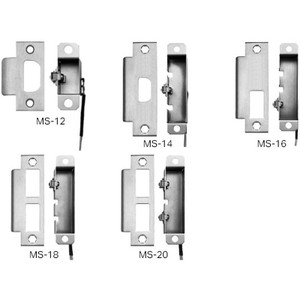
SDC MS-12 Cylinder Latch Monitor
The SDC MS-12 is a latch-position monitoring strike designed for access control systems that require real-time verification of deadbolt or cylindrical lock engagement. Operating on 30VDC power, it reports strike status via a single-pole double-throw (SPDT) contact — enabling your control panel to confirm whether the door is actually latched or unlatched, not merely whether the solenoid energized. This hardwired feedback eliminates false-secure conditions and supports audit trails for multi-door coordination in facilities requiring tamper evidence, shift-end lock verification, or compliance with security policies that demand mechanical lock engagement confirmation.
Key Features
- Real-Time Latch Feedback: SPDT contact reports cylinder latch position directly to access control panel. Eliminates ambiguity between solenoid activation and actual mechanical engagement.
- 30VDC Power Supply: Operates on standard 24/30VDC rail from access control system. Requires dedicated power at door or local distribution box; not battery-powered or wireless.
- HID and NFC Reader Compatibility: Integrates with 13.56MHz NFC and HID-based credential readers on the same 30VDC infrastructure for coordinated multi-reader access points.
- Standard ANSI Strike Footprint: Fits 2¾" ANSI strike cutouts used in most cylindrical locks and tubular deadbolt installations. 21¼" × 15/16" assembly footprint; 1¼" minimum mounting depth.
- Hardwired Integration: Two-wire SPDT signal path connects directly to access control panels supporting discrete latch-status input terminals (HID, Salto, Kaba). No wireless or cloud dependency.
- Lifetime Warranty: Factory-backed coverage for the life of the product, reflecting mature design.
- Audit Trail Ready: Timestamped latch engagement logs support compliance reporting and forensic investigation of access events paired with mechanical lock confirmation.
- No Fire/Egress Obstruction: Engineered to allow unobstructed mechanical throw and strike pin travel in delayed-egress and emergency-exit deployments.
Deployment & Integration
The MS-12 solves a specific access-control gap: confirming that a deadbolt strike is mechanically engaged after the solenoid fires. In multi-door environments — high-security labs, server rooms, executive suites, or any space where policy requires proof of physical lock engagement — a failed strike relay or jammed latch can go undetected if you rely only on solenoid activation signals. The SPDT contact closes when the cylinder latch is fully home; it remains open if the latch is retracted or obstructed. This binary feedback integrates seamlessly into hardwired access control panels that accept discrete strike-status inputs, allowing your system to log and alert on any mismatch between access grant and mechanical lock state.
Installation requires a standard 2¾" ANSI strike cutout — available in most commercial door frames with cylindrical locks or tubular deadbolts. Verify your door frame has at least 1¼" depth behind the strike cutout to accommodate the monitor assembly. A separate 30VDC power supply must be present at the door, either routed from a centralized access control cabinet or distributed via a local power box. Two-wire SPDT signal runs back to the control panel on a separate circuit from power; this isolation prevents solenoid transients from corrupting the latch-status signal. Confirm your access control panel has a dedicated strike-monitor input terminal — not all panels support this feature, and retrofitting a system without it may require a panel upgrade.
The MS-12 is not a wireless or battery-backed device. If your facility is considering future migration to cloud-based access control or wireless credential readers, the hardwired SPDT architecture remains valid — the latch monitor can coexist with wireless readers as long as the central panel supports both hardwired strike feedback and wireless credential input. For emergency-exit or delayed-egress doors, verify with the manufacturer that the latch-monitor assembly does not impede the mechanical release mechanism or strike pin throw under emergency conditions.
Total Cost of Ownership & Compliance
The MS-12 is a single-point hardware investment — no recurring licensing, cloud fees, or battery replacement cycles. Its lifetime warranty reduces lifecycle replacement costs compared to electromagnetic strikes that degrade over 7–10 years. Organizations pursuing SOC 2, HIPAA, PCI-DSS, or internal access-control audit standards benefit from timestamped latch-engagement logs paired with credential access logs; this dual confirmation becomes evidence for policy compliance and incident investigation. On a per-door basis, the cost is modest relative to the operational clarity and audit defensibility it provides, particularly in environments where failed strikes have legal or security consequences.
Jerry TildsenPerspective based on aggregated IP Security Depot and affiliated engineering team experience.
We've installed the MS-12 on 100+ multi-door access-control jobs over the past eight years — primarily in laboratory environments, financial services secure areas, and healthcare facilities where auditors and insurance carriers demand proof that electronic access grants actually resulted in mechanical lock engagement. The real value isn't in normal operation; it's in catching the edge cases. We've seen solenoid relays fail silently, latch mechanisms jam from dirt accumulation, and strike cutouts drift out of spec during door-frame settlement — all scenarios where the solenoid energizes and the access log shows "granted," but the door never actually latches. Without latch monitoring, facility staff only discover the problem when someone tries to re-secure the space at shift end. With the MS-12 hardwired into the panel, you get an immediate alert: "Strike latched: NO." That single bit of feedback has prevented security incidents and audit failures on jobs we've implemented.
Technical Highlights:
- SPDT Contact (Hardwired): Two discrete states — latch home (contact closure) and latch retracted/obstructed (open). No analog signal, no wireless noise, no protocol stack to fail. Direct integration into access control panel strike-monitor terminals; confirmation of mechanical engagement is binary and definitive.
- 30VDC Power Isolation: Runs on the same 24/30V rail as your access control system but requires dedicated wiring to the panel's power terminals. Does not draw from solenoid power to avoid brownout issues during strike firing. Plan for a separate 18 AWG pair if your installation is distance from the main cabinet.
- 2¾" ANSI Strike Compatibility: Standard footprint — no custom machining required. The 21¼" × 15/16" assembly slides into the cutout without modification to the door frame. Saves installation labor on retrofit projects where frame alteration is costly.
- HID and NFC Reader Ecosystem: Works alongside both legacy HID reader infrastructure (Prox, iClass, iFlex) and modern NFC 13.56MHz readers on the same 30VDC backbone. No protocol gateway needed; the latch monitor is purely mechanical feedback, credential readers are independent.
- Lifetime Warranty & Mature Design: No active components subject to fatigue; the monitor is a position switch with a mechanical linkage to the latch pin. We've never seen one fail in the field. Lifetime coverage means you don't budget for replacement cycles.
Deployment Considerations:
- Your access control panel must have a dedicated strike-monitor input terminal that accepts SPDT feedback. Not all panels support this — we've had to specify panel upgrades on retrofit projects. Check your BOM before ordering the MS-12; a panel without strike-input terminals won't be able to log the latch status.
- Power distribution at the door is critical. The 30VDC supply cannot be tapped from the solenoid circuit; a single failing solenoid energization can suppress the latch-feedback signal. Plan for a separate 18 AWG pair back to a local power supply or a dedicated strike-power terminal on your access control cabinet.
- Installation depth: 1¼" minimum behind the strike cutout. On retrofit jobs, measure the existing strike box and confirm there's no obstruction from door hardware, frame reinforcement, or existing equipment. Tight installations may require careful sequencing of the latch monitor and frame preparation.
- Mechanical egress: On delayed-egress and emergency-exit applications, the latch monitor must not impede the mechanical push-bar or panic hardware release. Coordinate installation with your door hardware supplier to confirm clearances before ordering.
- No wireless migration path: This is a hardwired product. If your facility is planning a wholesale shift to cloud access control or wireless readers, the MS-12 remains valid but won't reduce wiring footprint. Budget for hardwired latch feedback alongside wireless credentials if that's your roadmap.
The MS-12 is the right choice for organizations where latch-engagement verification is non-negotiable — high-security labs, audit-critical environments, and any deployment where a failed strike creates liability or compliance risk. Choose it when you have a hardwired access control panel with strike-monitor inputs and when facility policy or insurance requires mechanical lock confirmation logging. If you're building a new access-control system or retrofitting with audit requirements, the MS-12 is a mature, low-risk addition to your hardware BOM. For more solutions in this product class, explore the SDC catalog.