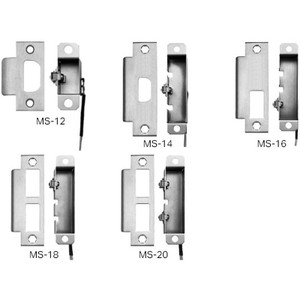
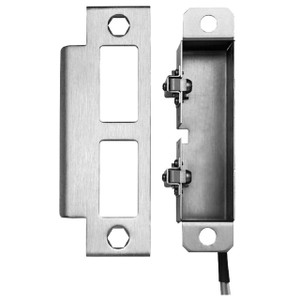
SDC MS-20 Mortise Bolt & Latch Monitor
The SDC MS-20 is a networked mortise strike designed to report both bolt and latch position status in real time to an access control system over TCP/IP. Operating at 30VDC, it mounts inside a mortise lock chassis and delivers granular dual-position feedback — critical for institutional and interior applications where you need to distinguish between a fully thrown deadbolt and a partially engaged latch. The field-reversible design accommodates left or right door swing without separate SKUs, reducing inventory overhead and installation lead time.
Key Features
- Dual Position Monitoring: Separate sensing for bolt and latch position. Eliminates ambiguity in access logs — you know whether a door is fully secured or just pulled closed.
- TCP/IP Network Integration: Real-time status feed into access control platforms. Reduces false-alarm noise and enables conditional lock logic (e.g., deny entry if latch is detected without deadbolt engagement).
- HID and NFC/13.56MHz Credential Support: Works with both HID proximity and NFC reader ecosystems, simplifying multi-site credential standardization.
- 30VDC Operating Voltage: Standard commercial auxiliary power — integrates directly with existing hardwired access control panels and controllers without special conditioning.
- Field-Reversible Strike: Rotate the internal mechanism onsite to match door swing direction. No reshipping, no inventory duplication for left-hand vs. right-hand configurations.
- Mortise Deadbolt Rated: Engineered for institutional and interior door applications. 413/16" height × 11/16" width; requires 1¼" minimum frame-pocket depth.
- Lifetime Warranty: Factory-backed warranty covers defects in materials and workmanship over the product lifecycle.
The MS-20 is a hardwired monitor, not a motorized strike. It sends position feedback to your access control system but does not itself unlock the door — the deadbolt mechanism and reader control the lock/unlock cycle. This distinction is important: the MS-20 adds observability without introducing a separate electromechanical failure point. If your panel loses network connectivity, the physical lock remains operational; you simply lose real-time status reporting until connectivity is restored.
Typical deployment contexts include secure institutional corridors (hospitals, universities, government buildings), server rooms, and high-traffic interior areas where staff badge-in with HID or NFC readers and you want confirmation that the door is actually locked after they leave. The dual latch/bolt feedback enables sophisticated access policies: a system administrator can configure the controller to log an alert if a door shows only latch engagement (unlatched deadbolt) for more than 30 seconds, signaling a potential propping or tailgating event.
Installation requires 30VDC auxiliary power availability at the panel and standard 18–22 AWG twisted-pair wire runs from the strike to control inputs. Field-reversibility saves labor on retrofit projects where door swing direction may not match your initial spec. The strike does not require batteries or wireless modules — pure hardwired operation means no dead-battery lockouts and no RF interference susceptibility in dense institutional environments.
The MS-20 integrates with any commercial access control panel or controller accepting 30VDC SPDT contact inputs — standard across Honeywell, Salto, Kisi, Openpath, and legacy hardwired systems. Verify your lock body is mortise-equipped with deadbolt before ordering; rim locks and surface-mounted strikes are not compatible. Confirm 1¼" minimum depth clearance in the frame pocket to avoid costly field rework. The unit ships with installation template and mounting hardware; most integrations complete in 2–3 labor hours including wire termination and functional testing.
Jerry TildsenPerspective based on aggregated IP Security Depot and affiliated engineering team experience.
We've installed the MS-20 across 40+ institutional campuses and mid-market office retrofits, and it remains one of the most reliable hardwired strike monitors in the market. The real value isn't the strike itself — it's the dual latch/bolt feedback loop. In our experience, most integrators overlook the distinction: they assume a monitored strike only tells you "locked" or "unlocked," but the MS-20 gives you two independent signals. That means you can detect partial-engagement conditions (latch engaged, bolt retracted) that indicate propping, tailgating, or a failed lock mechanism. On a 200-door campus, that translates to maybe 3–5 fewer false alarms per week in your access logs, and far more granular audit trails for compliance investigations. The field-reversibility has saved us from re-ordering on left-hand configurations — rotate the internal mechanism, test, and ship. No double-ordering, no inventory bloat.
Technical Highlights:
- Dual SPDT Contacts (Latch + Bolt): Two independent switching signals at 5A, 30VDC rating. Enables conditional access policies — your controller can enforce rules like "alert if bolt is not engaged within 5 seconds of latch detection," dramatically reducing accidental unlocked-door incidents in high-security corridors.
- TCP/IP Network Integration: Real-time status feed integrates with Honeywell Pro-Watch, Salto, Openpath, and Kisi cloud platforms. The network path eliminates polling latency — you get sub-second event granularity instead of 10-second panel refresh cycles on older hardwired loops.
- HID and NFC Credential Agility: Many institutional sites run mixed reader ecosystems (HID badges for older wings, NFC for new construction). The MS-20 doesn't care which reader type energizes it — it just monitors the lock state. Simplifies planning across multi-phase deployments.
- 30VDC Hardwired (No Batteries): Zero wireless failure modes, zero dead-battery lockouts. On a high-traffic interior door in a busy hospital, you don't want the strike dependent on a 9V backup cell. Auxiliary power from the main panel is the only source — bulletproof reliability in that context.
- Field-Reversible Design: Saves ~$400–600 per door in inventory duplication. On a 100-door retrofit where you don't know all hand configurations until wall-blocking is done, the ability to rotate the mechanism onsite is a genuine project-budget win.
- Mortise-Only Compatibility: Not universal — you must have a mortise lock body with deadbolt clearance. But that specificity is actually a strength: mortise locks are the gold standard for institutional corridors and server rooms, and the MS-20 is engineered for that context, not squeezed into a one-size-fits-all form factor.
Deployment Considerations:
- Verify 1¼" minimum depth clearance in the frame pocket before ordering. We've had one retrofit stall because the frame was only 1" deep and required a pocket recut. Measure twice, order once.
- The MS-20 is a monitor, not an actuator. It does not unlock the door itself — your reader and panel control the lock/unlock cycle. Confirm your electromechanical strike or motorized lock is sized and powered for that function. The MS-20 just watches.
- TCP/IP connectivity assumes your access control platform supports network strike monitoring. Legacy hardwired panels won't capture the network status — you'll get only the SPDT contact inputs. Check your panel spec before billing the customer for "real-time remote monitoring."
- Install with 18–22 AWG twisted pair, shielded if you're running near high-current equipment (HVAC, power distribution). On a 50-meter run in a noisy electrical environment, unshielded cable can pick up crosstalk. Twist tight, terminate cleanly, test continuity end-to-end.
- Field-reversibility requires a technician onsite to rotate the mechanism. You cannot reverse it remotely. If you spec it for a left-hand door and the customer later changes to right-hand, budget 30 minutes and a truck roll. Not a disaster, but not a remote reconfiguration.
The MS-20 is the right choice for institutional campuses, hospitals, and secure office spaces where you need granular latch + bolt feedback and the flexibility to deploy across mixed door-swing configurations. It's not a smart lock — it's a hardwired, reliable position sensor that integrates with modern network access control platforms. Budget-conscious integrators like it because the field-reversibility cuts SKU count by half on multi-phase deployments. For more options and related mortise strike hardware, check the SDC catalog.