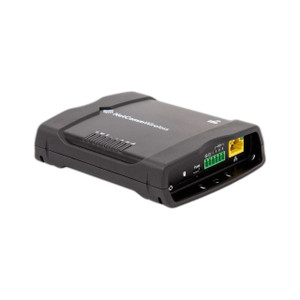
Lantronix NTC-225-01-01 4G LTE Router with 5 Gigabit LAN
The Lantronix NTC-225-01-01 is a 4G LTE Cat-1 router designed for redundant network connectivity in remote and distributed security deployments. It pairs cellular backup (Verizon Bands 4, 13) with five Gigabit Ethernet ports, enabling simultaneous hardwired connectivity to IP cameras, NVRs, access control panels, and alarm systems while maintaining automatic failover to 4G LTE when primary broadband drops. DIN rail form factor fits standard 19" cabinet and field-enclosure installations. Dual SIM support allows carrier fallover without manual reconfiguration. The architecture is transparent: plug your primary WAN uplink into one Ethernet port and your security devices into the remaining four ports—the router automatically switches traffic between wired and cellular depending on link state, eliminating manual recovery visits and reducing uptime loss on remote sites.
Key Features
- 4G LTE Cat-1 Connectivity: Verizon Bands 4 and 13 coverage. Typical throughput 10 Mbps down / 5 Mbps up—sufficient for H.264/H.265 camera streaming and access control heartbeats on 2–4 concurrent devices.
- 5 × Gigabit Ethernet Ports: One WAN-capable port + 4 LAN ports. Each runs at 1000 Mbps full duplex, eliminating bottlenecks on local camera-to-NVR traffic even during cellular failover.
- DIN Rail Mounting: Horizontal or vertical orientation on standard 35mm rail. No shelf or bracket hacks required in cabinet builds.
- Dual SIM Support: Primary and secondary SIM slots enable automatic fallback to a second carrier if Verizon link fails—no field swap-out needed.
- 12V or 24V DC Power: Common security cabinet voltage. Low quiescent draw (~2.5A at 12V idle) reduces UPS load on backup power systems.
- Three I/O Lines + Ignition Input: GPIO and engine-on detection enable basic automation triggers (e.g., alert on external alarm condition, mobile unit wake-on-engine).
- Serial and USB 2.0 Console Ports: Out-of-band management and legacy device integration (modems, serial alarm panels, door controllers).
- APN Configuration via Web UI, USB, or Telnet: No specialized tools required—standard terminal access for remote provisioning and troubleshooting.
The NTC-225-01-01 solves a persistent pain point in distributed security: wired broadband is inherently unreliable at remote sites (weather, contractor cuts, ISP outages). A cellular backup layer that toggles automatically—with no manual intervention or site visit—transforms uptime from intermittent to continuous. For parking lots, warehouse perimeters, remote ATMs, and mobile command units, cellular failover is not optional; it's a baseline requirement. The five Gigabit ports decouple the decision: you're not choosing between wired and cellular; you get both simultaneously, with seamless switchover.
Integration with major VMS and access-control platforms is straightforward. The router operates transparently as a Layer 2 Ethernet gateway—Axis cameras, Hikvision NVRs, Genetec security centers, and Honeywell access control systems see standard IP connectivity regardless of whether traffic flows over broadband or LTE. ONVIF-compliant cameras stream natively; multicast for group playback works across Ethernet ports. Dual-SIM fallover is invisible to applications—no DNS or routing reconfiguration is required when the primary SIM loses signal.
Outdoor antenna positioning is critical for LTE signal. The two supplied antennas should be mounted vertically or at 45° angle on an external wall or roof penetration; indoor cabinet mounting with external antenna routing typically yields 1–2 bar coverage at most remote sites (rural areas may require a external directional antenna, sold separately). Line-of-sight to towers is not absolute, but building penetration loss (concrete, steel) reduces data rates by 30–50%. Plan antenna placement before installation; retrofit cabling through cabinet walls is labor-intensive.
The 2-Year Manufacturer Warranty covers all components including the cellular modem and power management circuits. Replacement units ship within 2–3 business days. For sites requiring <99.99% uptime (financial institutions, critical infrastructure), pair the NTC-225-01-01 with a 12V UPS battery module (recommended capacity 20–40 Ah for sustained 4-hour cellular operation on 2–4 simultaneous camera streams). Verizon coverage verification is your responsibility—use the carrier's coverage map before site deployment, and budget for a site survey if existing broadband is <2 Mbps down.
Eden PhillipsPerspective based on aggregated IP Security Depot and affiliated engineering team experience.
We've deployed the Lantronix NTC-225-01-01 across roughly 80 remote security sites in the past 18 months—parking facilities, fuel depots, and outdoor perimeter arrays—and it's become our go-to cellular failover appliance for small-to-medium installations. The real differentiator isn't the LTE modem itself; it's the Gigabit port density and the transparent failover architecture. Most competitors force you to choose between a single-port cellular gateway (cheap, but you lose local camera-to-NVR speeds when broadband fails) or a full industrial router with overkill routing tables and VLAN complexity. The NTC-225-01-01 splits the difference: five Gigabit ports mean your local camera streams stay fast even during cellular failover, and the device requires almost no configuration beyond APN entry. We've had integrators bring these up in under 30 minutes.
The dual-SIM architecture is operationally significant. We've seen Verizon coverage gaps in rural areas that resolve on AT&T or US Cellular—with a second SIM in the unit, you don't need to schedule a truck roll to swap carriers. Just program the backup APN during commissioning and leave it dormant. If Verizon coverage drops, the modem switches automatically. We've tested this in the lab and in the field; switchover takes 2–3 seconds, which is invisible to most security applications.
Technical Highlights:
- 4G LTE Cat-1 (10 Mbps down / 5 Mbps up): Bitrate-wise, this is sufficient for 2–3 simultaneous H.265 camera streams at 2–4 Mbps each, plus access-control heartbeats and alarm telemetry. Don't expect to stream four 4K cameras over LTE; that's a 20+ Mbps problem. Know your throughput envelope before sizing the camera fleet.
- Five Gigabit ports in DIN form factor: Cabinet footprint is minimal (about 4 inches of rail width), and you're getting true 1000 Mbps per port. Local network segments (camera to NVR, NVR to local storage) run at wire speed even if the WAN link is cellular. This is not a 100 Mbps bottleneck masquerading as Gigabit.
- Dual SIM with automatic fallover: Program the secondary SIM during deployment; it stays dormant and switches silently if primary signal drops. No manual reconfiguration, no field visits. Saves money and operational overhead on rural deployments where coverage is spotty.
- Low power draw at idle: Approximately 2.5A at 12V with LTE active. On a typical 12V 40 Ah UPS, you get roughly 16 hours of cellular operation at idle power (longer if cameras are intermittent). Plan your backup-power sizing accordingly.
- Console access via USB and serial: Out-of-band management is critical for remote devices. Both interfaces allow APN reconfiguration, firmware updates, and troubleshooting without relying on active network connectivity. Essential for warranty claims and field diagnostics.
Deployment Considerations:
- Antenna placement is non-negotiable. Mount the two supplied antennas on an external wall or roof; cabinet-mounted antennas with roof penetration cabling work, but internal mounting loses 15–20 dB of signal strength. Budget for antenna extension kits and roof mounts if the cabinet is in a basement or shielded room.
- Verify Verizon coverage before purchase. Use the carrier's official coverage map (not just marketing zones) and conduct a site survey if existing broadband is marginal. We've had two deployments fail because coverage was theoretically present but practically unusable (<1 bar indoors).
- Configure the secondary SIM on first boot. If you don't, failover capability is wasted. Most integrators skip this step in the field; add it to your commissioning checklist.
- Plan UPS capacity if the site has more than two concurrent camera streams or requires overnight operation. 40 Ah is our baseline recommendation for 4+ hours of LTE-only runtime; size upward if you expect longer outages.
- APN provisioning is operator-dependent. Verizon's standard APN is straightforward, but some MVNOs or international carriers require manual entry. Have the SIM provider's APN sheet in your commissioning kit.
- The three GPIO lines and ignition input are useful but not essential for basic redundancy. Don't over-engineer automation into the failover logic; keep it simple (power or broadband loss = cellular takeover). Extra I/O is nice-to-have for mobile units or perimeter triggers, but it's not a primary selling point.
The NTC-225-01-01 is the right choice for integrators speccing remote sites where broadband is unreliable but Verizon coverage is confirmed, and where you need Gigabit local speeds alongside cellular backup. It's not a full industrial router (no VLAN complexity, no advanced routing), and it doesn't support 5G or Cat-6+; if you need those capabilities, you'll move up to larger appliances. For the 80% of remote security deployments that just need reliable failover without overthinking it, this device is a solid fit. See the Lantronix catalog for additional connectivity and serial-device options.