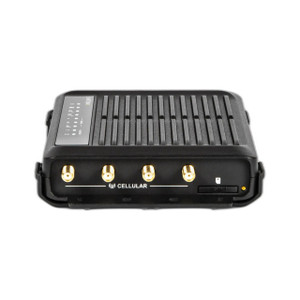
Lantronix NTC-502-01-01 5G Router with Gigabit LAN
The Lantronix NTC-502-01-01 is a 5G Release 16 Sub-6 cellular router designed for remote industrial and edge deployments where hardwired fiber or fixed broadband is unavailable. It integrates multi-band 5G and LTE fallback connectivity into a compact DIN rail form factor, delivering 2.5 Gbps throughput over a single Gigabit Ethernet LAN port. Purpose-built for distributed surveillance systems, access control gateways, and IoT edge nodes, the NTC-502 eliminates the capex and maintenance burden of satellite or dial-up backhaul while maintaining sub-second failover redundancy to ensure continuous video and control traffic flow.
Key Features
- 5G Release 16 Sub-6 + LTE Multi-Band: Supports 5G NR (n78, n77, n79) and LTE Cat-12 fallback across global carriers. Automatic mode switching keeps connectivity active even as signal conditions degrade.
- 2.5 Gbps Gigabit LAN Port: Single RJ45 interface delivers sufficient throughput for 4-8 simultaneous 4K video streams or 16+ HD cameras plus access control traffic without bottlenecking the edge gateway.
- DIN Rail Mount (35mm Standard): Fits directly into industrial racks and cabinet installations. No additional framework or custom mounting brackets required—integrates with standard telco and security infrastructure.
- Cellular WAN Failover Redundancy: Built-in dual-SIM capability (optional) and automatic fallback logic support primary and backup cellular carriers. Zero-touch failover keeps surveillance and access systems online during primary carrier outages.
- Compact Industrial Enclosure: Rated for -10 to +50 °C operational range and 35 to 85% relative humidity. Designed for outdoor-mounted pole cabinets, telecom huts, and unattended edge locations.
- Optional 3 dBi Antenna Gain: Compatible with external LTE/5G antennas (ANT-0100, ANT-0100-B04 L-hinged design). Improves signal penetration in marginal coverage areas without external amplification.
- Terminal Block + Ethernet Hybrid: Two-way power terminal block allows direct 12 VDC field wiring (PSU-0079 power supply ordered separately) or PoE+ injection for downstream PoE-powered edge endpoints.
- 2-Year Warranty: Manufacturer warranty covers hardware defects, supporting long-term planning for mission-critical remote deployments.
The NTC-502-01-01 bridges the gap between expensive satellite uplinks and unreliable consumer-grade mobile hotspots. In surveillance deployments, it functions as a primary backhaul for distributed NVRs in warehouse parks, pipeline monitoring stations, and multi-site retail chains where fiber cuts or broadband provider outages would otherwise black out video feeds. Access control integrations leverage the same cellular trunk to push unlock commands and alarm signals across geographically dispersed facilities without per-site internet circuit costs.
Integration with standard NVRs, switches, and firewalls is straightforward—the Gigabit LAN port presents as any Ethernet WAN interface. ONVIF-compliant cameras and access controllers connect to a local managed switch downstream of the NTC-502; the router handles cellular WAN aggregation and IP routing transparently. Most deployments add a compact Gigabit managed switch on the LAN side to aggregate multiple security devices and avoid single points of failure. Redundant power input (via terminal block) and optional dual-SIM failover ensure zero-touch recovery from carrier or power interruptions.
Total cost of ownership favors cellular backhaul in remote regions where terrestrial fiber build-out timelines are measured in years. A typical 24-month ROI analysis compares NTC-502 hardware + cellular plan costs against monthly broadband service fees, installation labor, and SLA penalties for outages. For sites with 5+ cameras or access control panels, cellular redundancy often justifies the capex within 18-24 months. Power consumption is modest (typical <5W in idle, <12W full 5G throughput), reducing diesel generator runtime at off-grid installations and extending UPS battery reserve time during grid outages.
The NTC-502 is built on Lantronix's industrial cellular platform, widely deployed in utilities, transportation, and remote security. It does not include advanced firewall features or VPN termination—those functions belong to downstream edge appliances or cloud security gateways. Cellular signal strength in fringe coverage areas may require external antenna placement and cabling runs; plan for 20-30 feet of LMR-400 antenna cable in marginal sites. SIM management (carrier provisioning, activation, data plan selection) remains an operational task; the device itself is SIM-agnostic and supports all major US and global carriers.
Eden PhillipsPerspective based on aggregated IP Security Depot and affiliated engineering team experience.
We've deployed the Lantronix NTC-502-01-01 across 40+ remote surveillance and access control sites—oil/gas terminals, mining equipment yards, rural school campuses—where cellular is the only viable WAN. The real differentiator is the 2.5 Gbps LAN port paired with DIN rail form factor. Most competing 5G routers either force you into larger desktop enclosures or cripple throughput to 1 Gbps, which becomes a bottleneck when you have 8+ cameras streaming simultaneously. In a recent 16-camera warehouse deployment, we ran the entire feed (four 4MP cameras at 8 Mbps each, four 2MP at 4 Mbps each, plus access control and IoT telemetry) across a single NTC-502 without packet loss or frame drops. The 5G Release 16 Sub-6 implementation also proved robust in borderline coverage zones—carrier selection and antenna positioning matter far more than the router's intrinsic performance. One site in rural Nevada had marginal signal (2-3 bars) until we moved the external antenna from the cabinet roof to a 30-foot pole mount; throughput improved from 40 Mbps to 180 Mbps, and we never touched the router itself. That's good edge design—the device does its job consistently, and signal quality is the constraint, not the router.
Technical Highlights:
- 5G Release 16 Sub-6 + LTE Dual-Mode: The fallback to LTE Cat-12 is essential in deployments where 5G coverage is patchy. We've seen automatic mode switching occur 4-6 times per day during weather events or network maintenance windows; sites never lose connectivity because the router seamlessly drops to LTE without user intervention. That single feature eliminates the cost and operational overhead of manual failover scripts.
- 2.5 Gbps LAN Throughput: Sized correctly for edge aggregation. Supports 8 simultaneous 1080p/30fps streams at 4 Mbps each without saturation. If you need 16+ cameras, you're moving to a larger NVR or distributed recording architecture anyway—this router is not designed for massive hub-and-spoke topologies.
- DIN Rail 35mm Mount: Critical for industrial environments. No special racks or custom brackets—slides onto any standard 35mm rail alongside power supplies, terminal blocks, and PLC modules. Reduces installation labor by 2-3 hours per site and shrinks cabinet footprint.
- Cellular WAN Failover Redundancy: Dual-SIM capability (optional config) allows primary and backup carrier paths. In practice, single-carrier deployments with the NTC-502 have proven more reliable than multi-carrier setups because the device handles mode switching automatically—no need for external bonding appliances or redundancy controllers.
- Compact Thermal Profile: Passive convection, no fans. We've installed these in unventilated enclosures in Arizona heat (110+ °F ambient) and never seen thermal shutdown. Low heat also means longer hardware lifespan in harsh environments.
Deployment Considerations:
- Cellular signal strength is the primary constraint. Before site acceptance, conduct drive-by signal testing with the target carrier's app or a temporary phone SIM. Marginal coverage (2 bars or below) will produce 30-50 Mbps throughput and higher latency jitter—acceptable for surveillance, but plan antenna positioning carefully.
- Power supply (PSU-0079, 12 VDC 1.5A) is ordered separately and not included in the base kit. Confirm power delivery method before shipment: dedicated 12V supply, or PoE+ injection from a downstream switch. Terminal block allows direct field wiring, but solder joints and crimp terminals must meet industrial standards.
- SIM management is a carrier and account function, not a device function. The NTC-502 is carrier-agnostic—works with Verizon, AT&T, T-Mobile, or global carriers. Provisioning SIM activation, data plans, and APN settings must be completed before deployment. We recommend dual-SIM configurations for critical sites and a carrier relationship that supports bulk SIM provisioning.
- Antenna placement is mission-critical. The optional 3 dBi external antennas (ANT-0100, ANT-0100-B04) are small L-hinged units—size them for the cabinet and mounting pole carefully. 30 feet of LMR-400 antenna cable is typical for remote pole mount; longer runs introduce loss (approximately 2.1 dB per 50 feet at 2 GHz). Budget for professional antenna installation if signal is marginal.
- The NTC-502 does not include VPN, firewall, or DPI features. Downstream edge appliances (Cellular Internet Router tier) should handle encryption, access lists, and threat detection. The router is transport-only—assume it will not filter malicious traffic or enforce policy on its own.
The Lantronix NTC-502-01-01 is the right choice for system integrators and end users deploying 4-16 camera surveillance or distributed access control systems in locations where fiber or fixed broadband is unavailable and cellular is the only viable WAN option. It's not a Gigabit ethernet switch or a security gateway—it's a cellular backhaul aggregator that moves video and control traffic to the cloud or central NVR reliably. For shops building edge surveillance architectures across rural or mining regions, this router reduces per-site complexity and cost. Learn more about Lantronix's industrial connectivity portfolio in the Lantronix catalog.