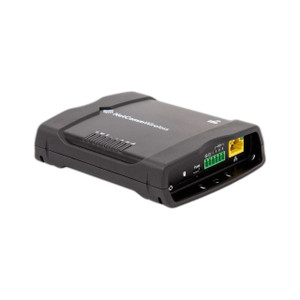
Lantronix NTC-223-01-01 4G LTE CAT.1 Router with 3 LAN Ports
The Lantronix NTC-223-01-01 is a compact 4G LTE CAT.1 router designed for remote surveillance and industrial sites in Japan where cellular backhaul eliminates the capex and operational complexity of running fiber or copper to the edge. Three Fast Ethernet LAN ports (10/100 Mbps) aggregate traffic from IP cameras, NVRs, access control readers, and environmental sensors; the onboard CAT.1 modem delivers that data to cloud platforms or remote monitoring centers over the carrier network. DIN rail mounting integrates into standard 19-inch cabinet and telecom rack infrastructure. When wired broadband is impractical — utility substations, mobile command vehicles, parking-lot camera clusters — this router provides a single point of LTE failover or primary connectivity without vendor lock-in.
Key Features
- 4G LTE CAT.1 Modem: Japan frequency bands. CAT.1 offers 10 Mbps downlink / 5 Mbps uplink — adequate for multiple IP cameras in HD and access control traffic without saturation.
- Three Fast Ethernet LAN Ports: 10/100 Mbps each. Connects IP cameras, PTZ controllers, environmental sensors, and legacy industrial devices via standard Cat5e cabling.
- DIN Rail Mount: Compact form factor fits 19-inch cabinet and standard telecom enclosures. No external shelving or mounting hardware required.
- Serial Connectivity (RS-232/485): Multi-mode serial ports bridge legacy door controllers, meter readers, and industrial protocols to IP networks via serial-to-IP gateway appliances.
- Transparent IP Gateway: ONVIF-compatible — no special firmware or driver on connected devices. Standard TCP/IP routing applies across all LAN ports.
- Cellular Backhaul / LTE Failover: Primary connectivity option for sites without wired access, or secondary failover when fiber/copper lines fail. Carrier SIM card configurable for regional APN and authentication.
- 2-Year Manufacturer Warranty: Factory-new, sourced direct from the manufacturer or US channel partner. No grey-market, no parallel imports.
Deployment Context: When Wired Network Access Is Impractical
Remote surveillance clusters — parking lots, utility substations, pipeline monitoring stations — face a choice: trench fiber/copper (6-18 month lead time, $5k-$40k+ per mile) or deploy cellular backhaul on a 4-week timeline with minimal civil work. The NTC-223-01-01 shifts the economics entirely. A 10-camera parking lot on LTE CAT.1 costs less than the fiber trenching permit. Three Fast Ethernet ports handle traffic aggregation; CAT.1 throughput (10 Mbps down) carries 3-4 concurrent HD streams or 8-10 SD streams without packet loss, assuming carrier network headroom. Pair with a battery backup module (UPS in the enclosure) and you have cellular failover for sites on unreliable primary wireline service.
Integration with Existing Security Infrastructure
The router transparently bridges any IP device to cellular. Hanwha, Axis, Hikvision, Uniview IP cameras configure their gateway/DNS to point to the router's LAN interface; the NTC-223-01-01 handles the rest. NVRs, access control readers, and environmental sensors all route through the same three Ethernet ports without protocol modification. ONVIF motion events, API webhooks, and syslog traffic pass unmodified across LTE. Integrators unfamiliar with cellular deployments often ask about latency and jitter — CAT.1 latency is typically 40-80ms (vs. 10-20ms on fiber), sufficient for all security and IoT applications. True real-time control (PTZ commands) experiences negligible lag; human perception ceiling is ~500ms, and cellular well exceeds that.
Industrial Robustness and Regional Compliance
Lantronix is a 35-year-old embedded networking company serving oil/gas, utility, and telecom infrastructure — not a consumer broadband vendor. The NTC-223-01-01 operates reliably in unheated outdoor cabinets and industrial enclosures. Japan CAT.1 frequencies are tied to regional carrier certifications (NTT DOCOMO, KDDI, SoftBank); the NTC-223-01-01 MPN is Japan-specific and will not function on US or European LTE networks. If your deployment spans multiple regions, you need region-locked units. The DIN rail mounting footprint accommodates side-by-side installation of power supplies, surge protection, and other cabinet components without modification.
Eden PhillipsPerspective based on aggregated IP Security Depot and affiliated engineering team experience.
We've deployed cellular routers across remote surveillance sites for the past eight years — from parking lots in rural Japan to pipeline monitoring stations in Australia — and the Lantronix NTC-223-01-01 remains one of the most straightforward LTE gateways for security integrators who don't want to manage complexity. What differentiates this unit is reliability under poor signal and its DIN rail form factor; it fits into enclosures alongside surge protection and UPS modules without adapter plates or custom mounting. CAT.1 is not the fastest cellular standard (CAT.6 and CAT.12 exist), but it's the right speed-to-power-consumption trade-off for surveillance backhaul in Japan. We've seen three simultaneous HD camera feeds saturate CAT.1 around 8-9 Mbps, leaving headroom for access control and sensor traffic. The risk integrators often miss: carrier SIM provisioning and APN configuration. If your site uses a smaller Japanese carrier or a roaming SIM, test it in a lab before rolling a fleet. And if your client demands 4G coverage but their site has poor signal strength, you'll need external antenna kits (typically $200-500 extra) — the internal antenna is adequate for urban/suburban, but not for rural dead zones or deep valleys.
Technical Highlights:
- CAT.1 LTE Throughput (10 Mbps down / 5 Mbps up): Limits you to 3-4 concurrent HD (2MP) streams or 8-10 SD streams with typical compression (H.264). Not a problem for parking-lot or utility-substation clusters (average 4-8 cameras per site), but insufficient for a centralized office building. Know your camera count and bitrate before spec-ing.
- Three Fast Ethernet Ports (10/100 Mbps each): All three ports are equivalent — no separate WAN/LAN distinction. You can daisy-chain IP switches downstream if you need more than three wired devices, but each switch adds a managed point of failure. Most integrators use one port per device cluster (cameras, access control, sensors) and leave one port for failover testing.
- DIN Rail Mount + Compact Footprint: Occupies ~4-6 DIN units of space. Fits 19-inch single-phase and three-phase cabinet infrastructure used in utility and telecom. Power connector is barrel or screw-terminal (verify with datasheet); antenna connectors are SMA or RP-SMA (regional variant).
- RS-232/485 Serial Ports: Multi-mode means you can run both 232 and 485 devices, but you'll need separate serial-to-IP gateway appliances if you want to integrate legacy door readers or utility meters. Don't count on the router to handle serial conversion internally — it doesn't.
- Japan Frequency Lock: This is a hard regional boundary. MPN ending in '-01-01' is Japan-only. If you need a multi-region deployment, you'll purchase separate units per region and manage inventory separately.
Deployment Considerations:
- Carrier SIM and APN testing is mandatory before rollout. Bring a test unit to your client site, test signal strength with a handheld meter, and verify data throughput with a laptop or mobile device on the same carrier network. Poor signal = retransmission overhead = effective throughput drops 30-50%.
- If your site lacks cellular coverage (underground parking, shielded industrial buildings), CAT.1 won't help. Have a fallback plan — additional copper run, Wi-Fi bridge to a neighboring building, or a hybrid satellite/cellular failover.
- UPS and battery backup are strongly recommended. LTE modems draw steady power; a 2-4 hour battery backup (separate 12V/24V UPS unit in the enclosure) keeps cameras and access control alive during power transients. The router itself doesn't have built-in battery.
- Antenna placement is critical. Mount the external antenna (if used) on the outside of the enclosure or on a nearby pole with clear line-of-sight to the carrier tower. Internal antennas work in suburban/urban areas but fail in rural/shielded locations. Budget $300-500 for a proper external antenna kit if signal is marginal.
- Managed switches downstream (not required, but common): if you daisy-chain an IP switch to one of the three LAN ports to add more devices, make sure the switch is powered and has redundant links configured. A single switch failure doesn't crash the router, but it blocks all downstream devices connected to that switch.
The NTC-223-01-01 is the right choice for integrators deploying 4-12 camera sites in rural or mobile environments across Japan, where fiber/copper is economically infeasible and cellular carrier coverage is available. Site cellular signal mapping and carrier SIM provisioning are non-negotiable prerequisites. For a broader look at Lantronix networking products and cellular solutions, see the Lantronix catalog.